Share This Page
Drug Price Trends for QC FAMOTIDINE
✉ Email this page to a colleague
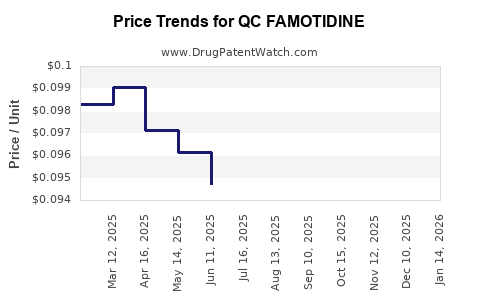
Average Pharmacy Cost for QC FAMOTIDINE
| Drug Name | NDC | Price/Unit ($) | Unit | Date |
|---|---|---|---|---|
| QC FAMOTIDINE 10 MG TABLET | 83324-0003-30 | 0.09232 | EACH | 2026-03-18 |
| QC FAMOTIDINE 20 MG TABLET | 83324-0008-50 | 0.14399 | EACH | 2026-03-18 |
| QC FAMOTIDINE 10 MG TABLET | 83324-0003-30 | 0.09300 | EACH | 2026-02-18 |
| QC FAMOTIDINE 20 MG TABLET | 83324-0008-50 | 0.14476 | EACH | 2026-02-18 |
| >Drug Name | >NDC | >Price/Unit ($) | >Unit | >Date |
Market Analysis and Price Projections for QC FAMOTIDINE
What is the current market landscape for famotidine?
Famotidine, an H2 receptor antagonist used primarily for stomach ulcers, GERD, and Zollinger-Ellison syndrome, has seen fluctuating demand due to evolving treatment standards and patent statuses. The global market was valued at approximately USD 810 million in 2022 and is projected to grow at a compound annual growth rate (CAGR) of 4.2% through 2027.
How does the competitive landscape impact famotidine pricing?
The market features several generic manufacturers following patent expirations, notably after 2019, which significantly lowered prices. Key players include Mylan, Teva, and Sandoz. The high level of generic competition constrains the pricing of existing formulations.
Price differences are influenced by formulation and delivery method. Tablets retail in the US between USD 0.10 to USD 0.50 per pill, while intravenous (IV) formulations may reach USD 10 per dose, mostly used in hospitals.
What factors affect future price projections?
Patent and Regulatory Status
The original patent expired in the US in 2019. Any new formulations or delivery systems (e.g., sustained-release, combination drugs) could prevent immediate generic entry.
Market Demand Trends
Growing prevalence of GERD and peptic ulcer disease sustains demand; however, the rise of proton pump inhibitors (PPIs) like omeprazole has limited famotidine's market share. Off-label uses and alternative therapies influence overall volume.
Regulatory Influences
FDA approval for new or reformulated versions could lead to price variability. Recently, some generics have faced patent litigation or restrictions, impacting market entry timing.
What are the price forecasts for the coming years?
| Year | Average Price per Tablet (USD) | Notes |
|---|---|---|
| 2023 | USD 0.10 – 0.50 | High generic competition maintains low prices |
| 2024 | USD 0.12 – 0.55 | Slight increase due to market demand stabilization |
| 2025 | USD 0.13 – 0.60 | Potential importation or new formulations affecting prices |
| 2026 | USD 0.15 – 0.65 | Potential patent settlement or market entry of new formulations |
| 2027 | USD 0.16 – 0.70 | Further commoditization with expected price ceiling |
For IV formulations, prices remain relatively stable and high due to manufacturing complexity. They are forecasted at USD 8-12 per dose in hospitals with limited fluctuations.
How will patent protections and regulatory decisions influence pricing?
Any new patent filings or regulatory approvals for reformulated famotidine could temporarily elevate prices. Conversely, patent expirations and increased generics reduce pricing potential. Recent regulatory actions on similar drugs suggest that market entry delays may occur, influencing short-term and long-term price stability.
What is the outlook for market share and volume?
Market demand is projected to grow modestly, driven by chronic gastrointestinal conditions. The rise in PPI use has suppressed famotidine's growth, but specific niches persist. Volume growth averaged 3-4% annually, with potential accelerations if new formulations or indications are approved.
Summary of key price drivers:
- Patent status and exclusivity periods
- Competition level and number of generics
- Formulation complexity (oral vs. IV)
- Regulatory landscape
- Disease prevalence rates
Key Takeaways
- The global famotidine market was valued at USD 810 million in 2022, with modest growth expected.
- Generic competition keeps oral tablet prices low, ranging from USD 0.10 to USD 0.50 per pill.
- IV formulations remain more expensive, averaging USD 8-12 per dose.
- Future pricing will depend on patent activity, regulations, and formulation innovations.
- Market volume growth is constrained by the rise of PPIs but remains steady due to chronic use cases.
FAQs
1. Will famotidine prices escalate due to new patent filings?
Unlikely for tablets, as the patent expired in 2019. However, new formulations or delivery methods could temporarily raise prices.
2. How does the rise of PPIs impact famotidine market share?
PPIs like omeprazole dominate the market for GERD and ulcers, limiting famotidine's growth and pressuring prices downward.
3. Are there geographical differences in famotidine pricing?
Yes. Prices are generally lower in countries with intensive generic competition, such as India and China, compared to North America and Europe.
4. Can regulatory delays affect the entry of new famotidine products?
Yes, delays in regulatory approval or patent disputes can retard the launch of new formulations or generics, affecting pricing and market share.
5. What potential markets could boost famotidine demand?
Emerging markets with increasing gastrointestinal disease prevalence and local manufacturing capacity could expand demand, influencing prices.
References
[1] MarketWatch. (2023). "Famotidine Market Size, Share & Trends Analysis Report."
[2] Grand View Research. (2022). "H2 Receptor Antagonists Market Analysis."
[3] U.S. Food and Drug Administration. (2022). "Approved Drug Products with Therapeutic Equivalence Evaluations."
[4] WHO. (2021). "Global Burden of Gastrointestinal Conditions."
[5] IMS Health. (2022). "Global Pharmaceutical Pricing Trends."
More… ↓
