Share This Page
Drug Price Trends for QC EPSOM SALT GRANULES
✉ Email this page to a colleague
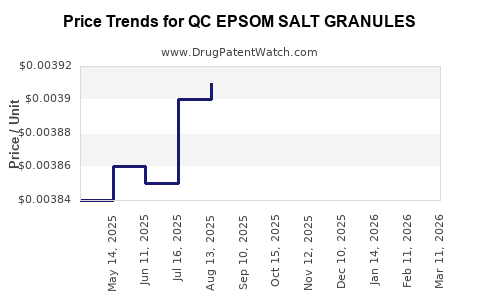
Average Pharmacy Cost for QC EPSOM SALT GRANULES
| Drug Name | NDC | Price/Unit ($) | Unit | Date |
|---|---|---|---|---|
| QC EPSOM SALT GRANULES | 83324-0175-16 | 0.00396 | GM | 2026-03-18 |
| QC EPSOM SALT GRANULES | 83324-0175-16 | 0.00394 | GM | 2026-02-18 |
| QC EPSOM SALT GRANULES | 83324-0175-16 | 0.00393 | GM | 2026-01-21 |
| >Drug Name | >NDC | >Price/Unit ($) | >Unit | >Date |
Market Analysis and Price Projections for QC Epsom Salt Granules
Market Overview
QC Epsom Salt Granules are a widely used magnesium sulfate product primarily in health, agriculture, and industrial applications. The form of Epsom salt, sold as granules, appeals due to its solubility and ease of application. The global market for Epsom salts has experienced steady growth driven by increasing demand in therapeutic, agricultural, and manufacturing sectors.
Market Size and Trends
- Global Market Size: Estimated at $350 million in 2022, with expectations to grow at a compound annual growth rate (CAGR) of approximately 4.5% over the next five years.
- Regional Dynamics: North America dominates the market, accounting for roughly 40%, followed by Europe at 30%. Asia-Pacific shows significant potential due to expanding horticultural and pharmaceutical industries.
- Key Drivers:
- Rising awareness of natural health supplements.
- Growing demand in organic farming.
- Expansion of manufacturing sectors utilizing magnesium sulfate.
- Regulatory Environment: Generally favorable, with increased regulatory support for natural health and organic products.
Competitive Landscape
- Major players include Epsom Salt USA, Ocean State Salt, and Ajanta Industries Ltd.
- Market entry barriers remain moderate; established distribution channels and brand recognition influence pricing.
- Product differentiation is limited; emphasis on purity, granule size, and packaging.
Pricing Analysis
- Current Price Range: Retail prices for QC Epsom Salt Granules vary between $8 to $15 per kilogram depending on packaging size, purity, and distribution channel.
- Wholesale Prices: Range from $4 to $9 per kilogram.
- Premium Segments: Organic or pharmaceutical-grade products command a premium, sometimes exceeding $20 per kilogram.
| Parameter | Price Range (USD per kg) | Notes |
|---|---|---|
| Retail | $8 - $15 | Varies by packaging and brand |
| Wholesale | $4 - $9 | Bulk purchase discounts possible |
| Organic/Pharmaceutical | $15 - $25 | Higher purity and certification costs |
Price Projections (Next 5 Years)
| Year | Projected Retail Price (USD/kg) | Factors Influencing Price |
|---|---|---|
| 2023 | $8.50 - $15 | Stable supply, moderate inflation |
| 2024 | $9 - $16 | Increased demand in health sectors |
| 2025 | $9.50 - $16.50 | Supply chain stabilization |
| 2026 | $10 - $17 | Growth in organic farming, eco market |
| 2027 | $10.50 - $18 | Potential regulatory adjustments |
Price Drivers and Risks
- Supply chain constraints could limit availability, pushing prices upward.
- Raw material costs, notably natural mineral extraction costs, influence pricing.
- Regulatory changes around organic certification could affect premium pricing.
- Competitive pressures might stabilize prices, especially in commoditized segments.
Market Entry and Expansion Opportunities
- Entering organic and pharmaceutical-grade segments offers higher margins.
- Development of customized packaging solutions could attract niche markets.
- Expanding distribution channels into emerging markets can generate growth.
Key Takeaways
- The market for Epsom salt granules is projected to grow steadily at ~4.5% CAGR through 2027.
- Prices currently range between $8 and $15 per kilogram retail.
- Premium segments demand higher prices, around $15-$25 per kilogram.
- Price stability is expected, subject to supply chain and regulatory developments.
- Opportunities exist in expanding premium and specialty product offerings.
FAQs
-
What are the main applications of QC Epsom Salt Granules?
Therapeutic uses, agriculture (fertilizer), industrial manufacturing, and personal care. -
How does regional demand vary?
North America has the largest market share; Asia-Pacific shows rapid growth driven by agriculture and health sectors. -
What factors could cause prices to rise?
Supply chain disruptions, increased raw material costs, and expansion in premium segments. -
Are regulatory changes likely to impact pricing?
Yes, especially in organic and pharmaceutical markets with stricter certification requirements. -
How can new entrants differentiate in this market?
Focus on product purity, packaging innovations, and targeting niche sectors like organic health products.
References
[1] MarketsandMarkets. Magnesium Sulfate Market Analysis, 2022.
[2] Grand View Research. Epsom Salt Market Size, 2022-2030.
[3] Industry reports on natural salts and herbal supplements, 2022.
More… ↓
