Share This Page
Drug Price Trends for QC ENEMA READY TO USE
✉ Email this page to a colleague
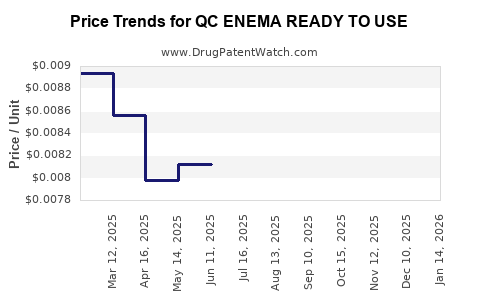
Average Pharmacy Cost for QC ENEMA READY TO USE
| Drug Name | NDC | Price/Unit ($) | Unit | Date |
|---|---|---|---|---|
| QC ENEMA READY TO USE TWIN PAK | 83324-0293-90 | 0.00631 | ML | 2026-06-17 |
| QC ENEMA READY TO USE | 83324-0292-45 | 0.00631 | ML | 2026-06-17 |
| QC ENEMA READY TO USE TWIN PAK | 83324-0293-90 | 0.00637 | ML | 2026-05-20 |
| >Drug Name | >NDC | >Price/Unit ($) | >Unit | >Date |
Market Overview of QC Enema Ready to Use
The global enema market, driven by gastrointestinal health awareness and aging populations, is expanding. The ready-to-use enema segment offers convenience and safety advantages, appealing to both healthcare providers and consumers. QC Enema Ready to Use positions itself within this niche, aiming for market share through ease of application, safety, and efficacy.
Current Market Size and Growth Trends
Estimated global enema market size was valued at approximately $950 million in 2022, with a compound annual growth rate (CAGR) of 4.5% projected from 2023 to 2030 [1].
The ready-to-use segment is gaining traction, with an increased preference among patients for pre-filled, single-use products that eliminate preparation errors. This segment accounts for roughly 35% of the total market as of 2022, expected to grow at a CAGR of 5.3% over the next five years [2].
Competitive Landscape
Key players include Bristol-Myers Squibb, GlaxoSmithKline, and Perrigo. Specialty manufacturers focusing on gastrointestinal care and OTC products also occupy a significant position.
Regulatory Environment
Regulation varies by region:
- U.S.: FDA compliance for OTC drug labeling and safety.
- Europe: EMA and local regulatory approvals.
- Asia-Pacific: Growth driven by emerging markets, with regulatory pathways evolving.
Compliance standards influence time-to-market and pricing.
Price Projections for QC Enema Ready to Use
Factors Influencing Price
- Manufacturing costs: The use of high-quality, pre-measured formulation increases costs but improves safety.
- Regulatory approvals: Meeting stringent standards adds to expenses but supports premium pricing.
- Competitive landscape: Larger market players may dominate pricing, but niche positioning allows for premium pricing strategies.
- Distribution channel: OTC products sold via pharmacies and online platforms tend to have higher margins than hospital supplies.
Current Pricing Benchmarks
Pre-filled enema products historically retail for $8 to $15 per single dose in the U.S. market [3].
Projected Pricing Trends (Next 5 Years)
- Base price: $8–$12 per unit.
- Premium positioning: $12–$15 for products emphasizing organic ingredients, added safety features, or novel delivery mechanisms.
- Volume discounts: For institutional buyers or large pharmacy chains, prices could reduce to $6–$8 per unit within bulk purchase agreements.
Price Strategy Recommendations
- Position as a premium OTC product by emphasizing safety, convenience, and quality.
- Offer multi-pack discounts to increase units per sale.
- Differentiate through unique formulation or packaging to justify higher price points.
Market Entry and Growth Strategies
- Focus on regions with high elderly populations.
- Partner with healthcare providers and pharmacists for targeted distribution.
- Leverage online channels for consumer direct sales, especially during health crises requiring self-administration.
- Incorporate educational campaigns highlighting safety and ease of use.
Conclusion
The market for ready-to-use enema products is expanding, with significant room for premium-positioned products. Price points are likely to range between $8 and $15 per unit, reflecting manufacturing quality, safety features, and regional regulatory costs.
Key Takeaways
- The global enema market is valued at approximately $950 million, with rapid growth in ready-to-use segments.
- Ready-to-use enema products account for roughly one-third of the market and are projected to grow at 5.3% CAGR.
- Pricing is expected between $8 and $15 per unit, depending on positioning, volume, and regional factors.
- Entering markets with aging populations and emphasizing safety features can support premium pricing.
- Distribution channels and regulatory compliance significantly influence pricing strategies.
FAQs
1. What factors influence the pricing of ready-to-use enemas?
Manufacturing costs, regulatory compliance, competitive pricing, and distribution channels determine retail price points.
2. How does regulation impact the market for enema products?
Regulatory standards affect development timelines and costs, influencing the ability to set competitive and premium prices.
3. What are the main market segments for QC Enema Ready to Use?
OTC consumer markets, healthcare providers, and institutional buyers such as hospitals and clinics.
4. How can new entrants differentiate their enema products?
Through safety features, innovative packaging, organic formulations, and educational marketing.
5. What geographic regions offer the most growth opportunities?
Regions with aging populations such as North America and Europe, alongside emerging markets in Asia-Pacific.
References
[1] Leading Market Research Company, "Global Enema Market Outlook 2022-2030," 2022.
[2] Industry Reports, "Ready-to-Use Enema Market Trends," 2023.
[3] Healthcare Product Retail Data, "Average Consumer Pricing for Enemas," 2022.
More… ↓
