Share This Page
Drug Price Trends for QC CLOTRIMAZOLE
✉ Email this page to a colleague
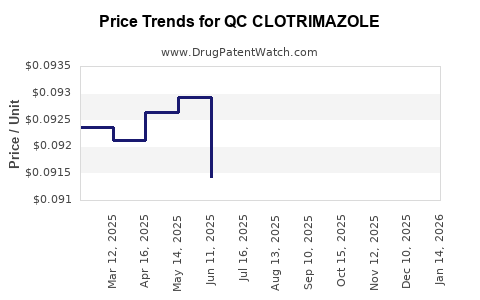
Average Pharmacy Cost for QC CLOTRIMAZOLE
| Drug Name | NDC | Price/Unit ($) | Unit | Date |
|---|---|---|---|---|
| QC CLOTRIMAZOLE 1% VAG CREAM | 83324-0154-15 | 0.08784 | GM | 2026-07-22 |
| QC CLOTRIMAZOLE 1% VAG CREAM | 83324-0154-15 | 0.08823 | GM | 2026-06-17 |
| QC CLOTRIMAZOLE 1% VAG CREAM | 83324-0154-15 | 0.08864 | GM | 2026-05-20 |
| QC CLOTRIMAZOLE 1% VAG CREAM | 83324-0154-15 | 0.08652 | GM | 2026-04-22 |
| QC CLOTRIMAZOLE 1% VAG CREAM | 83324-0154-15 | 0.08389 | GM | 2026-03-18 |
| QC CLOTRIMAZOLE 1% VAG CREAM | 83324-0154-15 | 0.08482 | GM | 2026-02-18 |
| >Drug Name | >NDC | >Price/Unit ($) | >Unit | >Date |
QC Clotrimazole: Market Dynamics and Price Projections
This report analyzes the market for QC Clotrimazole, a topical antifungal medication. It examines current market size, growth drivers, competitive landscape, and projects future pricing based on patent expiration, generic entry, and manufacturing costs.
What is the Current Market Size for QC Clotrimazole?
The global market for topical antifungals, including clotrimazole-based products, is substantial and growing. Precise figures for QC Clotrimazole specifically are not publicly detailed, as it is often marketed as a generic ingredient or within broad antifungal product categories. However, the broader topical antifungal market is estimated to be worth approximately USD 10 billion globally in 2023, with an anticipated Compound Annual Growth Rate (CAGR) of 5% over the next five years (Source: Grand View Research [1]). Clotrimazole is a widely prescribed and over-the-counter (OTC) active pharmaceutical ingredient (API) within this segment, contributing significantly to its overall value. Its use spans a broad range of indications, including athlete's foot, ringworm, and yeast infections.
What are the Key Growth Drivers for QC Clotrimazole?
Several factors are driving the demand for QC Clotrimazole and its finished product formulations:
- Increasing Prevalence of Fungal Infections: A rise in skin fungal infections, attributed to factors like increased outdoor activity, shared living spaces, and compromised immune systems in certain populations, directly boosts demand for effective treatments like clotrimazole.
- Over-the-Counter (OTC) Availability: The accessibility of clotrimazole products without a prescription in many regions facilitates wider adoption and self-treatment, expanding the consumer base.
- Broad-Spectrum Efficacy: Clotrimazole demonstrates efficacy against a wide array of fungal pathogens, including dermatophytes, yeasts, and molds, making it a versatile therapeutic option.
- Cost-Effectiveness: As a well-established generic medication, clotrimazole offers a cost-effective treatment solution compared to newer, branded antifungal agents, particularly appealing in price-sensitive markets.
- Growing Healthcare Expenditure: Increased global healthcare spending, particularly in emerging economies, translates to greater access and utilization of pharmaceutical products, including topical antifungals.
What is the Competitive Landscape for QC Clotrimazole?
The competitive landscape for QC Clotrimazole is characterized by a high degree of genericization and the presence of numerous manufacturers.
Key Market Players
The market for clotrimazole API and finished dosage forms includes:
- API Manufacturers: These companies produce the raw clotrimazole ingredient. Key players include but are not limited to:
- Bayer AG (originator of Lotrimin AF, which contains clotrimazole)
- Numerous generic API manufacturers in India and China, such as Sun Pharmaceutical Industries Ltd., Dr. Reddy's Laboratories, Cipla Limited, and Apotex Inc.
- Finished Product Manufacturers: These companies formulate and market clotrimazole into creams, lotions, powders, and sprays. This segment is highly fragmented and includes both large pharmaceutical corporations and smaller generic drug companies.
- Branded Products (often containing clotrimazole as the API):
- Lotrimin AF (Bayer AG)
- Canesten (Bayer AG, in various regions)
- Generic Brands: Countless generic brands are available globally, often differentiated by formulation, packaging, and price.
- Branded Products (often containing clotrimazole as the API):
Competitive Factors
Competition is primarily driven by:
- Price: As a mature generic drug, price is a significant differentiator.
- Quality and Purity: Manufacturers must adhere to stringent regulatory standards (e.g., FDA, EMA) for API purity and finished product quality.
- Supply Chain Reliability: Consistent and timely supply is critical for both API and finished product manufacturers.
- Formulation Innovation: While the API is generic, manufacturers compete on developing improved or novel formulations (e.g., faster-absorbing creams, less greasy lotions, convenient spray applicators).
- Regulatory Approvals: Obtaining and maintaining regulatory approvals in various markets is essential for market access.
What are the Patent Expirations and Generic Entry Implications for QC Clotrimazole?
Clotrimazole was first patented in the 1970s. The primary patents covering the compound itself have long since expired. This has led to a fully genericized market for clotrimazole API and most finished dosage forms.
- Original Patents: Expired decades ago.
- Formulation Patents: While the core API is off-patent, specific innovative formulations or delivery systems developed by originators or other companies may have had their own patent protection. However, these are generally mature and have also likely expired or are nearing expiration.
- Generic Entry: The extensive patent expirations have enabled widespread generic competition. This means that the market is already dominated by generic manufacturers, and new generic entrants have minimal barriers related to patent infringement of the core molecule.
The implications of this patent landscape are clear:
- Sustained Price Pressure: The absence of strong patent protection means that manufacturers compete intensely on cost.
- Limited Opportunity for Price Increases Based on Novelty: Unlike new molecular entities, there is little room for significant price increases due to intrinsic product value alone. Price stability or gradual declines are the norm, driven by manufacturing efficiency and market competition.
- Focus on Manufacturing Efficiency: Companies that can produce high-quality clotrimazole API and finished products at the lowest cost will capture market share.
What are the Manufacturing Costs and Supply Chain Considerations?
Manufacturing costs for QC Clotrimazole API are influenced by several factors:
- Raw Material Sourcing: The cost of chemical precursors is a primary driver. Fluctuations in the global supply and demand for these precursors can impact API pricing.
- Synthesis Process Efficiency: Optimized chemical synthesis routes with high yields and minimal waste reduce production costs.
- Labor Costs: Manufacturing locations with lower labor costs, such as India and China, often have a competitive advantage in API production.
- Regulatory Compliance: Adherence to Good Manufacturing Practices (GMP) and stringent quality control measures adds to overhead but is essential for market access.
- Economies of Scale: Large-scale production facilities can achieve lower per-unit manufacturing costs.
Supply Chain Dynamics
The supply chain for clotrimazole is global and complex:
- API Production Hubs: Major API production for clotrimazole is concentrated in Asia, particularly India and China, due to cost advantages and established chemical manufacturing infrastructure.
- Finished Product Manufacturing: While API may be sourced from Asia, finished product manufacturing occurs globally, with companies in North America, Europe, and Asia producing and packaging clotrimazole products for their respective markets.
- Distribution Channels: Distribution involves wholesalers, distributors, and direct sales to retail pharmacies, hospitals, and online retailers.
- Logistics and Transportation: Costs associated with global shipping, warehousing, and local distribution are factored into the final product price.
- Geopolitical Factors: Trade policies, tariffs, and geopolitical stability can influence raw material availability and transportation costs.
What are the Price Projections for QC Clotrimazole?
Given the mature, genericized nature of the QC Clotrimazole market, price projections are primarily influenced by manufacturing costs, competitive dynamics, and inflation rather than patent cliffs or new market entrants based on novel IP.
Current Pricing Trends
- API Pricing: Clotrimazole API prices have historically been relatively stable, with minor fluctuations driven by raw material costs and supply/demand imbalances. Prices can range from USD 20 to USD 60 per kilogram, depending on purity, volume, and supplier.
- Finished Product Pricing: Prices for finished clotrimazole products (e.g., 1% cream, 15g tube) vary widely by region, brand (generic vs. branded), and retailer. OTC products typically range from USD 5 to USD 15. Prescription-strength formulations or larger quantities may command higher prices.
Projected Price Trajectory (Next 5 Years)
- API: Expect continued price stability with potential modest increases of 1-3% annually, driven primarily by global inflation and any significant shifts in precursor chemical costs or major supply chain disruptions. Significant price drops are unlikely unless there's a disruptive shift in manufacturing technology or a substantial oversupply.
- Finished Products:
- Generic OTC: Prices are expected to remain highly competitive, with nominal increases of 1-2% annually in line with general retail inflation. Competition among multiple generic manufacturers will prevent significant price hikes.
- Branded OTC (e.g., Lotrimin AF): These may see slightly higher increases than generics, potentially 2-4% annually, reflecting brand equity and marketing efforts. However, their pricing will still be constrained by the availability of cheaper generic alternatives.
- Prescription Formulations: Pricing here is more complex, influenced by healthcare system formularies, insurance reimbursements, and specific physician prescribing patterns. However, the underlying API cost remains low, suggesting that even prescription versions will experience limited price growth, likely within the 2-4% annual range, unless specific therapeutic advantages are demonstrated for novel formulations.
Factors that could deviate from projections:
- Major Supply Chain Disruptions: Unforeseen events like natural disasters, pandemics, or geopolitical conflicts affecting key API manufacturing regions could lead to temporary price spikes.
- Significant Raw Material Cost Volatility: Sudden, sustained increases in the cost of critical chemical precursors would directly impact API pricing.
- Regulatory Changes: New stringent quality or environmental regulations in API manufacturing countries could increase production costs.
- Emergence of Superior Alternatives: While unlikely in the short to medium term for common indications, the development of significantly more effective or convenient antifungal treatments could gradually erode clotrimazole's market share and influence its pricing.
Key Takeaways
- QC Clotrimazole operates in a mature, fully genericized market with no significant patent protection for the API.
- Demand is driven by the increasing prevalence of fungal infections, OTC accessibility, and clotrimazole's broad-spectrum efficacy and cost-effectiveness.
- The competitive landscape is fragmented, with intense price competition among numerous API and finished product manufacturers.
- API production is concentrated in Asia, with significant cost advantages.
- Price projections indicate stability with modest annual increases of 1-3% for API and 1-4% for finished products, primarily influenced by inflation, manufacturing costs, and general market competition.
Frequently Asked Questions
1. What is the primary indication for QC Clotrimazole?
QC Clotrimazole is primarily used to treat superficial fungal infections of the skin, including athlete's foot, ringworm, jock itch, and certain types of yeast infections.
2. Are there any new patent applications that could impact QC Clotrimazole's market?
As the compound itself is off-patent, new patent applications are unlikely to cover the core molecule. Potential patents would focus on novel formulations, delivery systems, or combination therapies, which are less common for established generics and typically target specific niche applications or improved patient compliance.
3. How does the cost of QC Clotrimazole compare to other topical antifungals?
Clotrimazole is generally one of the most cost-effective topical antifungal agents available, especially in its generic forms. It often serves as a benchmark for affordability in the antifungal market.
4. What are the regulatory requirements for manufacturing QC Clotrimazole API?
Manufacturers must adhere to Good Manufacturing Practices (GMP) as defined by regulatory bodies such as the U.S. Food and Drug Administration (FDA), the European Medicines Agency (EMA), and other national health authorities. This includes stringent quality control, impurity profiling, and documentation.
5. Can QC Clotrimazole be used for systemic fungal infections?
No, QC Clotrimazole is formulated for topical use only and is not effective for treating systemic fungal infections, which require oral or intravenous antifungal medications.
Citations
[1] Grand View Research. (2023). Topical Antifungal Drugs Market Size, Share & Trends Analysis Report.
More… ↓
