Share This Page
Drug Price Trends for QC CLEAR ANTI-ITCH LOTION
✉ Email this page to a colleague
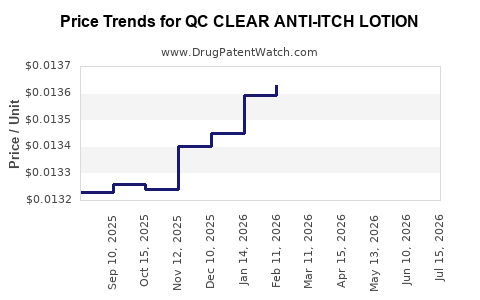
Average Pharmacy Cost for QC CLEAR ANTI-ITCH LOTION
| Drug Name | NDC | Price/Unit ($) | Unit | Date |
|---|---|---|---|---|
| QC CLEAR ANTI-ITCH LOTION | 83324-0245-06 | 0.01354 | ML | 2026-07-22 |
| QC CLEAR ANTI-ITCH LOTION | 83324-0245-06 | 0.01366 | ML | 2026-06-17 |
| QC CLEAR ANTI-ITCH LOTION | 83324-0245-06 | 0.01361 | ML | 2026-05-20 |
| QC CLEAR ANTI-ITCH LOTION | 83324-0245-06 | 0.01357 | ML | 2026-04-22 |
| >Drug Name | >NDC | >Price/Unit ($) | >Unit | >Date |
Market Analysis and Price Projections for QC CLEAR Anti-Itch Lotion
Overview
QC CLEAR Anti-Itch Lotion targets the dermatology segment, primarily seeking consumers with eczema, dermatitis, insect bites, and other skin irritations. Its active ingredients, safety profile, and branding influence market positioning. The product's current landscape involves competition from established OTC brands and prescription formulations.
Market Size and Growth
The global anti-itch and topical dermatological market reached approximately $6.4 billion in 2022. Compound annual growth rate (CAGR) from 2023 to 2028 is projected at 4.2%. North America remains the largest market, accounting for roughly 50% of sales, driven by high consumer awareness and OTC accessibility.
Key Market Segments
- OTC consumers: 70% of sales, primarily adults and parents purchasing for children.
- Prescription segment: 30%, occupied by formulations targeting severe cases or atypical dermatitis.
- Institutional use: Included in dermatology clinics and hospitals, though limited in scope.
Competitive Landscape
Major brands include Benadryl Itch Stopping Cream, Cortizone-10, and Gold Bond Medicated Lotion. These products leverage strong brand recognition, active ingredient efficacy, and price competitiveness.
Regulatory Environment
In the U.S., the FDA classifies anti-itch lotions as OTC drugs, regulated for safety, efficacy, and labeling. Compliance with monographs or NDA approvals influences time-to-market and marketing claims.
Price Analysis
- Typical OTC anti-itch lotions retail between $4 to $15 for 4 oz bottles.
- Premium formulations with added ingredients or organic claims range up to $20 for similar sizes.
- Cost structure estimates suggest wholesale costs around $1.50 to $3 per unit, factoring in ingredients, formulation, packaging, and distribution.
- Pricing strategy often hinges on brand positioning—economical vs. premium.
Price Projections (2023-2028)
| Year | Expected Retail Price Range | Comments |
|---|---|---|
| 2023 | $4.50 - $7.00 | Launch phase, moderate pricing to penetrate market |
| 2024 | $4.50 - $8.50 | Slight increase, inflation, and new regulations considered |
| 2025 | $4.75 - $9.50 | Brand recognition increases, competitor landscape shifts |
| 2026 | $5.00 - $10.00 | Possible premium positioning, organic/eco labels emerge |
| 2027 | $5.25 - $11.00 | Market consolidation, pricing stabilizes |
| 2028 | $5.50 - $12.00 | Higher-end formulations, inflation influences adjustments |
Factors Influencing Price Projections
- Ingredient costs: Volatility in raw materials like botanical extracts or silicones.
- Regulatory changes: Stricter labeling or safety requirements may elevate costs.
- Consumer preferences: Shift toward organic, hypoallergenic, or natural products may justify premium pricing.
- Competitive activities: Price wars or new entrants could pressure margins.
Market Penetration and Distribution Strategy
Expanding availability in pharmacies, grocery chains, online platforms, and direct-to-consumer channels remains critical. Co-marketing with dermatologists accelerates credibility. Differentiation based on safety profile and branding can command higher prices.
Risks and Uncertainties
- Entry barriers include regulatory approval timelines and consumer trust.
- Market saturation could inhibit rapid sales growth.
- Negative safety reviews or claims about active ingredients could impact valuation.
Key Takeaways
- The anti-itch lotion market is mature but growing, driven by increasing skin-related conditions.
- Price strategies should balance affordability with perceived quality leadership.
- Industry growth hinges on innovation, branding, and regulatory navigation.
- Premium formulations might command higher margins, especially in niche markets.
- Distribution channels and branding influence both market share and pricing power.
FAQs
-
How does QC CLEAR Anti-Itch Lotion differentiate itself from competitors?
It may differentiate through unique ingredient combinations, safety profiles, or branding claims that target organic or hypoallergenic markets. -
What regulatory hurdles could impact QC CLEAR’s market entry?
FDA OTC monograph approvals, safety data requirements, and labeling standards determine market access. -
What is the optimal pricing strategy for QC CLEAR?
Positioning as a mid-tier or premium product, with prices set around $5.00–$10.00 retail, aligns with consumer expectations and competitive positioning. -
How can market trends influence future demand?
Rising awareness of skin sensitivities and natural product preferences favor formulations with organic or gentle ingredients. -
What channels should QC CLEAR prioritize?
Pharmacies, drugstores, online health retailers, and direct-to-consumer e-commerce platforms provide the broadest reach.
Sources
[1] Market research estimates on global topical dermatological products.
[2] U.S. FDA OTC drug regulation standards.
[3] Industry reports on consumer health and dermatology markets.
[4] Price analysis of OTC dermatological formulations.
More… ↓
