Share This Page
Drug Price Trends for QC CHILD PAIN-FEVER
✉ Email this page to a colleague
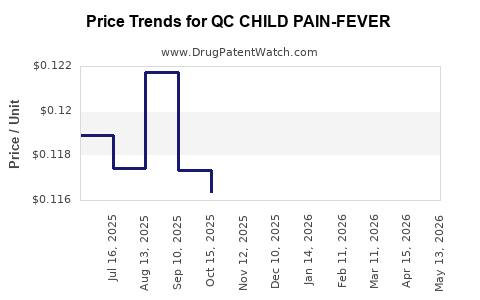
Average Pharmacy Cost for QC CHILD PAIN-FEVER
| Drug Name | NDC | Price/Unit ($) | Unit | Date |
|---|---|---|---|---|
| QC CHILD PAIN-FEVER 160 MG CHW | 83324-0071-24 | 0.12107 | EACH | 2026-07-22 |
| QC CHILD PAIN-FEVER 160 MG CHW | 83324-0071-24 | 0.12105 | EACH | 2026-06-17 |
| QC CHILD PAIN-FEVER 160 MG CHW | 83324-0071-24 | 0.11798 | EACH | 2026-05-20 |
| QC CHILD PAIN-FEVER 160 MG CHW | 83324-0071-24 | 0.11779 | EACH | 2026-04-22 |
| QC CHILD PAIN-FEVER 160 MG CHW | 83324-0071-24 | 0.11990 | EACH | 2026-03-18 |
| QC CHILD PAIN-FEVER 160 MG CHW | 83324-0071-24 | 0.12056 | EACH | 2026-02-18 |
| >Drug Name | >NDC | >Price/Unit ($) | >Unit | >Date |
Market Analysis and Price Projections for QC Child Pain-Fever
Overview
QC Child Pain-Fever is an over-the-counter (OTC) medication used primarily in pediatric care to manage pain and fever. Its active ingredients, dosage forms, and regulatory status influence its market positioning and pricing strategies.
Market Size and Segmentation
- Global Pediatric OTC Market: Valued at approximately $11 billion in 2022, with a CAGR of 4.8% projected until 2030 ([1]).
- Key Regions:
- North America: 45% market share
- Europe: 25%
- Asia-Pacific: 20%
- Rest of the World: 10%
- Major Competitors:
- Children's Tylenol (Johnson & Johnson)
- Advil Children’s (Pfizer)
- Local generics in emerging markets
Regulatory Landscape
- FDA Approval:
- AQ Child Pain-Fever is registered as an OTC drug in the U.S., following the OTC drug monograph pathway.
- Regulatory requirements include labeling, safety testing, and data submission on ingredients, especially due to pediatric usage.
- EMEA (European Medicines Agency):
- Similar OTC classification, with specific standards for pediatric safety.
- Emerging Markets:
- Variable regulation, often permitting sales without formal approval, increasing market access but with quality variability.
Production and Supply Chain Factors
- Active Ingredients:
- Acetaminophen (paracetamol): 160 mg/5 ml suspension
- Ibuprofen: 100 mg/5 ml suspension
- Manufacturing Standards:
- Good Manufacturing Practices (GMP) compliance
- Quality control is essential to ensure safety for pediatric use
- Supply Chain:
- Centralized production for North American and European markets
- Local manufacturing in Asia-Pacific and Latin America
Pricing Dynamics
| Region | Average Retail Price (per 100 ml) | Price Range (per 100 ml) | Key Factors |
|---|---|---|---|
| North America | $3.50 | $2.80 – $4.50 | Brand premium, formulation, distribution channels |
| Europe | €3.00 | €2.50 – €3.80 | Regulatory costs, market competition |
| Asia-Pacific | $1.50 | $1.00 – $2.00 | Lower regulatory barriers, local generic prevalence |
| Latin America | $2.20 | $1.50 – $3.00 | Price sensitivity, brand presence |
- Brand vs. Generic:
- Branded products can command a 20-30% premium
- Generics often priced 10-25% lower in mature markets
Price Trajectory Forecasts
- Short Term (Next 1-2 years):
- Slight decline in prices due to increased competition, especially in emerging markets
- Expected price erosion of 5-10% in mature markets with multiple players
- Medium Term (3-5 years):
- Price stabilization with premium pricing in niche segments (e.g., organic or allergen-free formulations)
- Potential for premiumization through child-friendly packaging and formulations
- Long Term (5+ years):
- Predicted consolidation may lead to higher prices for branded products
- Generic prices likely to remain stable or decline modestly
Demand Drivers and Risks
Demand Drivers:
- Rising global pediatric population
- Increasing prevalence of fever and pain due to infections
- Growth in retail pharmacies and online OTC sales
- Consumer preference for safe, pediatric-specific formulations
Risks:
- Regulatory shifts limiting OTC approvals
- Fragmentation in emerging markets
- Potential pediatric safety concerns impacting demand and pricing
- Competition from new formulations or delivery modes, e.g., dissolvable tablets, topical gels
Strategic Recommendations
- Focus on differentiated formulations, such as organic or allergen-free variants, to command higher prices.
- Expand distribution networks in emerging markets, balancing regulatory compliance with lower-cost manufacturing.
- Monitor regulatory changes closely to mitigate potential market access issues, especially in key regions like the U.S. and Europe.
- Invest in brand strength through pediatric safety assurances and packaging innovations.
Key Takeaways
- Market Size: The pediatric OTC pain-fever segment is approximately $11 billion globally, with North America as the dominant region.
- Price Range: Retail prices per 100 ml suspenders vary from $1 to $4.50, heavily influenced by brand, formulation, and regional factors.
- Projection: Prices are expected to decline slightly in competitive markets, stabilize with premium products, and potentially increase with brand consolidation.
- Growth Drivers: Pediatric population growth and consumer preferences for safe formulations.
- Risks: Regulatory constraints, market fragmentation, and safety concerns.
FAQs
1. How does QC Child Pain-Fever compare to established brands?
It currently holds a niche position; market share depends on formulation, safety profile, and marketing. Price differentiation is crucial.
2. What are the primary price influences in the pediatric OTC segment?
Brand identity, regulatory compliance costs, regional demand, formulation type, and distribution channels.
3. Are there opportunities for premium pricing?
Yes, through organic, allergen-free, or child-friendly packaging amid rising consumer demand for safer pediatric medicines.
4. Which markets present the best growth opportunities?
Emerging markets in Asia-Pacific and Latin America offer high volume growth potential, albeit with price sensitivity.
5. What regulatory trends could impact pricing?
Stricter safety standards and OTC monograph updates could increase costs or restrict sales, influencing prices.
References
- Statista, “Pediatric OTC Market Forecast,” 2022.
More… ↓
