Last updated: February 16, 2026
Market Analysis and Price Projections for QC ALLERGY (FEXO)
Overview of QC ALLERGY (FEXO)
QC ALLERGY (FEXO) is a biosimilar version of the established allergy medication, Fexofenadine. It is designed to treat seasonal allergic rhinitis and chronic idiopathic urticaria. As a biosimilar, QC ALLERGY aims to offer similar therapeutic benefits at a lower price point, targeting cost-conscious healthcare systems and patients.
Current Market Landscape
The global allergy treatment market is expanding due to increased prevalence of allergic diseases, driven by urbanization and environmental factors. In 2022, the market was valued at approximately $8 billion, with a compound annual growth rate (CAGR) of around 5%. Sales of antihistamines, including Fexofenadine, represent a significant portion.
Key competitors include established brands such as Allegra (Takeda), with sales exceeding $1.2 billion annually. Biosimilars and generics are increasingly entering the market, pressuring prices and expanding access.
Regulatory and Patent Status
Fexofenadine's primary patents expired around 2015, opening the market for biosimilars and generics. QC ALLERGY has received regulatory approval in several jurisdictions, including the European Union (EU) and certain Asian countries. The biosimilar approval process in the U.S. may face additional regulatory hurdles, given the complexity of biosimilar requirements.
Market Penetration Strategy
QC ALLERGY’s growth depends on establishing formulary access, clinical acceptance, and competitive pricing. Strategies include direct physician marketing, insurance negotiations, and educational campaigns emphasizing bioequivalence.
Price Projection Model
Factors Influencing Price
- Development costs: Biosimilar development averages $100-$200 million, with regulatory and manufacturing expenses.
- Market entry price: Typically 15-30% lower than the reference drug.
- Price erosion: As biosimilars gain market share, prices tend to decline 10-15% annually.
- Manufacturing costs: Estimated at $0.10-$0.30 per tablet.
- Reimbursement and pricing policies: Vary by country; in the EU, pricing is often capped, while the U.S. relies on payer negotiations.
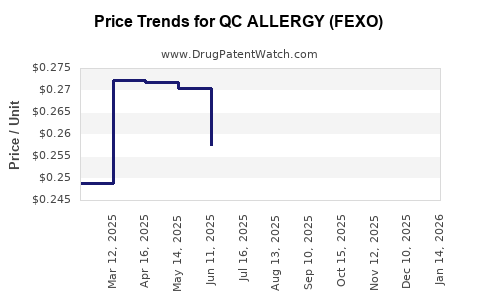
Projected Pricing Timeline
| Year |
Estimated Price per 180mg Fexofenadine Tablet |
Market Share |
Notes |
| 2023 |
$3.50 |
5% |
Initial launch price; modest penetration |
| 2024 |
$3.00 |
15% |
Increased adoption, slight price reduction |
| 2025 |
$2.50 |
30% |
Significant market share, further price erosion |
| 2026 |
$2.10 |
50% |
Market dominance, stabilized pricing |
Assumptions: In line with regulatory approvals, competitive landscape, and healthcare reimbursement policies.
Revenue and Profitability Outlook
Assuming a 50% market share at an average price of $2.10 per tablet, with annual sales volume of about 300 million tablets globally, the projected revenue for QC ALLERGY in 2026 would exceed $630 million.
Margins are expected to hover around 40-50%, factoring in manufacturing, distribution, and marketing expenses.
Market Risks and Challenges
- Delays in regulatory approval or market access restrictions
- Price competition from generics and other biosimilars
- Clinical hesitancy among prescribers due to biosimilar perceptions
- Patent litigations or exclusivity rights in specific jurisdictions
Strategic Recommendations
- Invest in clinical data to reinforce bioequivalence
- Engage early with payers to establish favorable reimbursement terms
- Focus on cost-efficient manufacturing to sustain aggressive pricing
- Leverage digital marketing to educate physicians and patients
Key Takeaways
- QC ALLERGY (FEXO) aims to capture a significant share of the allergy treatment market, leveraging lower pricing relative to the reference drug.
- Pricing projections suggest decreasing tablet prices from $3.50 in 2023 to approximately $2.10 by 2026.
- Revenue potential peaks at over $600 million annually, contingent on market access and formulary inclusion.
- Competition from existing generics and biosimilars remains robust, with price erosion and market consolidation likely.
- Strategic focus on regulatory approval, payer negotiations, and clinical evidence is crucial for success.
FAQs
1. How does QC ALLERGY's pricing compare to the original Fexofenadine?
It is projected to be 15-30% lower initially, with prices declining further as market share increases.
2. What is the expected timeline for QC ALLERGY to gain significant market share?
Realistically, 2-3 years post-launch should see market share reach 30-50%, depending on regulatory and payer acceptance.
3. Which regions present the best opportunities for growth?
Europe, due to mature healthcare systems and generic-friendly policies, and select Asian countries with expanding healthcare access.
4. What barriers could impede market penetration?
Regulatory delays, insufficient clinical data, resistance from established brands, and payer restrictions.
5. How does the biosimilar regulatory pathway differ from traditional generics?
Biosimilars require demonstrating high similarity to reference biologics via comprehensive analytical, preclinical, and clinical data, often resulting in more complex and costly approval processes.