Last updated: February 20, 2026
What is QC ALLERGY (CETRZN)?
CETRZN is the generic name for cetirizine, an antihistamine used primarily for allergy relief. It is available in various formulations (tablet, syrup, disintegrating tablet) and marketed under multiple brands globally. The drug is a leading treatment for allergic rhinitis and chronic idiopathic urticaria.
Current Market Landscape
Global Market Size
The global antihistamine market was valued at approximately USD 4.8 billion in 2022 and is projected to reach USD 6.3 billion by 2030, growing at a compound annual growth rate (CAGR) of 4.1% (Market Research Future, 2022). Cetirizine holds a significant share, expected to be roughly 35-40% within the antihistamine segment, given its widespread usage and generic availability.
Key Market Drivers
- Rising prevalence of allergic rhinitis, particularly in urban populations.
- Increasing awareness of allergic diseases and availability of OTC medications.
- Patent expiries encouraging generic competition.
- Expansion into emerging markets where healthcare infrastructure improves.
Major Competitors
- Zyrtec (U.S. Johnson & Johnson/Alphapharm)
- Reactine (Canada, Johnson & Johnson)
- Aller-Tec (India)
- Multiple regional generics
Regulatory Status
- Approved in over 100 countries.
- Generally available OTC in developed markets.
- Subject to patent expiration in key markets, allowing generics to enter.
Price Trends
Historical Pricing Data
| Region |
Brand |
Formulation |
2018 Avg Price (USD) per unit |
2022 Avg Price (USD) per unit |
Price Change (USD) |
Notes |
| U.S. |
Zyrtec |
Tablets 10 mg |
0.50 |
0.52 |
+0.02 |
Slight inflation, OTC |
| Canada |
Reactine |
Tablets 10 mg |
0.45 |
0.48 |
+0.03 |
Stable market |
| India |
Aller-Tec |
Tablets 10 mg |
0.10 |
0.12 |
+0.02 |
Price remains low, high volume |
Price Dynamics
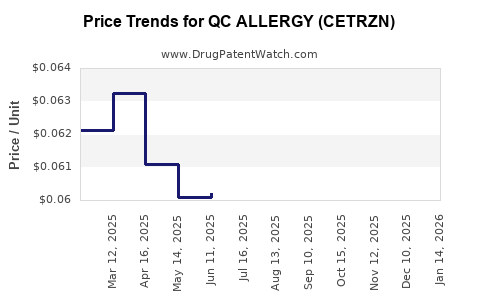
Generic cetirizine prices tend to decrease after patent expiration but stabilize or slightly increase due to manufacturing costs, supply chain factors, and regional regulations. Market entry of generics has historically led to price reductions of 20-40% within two years (IMS Health, 2020).
Market Forecast: 2023-2030
Assumptions
- Continued growth driven by allergic disease prevalence.
- Patent expiry of branded products in major markets around 2025.
- Entry of low-cost generics in emerging markets.
- Incremental price reductions in mature markets due to increased competition.
Price Projection
| Region |
2023 Avg Price (USD/unit) |
2025 Avg Price (USD/unit) |
2030 Avg Price (USD/unit) |
Notes |
| U.S./Europe |
0.52 |
0.45 |
0.40 |
Prices stabilize post-patent expiration |
| Emerging Markets |
0.12 |
0.11 |
0.09 |
Slight decline expected with market expansion |
Volume Growth Estimate
The global volume sales of cetirizine tablets are estimated to grow at 3-5% CAGR to 2030, driven by increased allergy prevalence and over-the-counter availability. Market penetration in Asia-Pacific is forecasted to expand faster, at 6-8% CAGR, due to rising urbanization and healthcare infrastructure.
Key Market Opportunities and Risks
Opportunities
- Expansion into new regions, particularly Southeast Asia, Latin America.
- Development of combination therapies for allergic conditions.
- Entry into formulations with improved bioavailability or extended-release profiles.
Risks
- Regulatory challenges in certain markets.
- Price sensitivity in emerging economies limiting margins.
- Competitive pressure from new antihistamines with improved efficacy or fewer side effects.
Regulatory and Patent Trends Impacting Pricing
Future patent cliffs in the U.S. and Europe in late 2024-2025 will allow generic manufacturers to dominate, exerting downward pricing pressure. Regulatory programs favoring biosimilars and generics could further accelerate price reductions.
Conclusion
CETRZN’s market remains robust, with a forecasted CAGR of approximately 4-5% through 2030. Prices are expected to decline modestly, averaging 10-15% reductions in mature markets post-patent expiry. In emerging markets, prices could stabilize or decline slightly due to increased supply and competition. The growth is predominantly volume-driven, with pricing pressure balanced by regional market expansion.
Key Takeaways
- Cetirizine remains a dominant antihistamine with significant global penetration.
- Market value is driven by allergy prevalence, OTC access, and patent expiries.
- Prices are trending downward, particularly in developed markets, with moderate declines forecasted through 2030.
- Volumes are expected to grow steadily, especially in Asia-Pacific.
- Competitive landscape and regulatory changes pose ongoing risks and opportunities.
FAQs
-
When are patent expiries expected for cetirizine in key markets?
Patent expiries are projected around late 2024 to mid-2025 in the U.S. and Europe.
-
How do generic prices compare across regions?
Generics are more affordable in emerging markets, with prices around $0.09-$0.12 per unit, compared to about $0.45-$0.52 in developed markets.
-
What are the main drivers for cetirizine market growth?
Disease prevalence, OTC availability, aging populations, and increasing allergy awareness drive growth.
-
How will new formulations impact the market?
Extended-release and combination products could capture market share from traditional formulations.
-
What factors could disrupt the current market outlook?
Regulatory barriers, new antihistamines with improved profiles, or supply chain disruptions could alter trends.
References
- Market Research Future. (2022). Antihistamines Market report.
- IMS Health. (2020). Global pharmaceutical price trends.
- Statista. (2022). Global allergy medication market data.