Share This Page
Drug Price Trends for QC ALCOHOL
✉ Email this page to a colleague
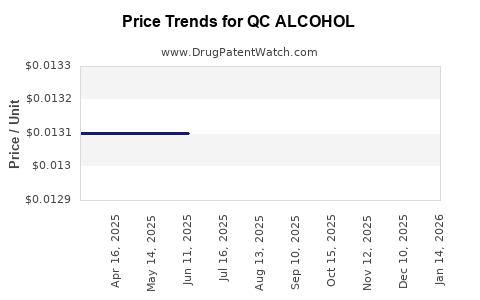
Average Pharmacy Cost for QC ALCOHOL
| Drug Name | NDC | Price/Unit ($) | Unit | Date |
|---|---|---|---|---|
| QC ALCOHOL 70% PREP PADS | 83324-0305-01 | 0.01372 | EACH | 2026-03-18 |
| QC ALCOHOL 70% PREP PADS | 83324-0305-01 | 0.01385 | EACH | 2026-02-18 |
| QC ALCOHOL 70% PREP PADS | 83324-0305-01 | 0.01388 | EACH | 2026-01-21 |
| QC ALCOHOL 70% PREP PADS | 83324-0305-01 | 0.01386 | EACH | 2025-12-17 |
| QC ALCOHOL 70% PREP PADS | 83324-0305-01 | 0.01355 | EACH | 2025-11-19 |
| >Drug Name | >NDC | >Price/Unit ($) | >Unit | >Date |
QC ALCOHOL Market Analysis and Financial Projection
What is QC ALCOHOL?
QC ALCOHOL is an over-the-counter (OTC) antiseptic hand sanitizer containing ethanol with typical concentrations ranging from 60% to 70%. It is used to reduce bacterial presence on the skin and is marketed for personal hygiene, especially during health crises such as the COVID-19 pandemic. The product is often packaged in bottles varying from 50 mL to 1 liter and is available through pharmacies, online platforms, and wholesale distributors.
What is the current market landscape for antiseptic alcohol products?
The market for alcohol-based hand sanitizers experienced exponential growth during the COVID-19 pandemic. Industry data indicates the global hand sanitizer market volume was valued at approximately USD 2.2 billion in 2020 and is projected to reach USD 3.5 billion by 2025, growing at a compound annual growth rate (CAGR) of roughly 9% [1]. Key players include:
- Sanofi (Purell)
- Reckitt Benckiser (Lyte, Dettol)
- Clorox
- Best sanitizers and private-label brands
- Regional manufacturers focusing on local distribution
The surge in demand led to increased production capacities, supply chain complexities, and emergence of new brands. As pandemic concerns ease, growth is expected to stabilize but remain above pre-pandemic levels.
How is the regulatory environment affecting QC ALCOHOL?
The U.S. Food and Drug Administration (FDA) has established guidelines for hand sanitizer manufacturing, requiring adherence to Good Manufacturing Practices (GMP). During the COVID-19 emergency, the FDA issued temporary policies permitting formulators to produce alcohol-based hand sanitizers with certain regulatory flexibilities, such as using specific epitopes of ethanol [2].
In Europe, the European Medicines Agency (EMA) and local authorities regulate disinfectant products under disinfectant regulations, requiring safety and efficacy documentation. Similar regulations in Asia, Latin America, and Africa enforce quality standards and labeling compliance.
Manufacturers must comply with local regulations concerning:
- Alcohol content validation
- Packaging and labeling
- Manufacturing site approvals
- Product safety data
Regulatory oversight acts as a barrier for small entrants but facilitates entry for established chemical or pharmaceutical manufacturers.
What are the price dynamics for QC ALCOHOL products?
Pricing varies based on production scale, ethanol purity, packaging, and geographic region:
| Packaging Type | Typical Price Range (USD) | Notes |
|---|---|---|
| 50 mL bottle | 0.50 - 1.00 | Small, portable units |
| 250 mL bottle | 1.50 - 4.00 | Standard personal use |
| 1-liter bottle | 3.50 - 7.50 | Bulk purchase / institutional |
Wholesale prices tend to be lower, generally 20%-30% below retail points, depending on order volume. During high demand periods (2020-2021), price spikes occurred due to raw material shortages, with retail prices doubling or tripling in some markets.
Brand premium and distribution channels impact final pricing; private label offerings often undercut branded products by 10%-15%. In developing regions, prices are typically 10%-25% lower owing to lower manufacturing costs and different regulatory costs.
What are the projections for QC ALCOHOL pricing and market volume?
Projections assume a stabilizing market with moderate growth rates post-pandemic:
- Market Volume: CAGR of 5% over the next five years, reaching approximately USD 4.4 billion globally by 2028 [1].
- Price Trends: Prices are expected to decline gradually as supply chains stabilize and raw material costs decrease. The average retail price per liter of 70% ethanol-based sanitizer may fall by 10%-15% over the next four years.
Raw material costs, primarily ethanol and isopropanol, account for 40%-60% of manufacturing costs. Wholesale ethanol prices fluctuated between USD 1.00 and USD 1.50 per liter in 2021, driven by crude oil prices and ethanol supply in global markets [3].
With improved production infrastructure and competition, wholesale prices could decrease by 20%-25% in the next three years, translating into a retail price decline of approximately 10%.
How are emerging markets influencing the global QC ALCOHOL market?
Emerging markets such as India, Brazil, Southeast Asia, and Africa are witnessing increased demand for affordable hand sanitizers driven by population growth and basic sanitation needs. Local manufacturers leverage low-cost raw materials and less stringent regulatory procedures to supply low-cost products.
For these regions, price points are generally below USD 1.00 per 250 mL bottle retail, and volume growth remains high. Import restrictions, tariffs, and supply chain constraints influence regional prices differently.
What are key considerations for companies entering or expanding in this market?
- Ensure regulatory compliance to avoid product recalls or bans
- Competitive pricing strategies tailored to regional purchasing power
- Secure reliable ethanol supply chains to prevent production disruptions
- Develop branding emphasizing efficacy and safety
- Invest in scalable manufacturing facilities to leverage economies of scale
What risks could impact future prices and availability?
- Raw material shortages, especially ethanol and isopropanol
- Regulatory changes imposing tighter quality controls or labeling requirements
- Price volatility in crude oil influencing ethanol prices
- Supply chain disruptions from geopolitical or logistic issues
- Market saturation leading to price competition
Key Takeaways
- The global hand sanitizer market, centered on ethanol-based products like QC ALCOHOL, is projected to grow at 5%-9% CAGR over the next five years.
- Prices are declining gradually due to supply chain stabilization, increased competition, and raw material cost reductions.
- Regulatory environments vary by region but generally require adherence to safety, efficacy, and labeling standards to maintain market access.
- Raw material costs heavily influence wholesale and retail pricing, with ethanol prices fluctuating based on external factors.
- Emerging markets drive volume growth, often favoring low-cost, locally produced alternatives.
FAQs
1. What are typical ethanol concentrations for QC ALCOHOL?
Between 60% and 70%, aligning with CDC and WHO recommendations for effective disinfection.
2. How does regulatory approval differ internationally?
U.S. FDA permits temporary flexibilities during emergencies; Europe’s EMA enforces stricter compliance with disinfectant regulations; Asian and Latin American countries have varying standards that can be less stringent but require safety certifications.
3. What raw materials are most influential on price?
Ethanol (or isopropanol) and glycerol constitute the largest cost components, with ethanol prices most affected by crude oil costs and ethanol supply-demand dynamics.
4. Will prices decline further post-pandemic?
Yes, as supply chains normalize and demand stabilizes, wholesale and retail prices are expected to decrease gradually.
5. Is there room for new entrants in the QC ALCOHOL market?
Yes, especially in developing regions with high demand and less saturated markets, provided they meet regulatory standards and have reliable raw material supplies.
References
[1] MarketsandMarkets. Hand Sanitizer Market. 2021.
[2] U.S. FDA. Temporary Policy for Manufacture of Alcohol-Based Hand Sanitizer During COVID-19. 2020.
[3] Investing.com. Ethanol Prices, 2021.
More… ↓
