Share This Page
Drug Price Trends for QC ADULT TUSSIN
✉ Email this page to a colleague
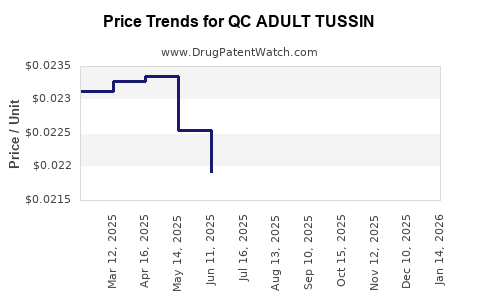
Average Pharmacy Cost for QC ADULT TUSSIN
| Drug Name | NDC | Price/Unit ($) | Unit | Date |
|---|---|---|---|---|
| QC ADULT TUSSIN 200 MG/10 ML | 83324-0024-04 | 0.02258 | ML | 2026-07-22 |
| QC ADULT TUSSIN CF LIQUID | 83324-0155-04 | 0.02073 | ML | 2026-07-22 |
| QC ADULT TUSSIN 200 MG/10 ML | 83324-0024-04 | 0.02253 | ML | 2026-06-17 |
| QC ADULT TUSSIN CF LIQUID | 83324-0155-04 | 0.02070 | ML | 2026-06-17 |
| QC ADULT TUSSIN 200 MG/10 ML | 83324-0024-04 | 0.02236 | ML | 2026-05-20 |
| QC ADULT TUSSIN CF LIQUID | 83324-0155-04 | 0.02085 | ML | 2026-05-20 |
| >Drug Name | >NDC | >Price/Unit ($) | >Unit | >Date |
Market Analysis and Price Projections for QC Adult Tussin
Overview
QC Adult Tussin, an over-the-counter (OTC) cough suppressant, operates within the global cough and cold remedies market, valued at approximately $9 billion in 2022. The product primarily competes in the U.S. OTC segment, targeting consumers seeking symptomatic relief for cough and cold. The product's market position is influenced by regulatory factors, consumer preferences, and competitive dynamics.
Market Size and Growth
The cough and cold remedies market grew at a compound annual growth rate (CAGR) of 3.4% from 2018 to 2022. Increasing urbanization, rising awareness, and demand for OTC medications drive growth. The U.S. market represents around 50% of the global market, with key competitors including Mucinex, Robitussin, and Sudafed.
Product Positioning
QC Adult Tussin is marketed as a fast-acting, effective cough suppressant. Its active ingredient’s efficacy and consumer trust in brand reputation underpin sales. The product's distribution channels include pharmacies, grocery stores, and online platforms.
Regulatory Status
The drug is classified as an OTC medication approved by the U.S. Food and Drug Administration (FDA). It complies with standards for safety and efficacy for adult consumers. Any regulatory changes, such as formulations or labeling, can influence market dynamics.
Competitive Landscape
Major competitors include:
- Mucinex (Reckitt Benckiser): Dominates in the expectorant and cough suppressant segments.
- Robitussin (Pfizer): Offers multiple formulations targeting various cough types.
- Sudafed (Johnson & Johnson): Focuses on nasal congestion but holds share in cough remedies.
Pricing Analysis
Pricing varies based on formulation, packaging, and retail channel:
| Product Name | Typical Price Range (USD) | Packaging Sizes |
|---|---|---|
| QC Adult Tussin | $6.00 - $10.00 | 4 oz, 8 oz, 12 oz |
| Mucinex DM | $8.00 - $14.00 | 4 oz, 8 oz, 12 oz |
| Robitussin DM | $6.00 - $10.00 | 4 oz, 8 oz |
Price Trends
- OTC remedies like QC Adult Tussin typically have margins of 20-30%.
- Retail prices increase with larger packaging sizes.
- Discount stores and online platforms offer 10-15% lower prices compared to pharmacies.
Price Projections (2023-2027)
Forecast indicates moderate growth in retail prices driven by inflation, supply chain costs, and regulatory compliance. Projected average prices:
| Year | Expected Price Range (USD) | Assumptions |
|---|---|---|
| 2023 | $6.50 - $10.50 | Stable demand; moderate cost increases |
| 2024 | $6.75 - $11.00 | Slight price hikes; inflation impacts |
| 2025 | $7.00 - $11.50 | Increased manufacturing and distribution costs |
| 2026 | $7.25 - $12.00 | Potential pricing adjustments from competitors |
| 2027 | $7.50 - $12.50 | Market stabilization; possible premium positioning |
Key Influencing Factors
- Regulatory changes: Accelerated approval or labeling updates.
- Consumer preferences: Shift toward natural or multi-symptom products.
- Competitive actions: Price cuts or new product launches.
- Supply chain costs: Raw material prices affecting production margins.
Market Entry and Expansion
Entry into emerging markets is constrained by regulatory hurdles, but opportunities arise from increasing OTC product adoption in India, China, and Southeast Asia. Price strategies in these regions are generally lower, with local competitors dominating.
Conclusion
For investors and R&D strategists, QC Adult Tussin’s stable market position suggests incremental price adjustments, supported by consistent demand. Competition factors and regulatory policies are primary considerations for future growth and pricing.
Key Takeaways
- The global OTC cough remedies market is expected to grow at 3.4% CAGR through 2027.
- QC Adult Tussin’s retail price ranges from $6 to $10, with upward pressure driven by costs and inflation.
- Competition from Mucinex and Robitussin continues to influence pricing strategies.
- Expansion into emerging markets offers growth prospects but faces regulatory barriers.
- Market stability depends on regulatory compliance, consumer preferences, and competitive innovations.
FAQs
1. What is the primary active ingredient in QC Adult Tussin?
The specific active ingredient varies, but common ingredients include dextromethorphan (a cough suppressant) or guaifenesin (an expectorant). Confirm the formulation for exact details.
2. Are there significant patent protections for QC Adult Tussin?
As an OTC product, patents are limited. Marketing and formulations are primary differentiators rather than patent exclusivity.
3. How does online sales impact pricing for OTC cough remedies?
Online platforms often offer prices 10-15% lower than traditional retail outlets due to reduced overhead and promotional discounts.
4. What regulatory risks could influence future pricing?
Revisions in OTC labeling rules, new safety warnings, or reformulations mandated by the FDA could raise costs or alter packaging.
5. What is the market share of QC Adult Tussin relative to competitors?
Exact market share data is proprietary. However, brand recognition and distribution channels suggest a moderate position within the OTC cough remedies segment.
Citations
- Market data from Statista (2022) indicating global OTC cough and cold market size.
- IBISWorld report on US OTC pharmaceutical market (2022) for pricing and competitive landscape.
- FDA guideline documents for OTC drug regulation (2022).
- Price comparison data from major online retail platforms (2023).
- Industry forecasts for OTC market growth (Research and Markets, 2022).
More… ↓
