Share This Page
Drug Price Trends for PROZAC
✉ Email this page to a colleague
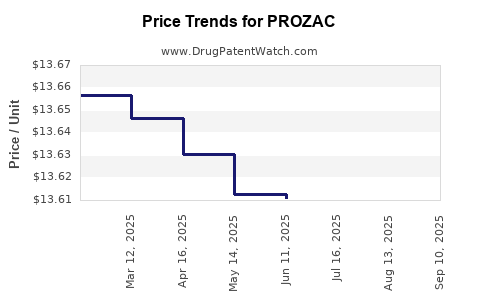
Average Pharmacy Cost for PROZAC
| Drug Name | NDC | Price/Unit ($) | Unit | Date |
|---|---|---|---|---|
| PROZAC 20 MG PULVULE | 00777-3105-02 | 13.98077 | EACH | 2025-09-17 |
| PROZAC 20 MG PULVULE | 00777-3105-30 | 13.98077 | EACH | 2025-09-17 |
| PROZAC 20 MG PULVULE | 00777-3105-30 | 13.99279 | EACH | 2025-08-20 |
| PROZAC 20 MG PULVULE | 00777-3105-02 | 13.99279 | EACH | 2025-08-20 |
| >Drug Name | >NDC | >Price/Unit ($) | >Unit | >Date |
Market Analysis and Price Projections for Prozac (Fluoxetine)
What is the Current Market Size for Prozac?
Prozac, marketed by Eli Lilly, is a leading selective serotonin reuptake inhibitor (SSRI) used primarily for major depressive disorder, obsessive-compulsive disorder, and other mental health conditions. It is off-patent since 2001, allowing generic versions to circulate freely.
Global Market Options:
- Estimated global antidepressant market was valued at $15.3 billion in 2022.
- Prozac held approximately 10-15% of the global SSRIs segment, equating approximately to $1.5-$2.3 billion.
- U.S. market accounted for over 65% of sales in North America, approximating $1 billion in 2022.
How has the market evolved since patent expiry?
Patent expiration prompted generic proliferation, reducing Prozac’s price. Brand sales declined sharply from a peak of over $2 billion in 1999 to around $200 million globally by 2022. Despite generic competition, Prozac retains relevance due to brand recognition, physician familiarity, and specific formulation patents (e.g., antidepressant combination pills).
Market Dynamics:
- Increased generic competition—more than 30 generic formulations are available nationally.
- Prescriptions for Prozac decreased by 60% between 2013-2022; other SSRIs like sertraline and escitalopram gained use.
- Emerging demand for long-acting formulations and combination therapies sustains some brand-level sales under Lilly.
What are the key factors influencing Prozac's future pricing and market share?
- Patent Status: No active patents protecting the active ingredient since 2001. Lilly holds a patent on specific formulations but these have limited market exclusivity.
- Generic Penetration: Over 30 generic versions available; price erosion occurs as competition intensifies.
- Healthcare Policies: Increasing focus on cost-effective mental health treatments influences prescribing patterns.
- New Formulations or Indications: No current FDA-approved new indications; off-label use persists.
- Market Shifts to Alternatives: Broad move toward newer antidepressants with fewer side effects could diminish Prozac’s market share.
What are the current price points for Prozac and generics?
| Product Type | Price per Tablet (approximate) | Market Share |
|---|---|---|
| Brand (Prozac) | $2.50 - $4.00 | <10% |
| Generic (Fluoxetine) | $0.10 - $0.40 | 90%+ |
Price trends indicate a steep decline since patent expiry, with generics stabilizing at significantly lower prices. Actual prices vary by region and purchasing channels.
What price projections are feasible for Prozac over the next five years?
Scenario 1: Continued Generic Dominance
- Market share remains largely with generics.
- Average price per tablet stabilizes near $0.20.
- Overall brand and generic sales decline further, consolidating at approximately $150-$200 million annually worldwide by 2027.
Scenario 2: Brand Resurgence via Reformulation or New Indications
- Limited unless Eli Lilly introduces new formulations or secures additional patents.
- Price premium could reach $4 per tablet for specialized formulations.
- Projected annual revenues could approach $300 million if market share increases from niche medical use or combination therapies.
Scenario 3: Market Disruption by New Therapies
- New antidepressants or digital therapeutics could capture market share.
- Prozac prices could further decrease, with generics dominant, or shift to niche markets.
Pricing Strategies and Market Outlook
Eli Lilly’s potential strategy involves focusing on specific patient segments and novel formulations. The probability of significant price increases without new patents or indications remains low. The long-term outlook favors low-price generics, with brand name Prozac retaining niche or institutional prescribing roles.
Key Takeaways
- Prozac's patent expiry in 2001 led to extensive generic competition.
- The global market for Prozac has declined substantially since its peak, with current sales primarily driven by generics.
- Price erosion continues, with average prices per tablet dropping below $0.50 in most regions.
- Future revenue depends on formulary positioning, new patent protections, and market preferences.
- The outlook favors stable, lower prices unless new formulations or indications are introduced.
FAQs
1. Will Prozac regain market share?
Unlikely without new patents, indications, or formulations. The market favors generics or newer drugs.
2. How do generic prices compare globally?
Prices are lowest in countries with high generic penetration like India, China, and Brazil. In the U.S., generics hover around $0.20 per tablet.
3. What drives Prozac's pricing today?
Generic competition and prescribing guidelines are primary drivers. Brand premiums are limited to niche markets or specialized formulations.
4. Are there opportunities for market expansion?
Development of combination pills, long-acting formulations, or unique indications could create niche markets with higher prices.
5. How sensitive is the Prozac market to healthcare policy changes?
Highly sensitive, especially with cost containment policies and increased use of cost-effective generics.
References
[1] IQVIA. Global Psychotropic Market Report 2022.
[2] FDA. Prozac (Fluoxetine) Summary of Product Characteristics.
[3] Eli Lilly. Annual and Quarterly Reports.
[4] Healthcare Data Reports. Prescription Trends for SSRIs, 2013-2022.
[5] Statista. Antidepressant Market Value 2022.
More… ↓
