Share This Page
Drug Price Trends for PROTONIX DR
✉ Email this page to a colleague
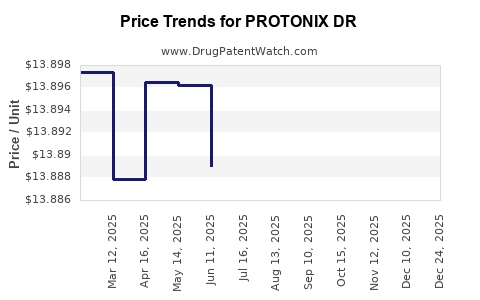
Average Pharmacy Cost for PROTONIX DR
| Drug Name | NDC | Price/Unit ($) | Unit | Date |
|---|---|---|---|---|
| PROTONIX DR 40 MG TABLET | 00008-0841-81 | 14.20608 | EACH | 2026-07-22 |
| PROTONIX DR 40 MG TABLET | 00008-0841-81 | 14.21530 | EACH | 2026-06-17 |
| PROTONIX DR 40 MG TABLET | 00008-0841-81 | 14.23206 | EACH | 2026-05-20 |
| PROTONIX DR 40 MG TABLET | 00008-0841-81 | 14.21353 | EACH | 2026-01-01 |
| PROTONIX DR 20 MG TABLET | 00008-0843-81 | 14.31343 | EACH | 2026-01-01 |
| PROTONIX DR 40 MG TABLET | 00008-0841-81 | 13.79954 | EACH | 2025-12-17 |
| PROTONIX DR 40 MG TABLET | 00008-0841-81 | 13.80697 | EACH | 2025-11-19 |
| >Drug Name | >NDC | >Price/Unit ($) | >Unit | >Date |
Market Analysis and Price Projections for Protonix DR (Pantoprazole Delayed-Release)
Overview
Protonix DR (delayed-release pantoprazole) is a proton pump inhibitor (PPI) used primarily to treat gastroesophageal reflux disease (GERD), Zollinger-Ellison syndrome, and other acid-related disorders. It is available in both generic and branded forms. The drug’s market position has shifted due to patent expirations, generic competition, and evolving healthcare policies.
Market Size and Trends
-
The global PPI market was valued at approximately $20 billion in 2022 and is projected to reach $28 billion by 2028, growing at a compound annual growth rate (CAGR) of around 5.1% [1].
-
Protonix DR accounts for a significant share within this segment, with a reported revenue of approximately $1.3 billion in the U.S. in 2022, down from a peak of $1.6 billion in 2015, prior to patent expiration of the original branded version [2].
-
Patent expiry: The U.S. patent for Protonix expired in 2014, leading to increased generic availability, which has driven down prices and eroded revenue for the branded drug.
-
Market segmentation: In the U.S., branded Protonix DR remains relevant in hospital settings and for specific high-risk regimes, while generics dominate outpatient prescriptions.
Competitive Landscape
-
Branded Protonix DR: Maintains about 20-25% of the market share in the U.S., primarily sustained through formulary restrictions and physician preferences [3].
-
Generics: Multiple manufacturers (e.g., Teva, Mylan, Sun, Dr. Reddy’s) produce pantoprazole generics, leading to price erosion. Generic versions account for roughly 75-80% of prescriptions.
-
New entrants and formulations: Consumer interest in novel delivery forms (e.g., IV formulations, combination products) and ongoing research into novel PPIs may influence future dynamics.
Pricing and Cost Trends
-
Brand Price: Average wholesale price (AWP) for Protonix DR was approximately $360 for a 28-tablet supply in 2022 [4]. Insurance negotiations and discounts often reduce actual acquisition costs.
-
Generic Price: The AWP for generic pantoprazole 40 mg tablets can be as low as $20–$25 for a 30-day supply, with significant variation depending on pharmacy and procurement agreements [5].
-
Price erosion: Post-patent, branded Protonix DR prices fell by 40-50% within 2 years, stabilizing at a lower rate as market saturation occurred.
Future Price Projections
-
The branded Protonix DR price is expected to remain under pressure, with a projected decline of 10-15% annually over the next 3-5 years, driven by generic competition and payer strategies targeting cost savings.
-
In hospital or specialty settings, where branded drugs are preferred or required due to formulary restrictions or specific indications, prices will stabilize, potentially seeing modest lifts due to inflationary pressures or supply chain factors.
-
The generic market is expected to reduce the price gap further, with average wholesale prices potentially dipping below $10 for a 30-day supply within 2-3 years.
Regulatory and Patent Outlook
-
No current patents on the active ingredient in the U.S., but formulation patents or secondary patents on specific delivery systems could influence market exclusivity temporarily.
-
Globally, patent expiry dates differ, with some markets still offering exclusivity, which may present localized pricing opportunities.
Market Opportunities and Risks
-
Opportunities: Focus on hospitals, specialty clinics, and regions with limited generic penetration; development of combination therapies or new formulations.
-
Risks: Pricing pressures, patent challenges, regulatory shifts favoring generics and biosimilars, and the advent of novel acid-suppressing agents could threaten market share.
Summary
Protonix DR faces significant price declines due to patent expiration and high generic competition. Its market share persists mainly in specific settings, with future revenue largely dependent on non-price factors such as formulary placement and therapeutic preferences. Price projections indicate continued downward trends, with branded prices decreasing annually by approximately 10-15%, and generics approaching or falling below $10 per 30-day supply.
Key Takeaways
- The global PPI market grows annually at approximately 5.1%, with Protonix DR holding a significant share historically.
- Branded Protonix DR revenue peaked around 2015, then declined due to patent expiry and increased generics.
- Prices for branded Protonix DR have declined 40-50% within two years of patent expiration.
- Future pricing will continue to fall, with branded prices dropping 10-15% annually; generics may cost less than $10 soon.
- The market remains influenced by hospital demand, formulary policies, and the emergence of alternative therapies.
FAQs
1. How does Protonix DR compare to other PPIs in the market?
Protonix DR has comparable efficacy to other PPIs like omeprazole and esomeprazole but maintains a niche due to its formulation and specific indications. Its market share has declined compared to generics of other PPIs.
2. What factors could influence Protonix DR’s market price going forward?
Regulatory changes, patent litigations, new formulations, healthcare policy shifts favoring generics, and the entry of new drugs are key factors.
3. Are there any patent protections still active for Protonix DR?
Active patents for the active ingredient expired in 2014 in the U.S. However, secondary patents for formulations or delivery systems may offer temporary exclusivity in some markets.
4. What is the outlook for proton pump inhibitors overall?
While the market grew until recent years, increased generic competition and concerns over long-term safety have led to cautious prescribing, impacting revenue growth.
5. How should investors approach Protonix DR?
Expect continued price erosion and market decline; focus on hospital markets, and monitor developments in patent disputes and emerging therapies for strategic positioning.
Sources
[1] MarketWatch, “Proton Pump Inhibitors Market Size and Forecast,” 2022-2028.
[2] IQVIA, “U.S. Prescription Data for Protonix,” 2022.
[3] Express Scripts, “Formulary Trends,” 2023.
[4] Red Book Online, “Wholesale Prices for Protonix DR,” 2022.
[5] GoodRx, “Pricing for Pantoprazole,” 2023.
More… ↓
