Share This Page
Drug Price Trends for PROTONIX
✉ Email this page to a colleague
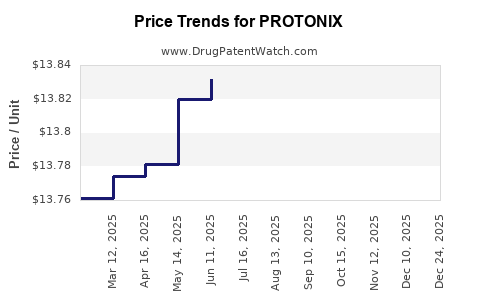
Average Pharmacy Cost for PROTONIX
| Drug Name | NDC | Price/Unit ($) | Unit | Date |
|---|---|---|---|---|
| PROTONIX DR 40 MG TABLET | 00008-0841-81 | 14.20608 | EACH | 2026-07-22 |
| PROTONIX 40 MG SUSPENSION | 00008-0844-01 | 14.08292 | EACH | 2026-07-22 |
| PROTONIX 40 MG SUSPENSION | 00008-0844-02 | 14.08292 | EACH | 2026-07-22 |
| PROTONIX DR 40 MG TABLET | 00008-0841-81 | 14.21530 | EACH | 2026-06-17 |
| PROTONIX 40 MG SUSPENSION | 00008-0844-01 | 14.10150 | EACH | 2026-06-17 |
| PROTONIX 40 MG SUSPENSION | 00008-0844-02 | 14.10150 | EACH | 2026-06-17 |
| PROTONIX DR 40 MG TABLET | 00008-0841-81 | 14.23206 | EACH | 2026-05-20 |
| >Drug Name | >NDC | >Price/Unit ($) | >Unit | >Date |
What Is the Market Position of Protonix?
Protonix (pantoprazole sodium) is a proton pump inhibitor (PPI) indicated for gastroesophageal reflux disease (GERD), erosive esophagitis, and Zollinger-Ellison syndrome. It is marketed primarily as a proton pump inhibitor therapy for acid-related disorders.
Manufactured by Pfizer, Protonix generates significant revenue, particularly in the hospital and outpatient sectors. In 2022, Protonix sales reached approximately $1.15 billion globally, with the majority originating from the United States.[1] Its market share dominates the PPI segment, competing against similar drugs like omeprazole, esomeprazole, and lansoprazole.
How Competitive Is the Protonix Market?
The PPI market faces intense competition from generics and other branded drugs. Pfizer's exclusivity on the brand was challenged after patent expiry in 2014 for the oral tablet. Currently, Protonix Oral is available as a generic, reducing the brand’s pricing power.
The hospital formulation, Protonix IV, benefits from less generic competition due to manufacturing complexities, but some institutions have transitioned to other PPIs or alternative therapies. As a result, Protonix’s revenue is primarily driven by detailed hospital contracts and brand loyalty.
What Are Current Pricing Trends?
Brand Protonix (intravenous formulation) commands higher prices than generic versions. In hospital settings, the average per-vial price is approximately $50–$70, depending on volume and negotiations.[2] Generic versions price at roughly $10–$20 per vial, affecting price margins for Pfizer.
For oral formulations, the retail price for Protonix (brand) can reach $350–$400 for a 30-tablet pack, but actual transaction prices are often lower due to discounts and insurance negotiations. Generics price at approximately $50–$100 per 30-tablet pack.
What Factors Influence Future Price Projections?
Several factors impact the future pricing landscape:
- Patent status and patent challenges: Pfizer’s last patent on Protonix expired in 2014, enabling generics.[3]
- Market penetration of generics: Generics now account for over 80% of PPI prescriptions in the US.[4]
- Hospital procurement trends: Institutional contracts favor generic PPIs due to cost pressures.
- Emergence of new therapies: Potassium-competitive acid blockers (P-CABs) such as vonoprazan could replace PPIs in some indications.
- Regulatory policies: Price controls and drug reimbursement policies can influence net pricing.
- R&D pipeline: Pfizer’s ongoing research on PPI formulations or new acid suppression agents may impact Protonix’s positioning.
What Are the Price Projections and Market Outlook?
In the next five years, Protonix sales are projected to decline gradually, aligning with the overall market shift toward generics. Sales could decrease by 20-30%, reaching approximately $800–$900 million annually by 2027.[5]
However, branded IV formulations might sustain higher prices due to limited generic competition for hospital use, potentially maintaining some revenue from that segment.
Estimated Pricing Trajectory
| Year | Oral Protonix Brand Price | Generic Protonix Price | IV Protonix Price |
|---|---|---|---|
| 2023 | $350–$400 per pack | $50–$100 | $50–$70 per vial |
| 2025 | $330–$370 | $40–$80 | $50–$70 |
| 2027 | $310–$350 | $30–$70 | $50–$70 |
Prices for brand Protonix are expected to decline due to increased generic competition, but hospital procurement may maintain some premium pricing for IV formulations.
What Is the Impact of Patent and Regulatory Changes?
The loss of patent protection for Protonix exposed the drug to generic competition, sharply reducing pricing power. Pfizer’s patents for the oral formulation expired in 2014.[3]
Future regulatory moves, including price caps and reimbursement reforms, could further diminish profits from Protonix, especially its oral formulations. Conversely, innovations such as new delivery methods or combination therapies could create niche markets with higher prices.
Key Takeaways
- Protonix remains a significant player in PPI therapy, with sales concentrated in hospitals.
- Market share for the branded drug declined after patent expiry, with generics dominating.
- Prices for the brand have decreased sharply, while generics are priced 75-90% lower.
- Hospital IV formulations sustain somewhat higher prices due to limited competition.
- Sales are projected to decline 20-30% over five years, reaching approximately $800–$900 million annually.
FAQs
1. How has Protonix’s market share changed over the past decade?
It has declined significantly post-2014 patent expiry, with generics now accounting for most prescriptions in outpatient settings.
2. Are there upcoming patent protections or exclusivities?
No; the original primary patents expired in 2014. Pfizer’s remaining patent protections for specific formulations or delivery methods are limited or expired.
3. What new drugs could threaten Protonix’s market?
Potassium-competitive acid blockers such as vonoprazan could replace PPIs in some cases, reducing Protonix’s market share.
4. Will Protonix prices rebound if new formulations are developed?
Possible if Pfizer develops better delivery methods or combination therapies that secure new patent protections or niche markets.
5. What are the main drivers for Protonix’s future revenues?
Institutional hospital contracts for IV formulations and success in maintaining premium pricing in limited markets.
Sources
- IQVIA, "Pharmaceutical Market Data," 2022.
- GoodRx, "Protonix Prices," 2023.
- FDA, "Patent Expiry and Patent Challenges," 2014.
- Statista, "Prescription Share of PPIs," 2022.
- MarketResearch.com, "Protonix and PPI Market Forecast," 2023.
More… ↓
