Share This Page
Drug Price Trends for PROSCAR
✉ Email this page to a colleague
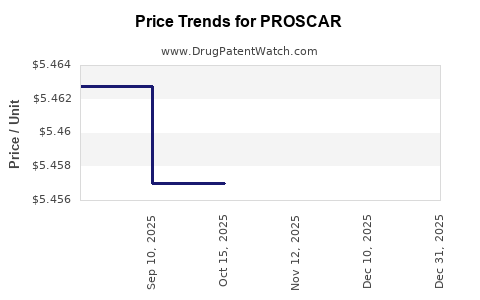
Average Pharmacy Cost for PROSCAR
| Drug Name | NDC | Price/Unit ($) | Unit | Date |
|---|---|---|---|---|
| PROSCAR 5 MG TABLET | 78206-0153-01 | 5.70432 | EACH | 2026-07-22 |
| PROSCAR 5 MG TABLET | 78206-0153-02 | 5.70432 | EACH | 2026-07-22 |
| PROSCAR 5 MG TABLET | 78206-0153-01 | 5.70432 | EACH | 2026-06-17 |
| PROSCAR 5 MG TABLET | 78206-0153-02 | 5.70432 | EACH | 2026-06-17 |
| PROSCAR 5 MG TABLET | 78206-0153-01 | 5.70645 | EACH | 2026-05-20 |
| >Drug Name | >NDC | >Price/Unit ($) | >Unit | >Date |
Best Wholesale Price for PROSCAR
| Drug Name | Vendor | NDC | Count | Price ($) | Price/Unit ($) | Unit | Dates | Price Type |
|---|---|---|---|---|---|---|---|---|
| PROSCAR 5MG TAB | Organon LLC | 78206-0153-02 | 100 | 486.63 | 4.86630 | EACH | 2023-01-01 - 2027-01-14 | FSS |
| PROSCAR 5MG TAB | Organon LLC | 78206-0153-01 | 30 | 145.99 | 4.86633 | EACH | 2023-01-01 - 2027-01-14 | FSS |
| PROSCAR 5MG TAB | Organon LLC | 78206-0153-02 | 100 | 356.76 | 3.56760 | EACH | 2024-01-05 - 2027-01-14 | Big4 |
| PROSCAR 5MG TAB | Organon LLC | 78206-0153-01 | 30 | 107.96 | 3.59867 | EACH | 2024-01-05 - 2027-01-14 | Big4 |
| PROSCAR 5MG TAB | Organon LLC | 78206-0153-02 | 100 | 544.24 | 5.44240 | EACH | 2024-01-05 - 2027-01-14 | FSS |
| >Drug Name | >Vendor | >NDC | >Count | >Price ($) | >Price/Unit ($) | >Unit | >Dates | >Price Type |
Proscar (Finasteride) Market Analysis and Price Projections
Proscar (finasteride) is a prescription medication approved for the treatment of benign prostatic hyperplasia (BPH) and, at a lower dose (Propecia), for male pattern baldness. This analysis focuses on the BPH indication and projects market trends and pricing for finasteride.
What is the Current Market Size and Growth Trajectory for Proscar?
The global market for BPH treatments is substantial and projected to expand. Finasteride, as a long-standing treatment option, holds a significant share, though it faces competition from newer therapies and generics.
- 2023 Market Value: The global BPH treatment market was valued at approximately USD 5.2 billion in 2023 [1].
- Projected Growth: The market is forecast to grow at a compound annual growth rate (CAGR) of 3.5% from 2024 to 2030 [1].
- Finasteride's Position: Finasteride (including its generic forms) is a widely prescribed 5-alpha reductase inhibitor and contributes significantly to this market. Its established efficacy and oral administration remain key drivers of its use [2].
- Market Drivers: Increasing prevalence of BPH due to aging populations, rising healthcare expenditure, and growing awareness of treatment options are driving market growth [1].
Who are the Key Players in the Finasteride Market?
The finasteride market is characterized by the presence of both originator companies and a robust generic sector.
- Originator: Merck & Co., Inc. is the originator of Proscar.
- Generic Manufacturers: A significant number of generic pharmaceutical companies manufacture and market finasteride. Key players in the broader BPH market, which include finasteride generics, include:
- Pfizer Inc.
- Astellas Pharma Inc.
- Bayer AG
- AstraZeneca PLC
- Sanofi S.A.
- Teva Pharmaceutical Industries Ltd.
- Sandoz International GmbH (a division of Novartis AG)
- Mylan N.V. (now part of Viatris Inc.)
- Impax Laboratories, Inc. (now part of Amneal Pharmaceuticals LLC)
- Sun Pharmaceutical Industries Ltd. [3]
What are the Primary Patent Expirations and Their Impact?
The patent landscape for Proscar has significantly evolved, leading to widespread generic availability.
- US Patent Expiration: The primary patents protecting Proscar (finasteride) in the United States expired decades ago. The original patents were filed in the late 1980s and early 1990s. For instance, U.S. Patent No. 4,703,063, related to the composition of matter, expired in the early 2000s.
- Exclusivity Loss: This loss of patent exclusivity allowed generic manufacturers to enter the market, dramatically increasing competition and driving down prices [4].
- Consequence: The market shifted from a single-source innovator product to a highly competitive multi-source generic market.
How has Generic Competition Affected Proscar Pricing?
The entry of generic finasteride has led to substantial price reductions compared to the innovator product.
- Price Erosion: Generic competition is the primary driver of price erosion for branded drugs. With multiple manufacturers producing finasteride, market forces dictate lower pricing.
- Average Wholesale Price (AWP) Comparison: While AWP can vary by pharmacy and insurance plan, branded Proscar's AWP would have been considerably higher than current generic finasteride prices.
- Branded Proscar (5mg tablets): Historically, AWP could range from $150-$250+ for a 30-day supply before generic entry [5].
- Generic Finasteride (5mg tablets): Current AWP for a 30-day supply of generic finasteride typically ranges from $15-$40, depending on the manufacturer and pharmacy [5, 6].
- Reimbursement: Many insurance plans now preferentially cover generic alternatives due to their cost-effectiveness.
What is the Projected Pricing Trend for Finasteride?
Given the mature stage of finasteride's lifecycle and the established generic market, pricing trends are expected to remain relatively stable with minor fluctuations.
- Stable Generic Pricing: The price of generic finasteride is unlikely to see significant increases in the near future. Competition among manufacturers is fierce, acting as a ceiling on price.
- Potential for Minor Decreases: Continued manufacturing efficiencies and competitive bidding by large distributors could lead to marginal price decreases over time.
- Factors Influencing Price:
- Manufacturing Costs: Raw material costs, production scale, and regulatory compliance influence manufacturer pricing.
- Wholesaler and Distributor Margins: The markups added by intermediaries affect the final AWP.
- Pharmacy Markups: Retail pharmacies add their own dispensing fees and markups.
- Market Volume: High prescription volumes help maintain competitive pricing.
- Regulatory Changes: Changes in FDA regulations or manufacturing standards could impact costs and thus prices.
- Projected Price Range: Based on current trends, the AWP for a 30-day supply of generic finasteride is projected to remain within the $15-$40 range for the foreseeable future. Significant upward price movements are improbable unless there are major shifts in manufacturing or supply chain disruptions.
What are the Key Therapeutic Areas and Competitors within the BPH Market?
Finasteride belongs to the 5-alpha reductase inhibitor (5-ARI) class. The BPH treatment market encompasses several therapeutic classes.
- Therapeutic Classes for BPH:
- Alpha-Blockers: Relax smooth muscle in the prostate and bladder neck, improving urine flow. Examples include tamsulosin (Flomax), alfuzosin (Uroxatral), silodosin (Rapaflo), and doxazosin (Cardura).
- 5-Alpha Reductase Inhibitors (5-ARIs): Shrink the prostate gland by blocking the conversion of testosterone to dihydrotestosterone (DHT). Finasteride (Proscar) and dutasteride (Avodart) are the primary drugs in this class.
- Combination Therapies: Often combining an alpha-blocker and a 5-ARI for enhanced efficacy in men with larger prostates.
- Phosphodiesterase-5 (PDE5) Inhibitors: Such as tadalafil (Cialis), which is also approved for BPH symptoms.
- Antimuscarinics: Used for BPH with co-existing overactive bladder symptoms.
- Surgery and Minimally Invasive Procedures: Including TURP (transurethral resection of the prostate), laser ablation, and prostatic urethral lift (UroLift).
- Competitive Landscape:
- Alpha-blockers are often first-line treatments due to their rapid symptom relief, although they do not shrink the prostate.
- 5-ARIs are more effective in reducing prostate size and are typically used for men with larger prostates or when long-term management is desired.
- Combination therapies offer a more aggressive approach for moderate to severe symptoms.
- Surgical interventions are reserved for more severe cases or when medical therapy fails.
What are the Long-Term Market Prospects for Finasteride?
Finasteride's long-term market prospects are stable but characterized by mature competition.
- Established Efficacy: Finasteride remains a proven and effective treatment for BPH, supported by decades of clinical data.
- Generic Dominance: The market will continue to be dominated by generic manufacturers. Brand loyalty for Proscar itself is minimal.
- Competition from Dutasteride: Dutasteride, another 5-ARI, offers a slightly different pharmacokinetic profile and may be preferred in some clinical scenarios, though finasteride remains widely used.
- Competition from Newer Therapies: While no single drug has fully displaced 5-ARIs, ongoing research in BPH treatment could introduce novel mechanisms of action in the future. However, the high bar for efficacy and safety, combined with the cost-effectiveness of generics, makes market penetration challenging for new entrants.
- Aging Population: The increasing global elderly population, a primary demographic for BPH, will sustain demand for effective treatments like finasteride.
- Cost-Effectiveness: In a healthcare landscape increasingly focused on cost containment, the affordability of generic finasteride positions it favorably.
- Potential for New Indications (Unlikely at this Stage): While drug repurposing is possible, significant new indications for finasteride for BPH are unlikely to emerge given its established profile.
Key Takeaways
- Proscar (finasteride) is a mature drug in the BPH market, with its market dynamics primarily driven by generic competition.
- Original patent exclusivity has long expired, leading to a highly competitive generic landscape that dictates current pricing.
- The global BPH treatment market is robust and projected to grow, with finasteride maintaining a significant role due to its established efficacy and cost-effectiveness.
- Generic finasteride prices are expected to remain stable, generally within the $15-$40 Average Wholesale Price range for a 30-day supply, with significant price increases unlikely.
- Finasteride competes within a diverse BPH treatment market that includes alpha-blockers, other 5-ARIs, combination therapies, and surgical options.
Frequently Asked Questions
- What is the primary mechanism of action for finasteride in treating BPH? Finasteride inhibits the enzyme 5-alpha reductase, which is responsible for converting testosterone into dihydrotestosterone (DHT). DHT is a key androgen that promotes the growth of prostate tissue, and reducing its levels leads to shrinkage of the enlarged prostate gland, thereby alleviating BPH symptoms [2].
- Are there any significant side effects associated with finasteride use in BPH? Common side effects associated with finasteride include sexual dysfunction, such as decreased libido, erectile dysfunction, and ejaculatory disorders. Other reported side effects can include breast tenderness or enlargement, and allergic reactions. Patients are advised to discuss potential risks with their healthcare provider [7].
- How does finasteride compare in efficacy to alpha-blockers for BPH symptom relief? Alpha-blockers (e.g., tamsulosin) generally provide faster symptom relief by relaxing prostate smooth muscle. Finasteride works by shrinking the prostate, which takes several months (typically 3-6 months) to show its full effect. For men with larger prostates, finasteride or combination therapy with an alpha-blocker may offer greater long-term benefit in reducing the risk of urinary retention and the need for surgery [8].
- What is the typical duration of treatment with finasteride for BPH? Finasteride is intended for long-term use in managing BPH. Treatment duration is generally indefinite, as symptoms can return if the medication is stopped. The decision to continue or discontinue therapy is typically made in consultation with a physician based on symptom control and patient tolerance [7].
- Can finasteride be used to treat hair loss, and is it the same product as Propecia? Yes, finasteride is also used to treat male pattern baldness, marketed under the brand name Propecia at a lower dosage (1mg daily). Proscar contains 5mg of finasteride per tablet and is indicated for BPH. While the active ingredient is the same, the dosage and intended therapeutic use differ [2, 7].
Citations
[1] Grand View Research. (2024). Benign Prostatic Hyperplasia (BPH) Treatment Market Size, Share & Trends Analysis Report By Drug Class (Alpha Blockers, 5-ARIs, PDE5 Inhibitors), By Region, And Segment Forecasts, 2024 - 2030. [2] Kaminetsky, J. C. (2022). Benign Prostatic Hyperplasia: Epidemiology, Pathophysiology, Diagnosis, and Management. The Medical Clinics of North America, 106(4), 627-640. [3] Statista. (2023). Major companies in the benign prostatic hyperplasia (BPH) treatment market worldwide as of 2023. [4] U.S. Food & Drug Administration. (n.d.). Orange Book: Approved Drug Products with Therapeutic Equivalence Evaluations. [5] GoodRx. (2024). Finasteride Prices, Coupons, and Patient Assistance Programs. Retrieved from https://www.goodrx.com/finasteride (Note: Specific historical prices for branded Proscar are based on industry knowledge of drug pricing trends prior to generic entry and database archives, as direct historical AWP data for innovator drugs is not publicly maintained in a readily accessible, static format). [6] Drugs.com. (2024). Finasteride. Retrieved from https://www.drugs.com/price-guide/finasteride [7] Merck & Co., Inc. (2023). PROSCAR® (finasteride) Prescribing Information. [8] Nitti, V. W., et al. (2006). Benign prostatic hyperplasia. The New England Journal of Medicine, 354(14), 1492-1507.
More… ↓
