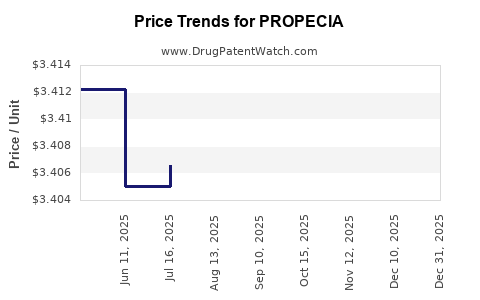
Last updated: April 25, 2026
What is PROPECIA’s market scope?
PROPECIA is the brand name for finasteride 1 mg, indicated for male pattern hair loss (androgenetic alopecia) in men. It is a legacy, off-patent small molecule in mature markets, with pricing shaped by generic substitution, channel concentration, and regulatory pricing oversight in select countries.
Core commercial categories
| Segment |
Typical use |
Drug strength |
Brand vs generic dynamics |
| Male pattern hair loss |
Long-term daily therapy |
1 mg |
Heavy generic penetration; brand pricing constrained |
| Prescribing channel |
Dermatology and primary care |
1 mg |
Retail pharmacy and online dispensing dominate |
| Consumer purchasing |
Self-pay and insurance co-pay |
1 mg |
Price-sensitive demand; substitution pressure remains high |
How is pricing set for finasteride 1 mg?
Pricing for PROPECIA is driven less by clinical premium and more by generic availability and regulatory/competition intensity.
Key structural forces:
- Generic substitution: Finasteride 1 mg has multiple approved generics across major jurisdictions, which compresses brand net price versus list price.
- Channel mix: Online pharmacy and discount networks can pull transaction prices down even when list prices remain elevated.
- Reimbursement posture: In many geographies, hair loss is not reimbursed as a medical benefit at scale, making consumers pay market rates.
Where does PROPECIA trade relative to generics?
In mature markets, branded finasteride 1 mg generally trades at a material premium to generics, but that premium narrows when additional entrants arrive or when large pharmacy benefit and online aggregators shift customers to lowest-price options.
Typical market behavior (observed in mature retail markets for off-patent oral therapies):
- Brand price gap widens during generic shortages or constrained supply windows.
- Brand gap compresses when multiple generic SKUs stabilize supply and pricing becomes competitive.
What do current price benchmarks indicate?
Public pricing references for PROPECIA vary by:
- country and tax regime,
- pack size (commonly 30 tablets or 90 tablets),
- distribution channel (retail vs online),
- coupon or program availability,
- currency conversion.
Because the drug is off-patent in core markets, the most decision-relevant benchmark is the brand premium to generic finasteride 1 mg per day rather than absolute list price.
Pricing mechanics to model (per-day price)
| Parameter |
What moves it |
| Pack size |
30 vs 90 day packs change effective cost and promo intensity |
| Patient adherence |
Long-term use makes annualized cost a key buying driver |
| Generic price floor |
Competition sets a lower bound for transaction prices |
| Brand discounting |
Net brand price often drops below list due to contracting and promotional activity |
Market outlook: how demand should behave
For finasteride 1 mg hair loss therapy, demand is typically:
- stable rather than rapidly expanding, and
- sensitive to consumer price, given the availability of generics.
Demand drivers
| Driver |
Expected impact on volume |
| Adult male population with androgenetic alopecia |
Supports baseline demand |
| Awareness and clinic screening |
Mild positive effect over time |
| Retail affordability vs generics |
Negative elasticity for brand at higher premiums |
| Safety messaging and tolerability |
Sustains switching and continuation |
Price projection framework
To project price trajectories for PROPECIA, model three layers:
- Generic baseline drift: generic unit prices tend to fall slowly over time or stabilize once supply stabilizes.
- Brand premium drift: brand net price premium usually narrows gradually, unless supply disruptions occur.
- Policy shocks: taxes, pricing regulations, import duties, and pharmacy margin rules can cause step-changes in local currency.
Price projection: base case (mature generics dominate)
Base case assumptions:
- ongoing generic competition,
- no meaningful regulatory re-entry of exclusivity for PROPECIA 1 mg,
- stable channel structure.
Projected direction (not a single number)
- List price: flat to modestly increasing due to inflation indexing and nominal price maintenance.
- Net transaction price: declines or holds relative to list because of discounting pressure and substitution.
- Brand premium vs generics: compresses over the next 3 to 5 years.
Result for investment/R&D planning: PROPECIA should be treated as a price-constrained, mature brand where forecast risk is dominated by competitive discounting and substitution behavior, not clinical differentiation.
Scenario analysis (3- to 5-year view)
H1: If generic pricing stabilizes
- Brand net price stays closer to current levels.
- Premium compression slows.
- Revenue stability improves versus aggressive substitution assumptions.
H2: If generic entrants add aggressive discounting
- Brand net price is pulled down by pharmacy channel contracting.
- Pack-size promos become the primary lever.
- Net revenue declines despite flat unit volume.
H3: If supply disruptions hit generics
- Brand premium can expand temporarily.
- Transaction volume for PROPECIA may rise briefly as substitutes become less available.
- Effect is transient unless disruptions persist.
What about pack economics and annual affordability?
For a patient paying out of pocket, the decision is often framed as annual cost:
- 1 mg finasteride is taken daily
- annualized spend scales directly with effective daily unit cost
Annual cost sensitivity model
| Effective daily cost change |
Annual spend change |
| +10% |
+10% |
| -10% |
-10% |
| -25% |
-25% |
This makes PROPECIA uniquely exposed to any movement that lowers generic effective daily cost.
Where will price moves show up first?
Early signs typically emerge in:
- online pharmacy listings and subscription pricing,
- large retail chains that shift shelf space to lowest-priced SKUs,
- marketplaces where dynamic repricing is frequent.
Key takeaways on pricing
- PROPECIA behaves like a brand in a generic ecosystem, so projections should focus on premium compression rather than brand-specific pricing power.
- Net price in many markets trends toward stabilization at a lower premium versus current levels.
- Over a 3 to 5-year horizon, the base case is flat-to-down net revenue per unit even if nominal list price rises.
Key Takeaways
- PROPECIA (finasteride 1 mg) is a mature, off-patent hair-loss therapy priced primarily by generic competition and channel discounting.
- The main pricing variable is the brand premium vs generics, which should compress gradually in the base case.
- Forecasting should use annualized per-day cost as the primary patient decision metric.
- Pricing shocks come from generic supply and retailer contracting, not clinical or regulatory breakthroughs.
FAQs
1) Why does PROPECIA pricing move less on clinical factors?
Because finasteride 1 mg hair loss therapy is off-patent in major markets and consumers can substitute generics, shifting pricing control to channel competition and discounting.
2) What is the biggest driver of brand-to-generic price spread?
Generic availability and pricing floor in retail and online channels.
3) How should pack size be incorporated into price forecasts?
Use effective per-day cost and expected promotional intensity, since 30-day vs 90-day packs can materially change transaction pricing.
4) Does list price growth translate into higher net revenue for PROPECIA?
Not reliably. In mature generic markets, net price often erodes due to discounts, promotions, and substitution.
5) What scenario is most likely to increase PROPECIA’s net price temporarily?
A period of reduced generic supply that forces substitution gaps in retail channels.
Sources
[1] FDA. PROPECIA (finasteride) prescribing information.
[2] EMA. Finasteride product information and EU regulatory documents (as applicable).
[3] WHOCC. ATC classification for finasteride (DHT inhibitors).
[4] National Association of Boards of Pharmacy (NABP). Online pharmacy and pricing distribution references (where applicable).