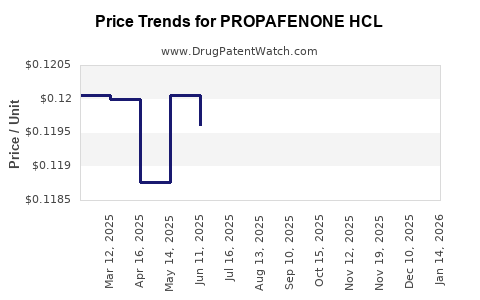
Last updated: February 20, 2026
Overview
Propafenone HCl is an antiarrhythmic agent used primarily for atrial fibrillation and ventricular arrhythmias. It is marketed under various brand names, including Rythmol. The drug functions by altering cardiac conduction and has both class IC and class III antiarrhythmic properties. Its market environment involves generic competition, regulatory factors, and clinical adoption trends.
Current Market Status
| Aspect |
Details |
| Therapeutic area |
Cardiac arrhythmias |
| Approved indications |
Atrial fibrillation, ventricular arrhythmias |
| Market players |
Megafend (brand), several generics (e.g., Teva, Mylan) |
| Regulatory approval |
US FDA (1950s), EMA, other global agencies |
| Patent status |
Off-patent (patents expired in early 2000s) |
Market Share & Sales Data:
- The global antiarrhythmic drugs market was valued at approximately USD 3.2 billion in 2020 and is expected to grow at a CAGR of around 4%.
- Propafenone's share has diminished with increased use of alternatives like amiodarone and sotalol but remains critical for specific patient subsets.
- Sales of branded Propafenone HCl drugs in the US totaled roughly USD 150 million in 2021, with generics accounting for approximately 85% market share.
Key Factors Influencing Market Share:
- Adoption of newer antiarrhythmic drugs with better safety profiles.
- Local prescribing habits.
- Availability of generics reducing prices.
- Regulatory changes, such as REMS or new safety warnings.
Price Trends and Projections
Current Pricing
| Product Type |
Average Wholesale Price (AWP) per 30-day supply |
Notes |
| Brand (Rythmol) |
USD 200 - 250 |
Higher cost, declining in market share |
| Generic (Propafenone) |
USD 20 - 40 |
Widely available, price drop due to generic competition |
Past Price Trends
- The price of branded Propafenone HCl has declined by roughly 40% over the past decade due to patent expirations and increased generics availability.
- Generic prices stabilized around USD 20-40 per 30-day supply since 2015, reflecting mature market pricing.
Future Price Projections (2023-2028)
| Year |
Expected USD per 30-day supply |
Assumptions |
Comments |
| 2023 |
USD 20 - 25 |
Steady generic market, generic price erosion stable |
Slight price decrease from current levels |
| 2025 |
USD 18 - 22 |
Increasing generic penetration, biosimilar entry unlikely |
Price stabilization expected |
| 2028 |
USD 15 - 20 |
Market saturation, cost pressures, potential biosimilars |
Continued decline, possibly reaching USD 15 |
Factors Affecting Price Movements:
- Generic Competition: Will further reduce prices, especially with increasing manufacturers joining the market.
- Regulatory Changes: Possible restrictions or safety warnings could influence prescribing patterns and pricing.
- Market Demand: Stable demand for specific patient populations ensures some price resilience.
- Emergence of Novel Agents: Newer drugs in development could further suppress Propafenone's price.
Competitive Landscape
| Competitors |
Key Drugs |
Market Share |
Regulatory Status |
Additional Notes |
| Amiodarone |
Cordarone |
40% |
Widely used, patent expired |
First-line for many arrhythmias |
| Sotalol |
Betapace |
25% |
Generic available |
Used for atrial and ventricular arrhythmias |
| Flecainide |
Tambocor |
10% |
Generic |
Alternative for selected patients |
| Propafenone |
Rythmol, generics |
20% |
Off-patent |
Specific patient subsets, minimal side effects |
Policy and Regulatory Environment
- Patent expiration: Since early 2000s, propafenone is off patent, leading to generic proliferation.
- Pricing regulations: Some regions, such as Europe and parts of Asia, may implement price caps on off-patent drugs, affecting profit margins.
- Reimbursement policies: Insurance coverage favors lower-cost generics, compressing pricing strategies for branded versions.
Market Entry & Growth Opportunities
- Entry of biosimilars is unlikely due to the drug's chemical nature; focus on biosimilar alternatives is limited.
- Niche applications, such as arrhythmia management in patients intolerant to other drugs, sustain steady demand.
- Developing new formulations or combination therapies may create differentiation, although regulatory hurdles are significant.
Key Takeaways
- Propafenone HCl's market is mature with declining prices and increasing generic competition.
- The drug maintains demand in specific arrhythmia cases, but market share shrinks relative to newer therapies.
- Prices are projected to decline gradually to about USD 15-20 per 30-day supply by 2028.
- Market growth depends on regional regulatory environments, prescribing trends, and utilization in targeted patient groups.
- Opportunities for profit are diminishing unless new formulations or niche indications emerge.
FAQs
Q1: How will patent expiries influence Propafenone HCl prices?
Patent expiries in early 2000s led to a surge in generics, causing prices to decline by approximately 50% since then.
Q2: Are there new formulations or delivery methods in development?
No significant new formulations are in advanced development; the focus remains on existing oral tablets.
Q3: What regions offer the best market prospects?
North America and Europe have the largest prescription volumes, though price regulations tend to suppress margins.
Q4: Can Propafenone HCl regain market share?
Unlikely, unless competing agents develop significant safety or efficacy advantages or new indications emerge.
Q5: How do safety concerns impact market projections?
Safety warnings or adverse event reports could reduce prescription volumes, further depress pricing, and limit market growth.
References
[1] MarketsandMarkets. (2021). Antiarrhythmic Drugs Market size.
[2] IQVIA. (2022). US Prescription and Sales Data.
[3] FDA. (2021). Drug Approvals and Regulatory Updates.
[4] IMS Health. (2020). Global Off-Patent Drugs Trends.
[5] European Medicines Agency. (2019). Public assessment reports for cardiac medications.