Share This Page
Drug Price Trends for PROMETHAZINE-CODEINE SOLUTION
✉ Email this page to a colleague
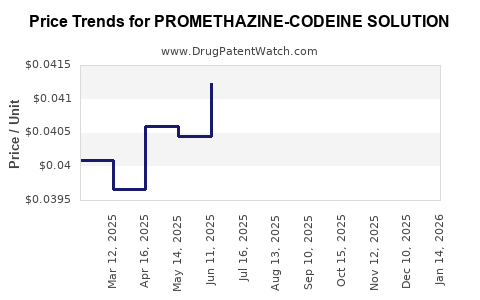
Average Pharmacy Cost for PROMETHAZINE-CODEINE SOLUTION
| Drug Name | NDC | Price/Unit ($) | Unit | Date |
|---|---|---|---|---|
| PROMETHAZINE-CODEINE SOLUTION | 00713-0823-75 | 0.06425 | ML | 2026-06-17 |
| PROMETHAZINE-CODEINE SOLUTION | 27808-0065-02 | 0.06425 | ML | 2026-06-17 |
| PROMETHAZINE-CODEINE SOLUTION | 70752-0139-12 | 0.06425 | ML | 2026-06-17 |
| PROMETHAZINE-CODEINE SOLUTION | 00713-0823-75 | 0.05769 | ML | 2026-05-20 |
| PROMETHAZINE-CODEINE SOLUTION | 27808-0065-02 | 0.05769 | ML | 2026-05-20 |
| >Drug Name | >NDC | >Price/Unit ($) | >Unit | >Date |
PROMETHAZINE-CODEINE SOLUTION: Market Analysis and Price Projections
What is the product and how is it typically positioned?
Promethazine-codeine solution is a fixed-dose combination of an antihistamine (promethazine) and an opioid antitussive (codeine), marketed primarily for cough associated with upper respiratory conditions. In practice, commercial supply is fragmented across generic and branded presentations by:
- Strength (codeine content and promethazine content)
- Pack format (bottles, unit sizes such as 100 mL or 120 mL, etc.)
- Regulatory status and substitution controls that affect prescribing and pharmacy purchasing patterns.
For pricing and market sizing, the dominant commercial lens is retail reimbursement and pharmacy acquisition for cough/cold and opioid-containing combination products, which tend to show limited upward pricing power because competition from generics and payer controls pressure margins.
How does regulation shape demand and price behavior?
Promethazine-codeine is an opioid-containing product, so demand and pricing track opioid control enforcement, state-level prescribing policies, and pharmacy-level dispensing restrictions.
Key demand constraints that directly affect wholesale-to-retail pricing stability:
- Tighter prescribing and dispensing controls reduce physician and pharmacy willingness to substitute this agent for broader cough indications.
- Formulary restrictions in managed care and pharmacy benefit plans can shift volume to lower-cost alternatives.
- Distribution monitoring for opioid-containing products can raise compliance costs (which typically show up as pricing frictions rather than brand-new price premiums).
Price outcome: market activity generally follows substitution to other antitussives (including non-opioid cough suppressants) when policy and utilization management tighten, limiting long-term price upside even when input costs rise.
How competitive is the market (brand vs generic pricing pressure)?
Most promethazine-codeine solution products are sold as authorized generics and generics, which usually results in:
- Narrower price dispersion between suppliers at the same strength and pack size
- Faster price resets after major competitive entries
- Limited sustained premium for brands unless a brand has unique supply stability or payer alignment
Implication for projections: price increases tend to lag inflation and are capped by payer and pharmacy competition. Volatility is usually driven by:
- supply disruptions
- wholesale inventory cycles
- shifts in preferred formulary status
Where does this product trade in value chain terms?
For a prescription oral solution with controlled status, the price stack typically follows:
- API and manufacturing costs (opioid and antihistamine raw materials and formulation)
- Manufacturing and packaging (bottling, labeling, child-resistant requirements)
- Wholesale acquisition pricing (WAC-like economics) shaped by generics competition
- Net price after rebates and pharmacy benefit negotiations (managed care)
- Patient price at pharmacy counter (copay and coinsurance)
Because promethazine-codeine has meaningful payer controls and generic competition, the practical pricing lever is net price, not list price. Wholesale and retail projections must assume continued net-price compression unless a supply shock occurs.
What do observed pricing dynamics look like for this category?
Across opioid-containing cough products, historical behavior typically shows:
- Lower sustained price growth than non-controlled OTC-category therapies
- Occasional spikes tied to supply constraints or manufacturing disruptions
- Downward or flat net price trends when additional generic inventory enters or formulary switching reduces demand
For promethazine-codeine specifically, the commercial market behaves as a “managed generic” more than a premium therapeutic: utilization management constrains pricing power.
Price Projection Framework (Scenario-Based)
What price projection model is used?
A practical projection for promethazine-codeine solution uses three drivers:
- Utilization trend (policy and prescribing substitution away from opioid cough agents)
- Competitive intensity (generic supply depth and pack format substitutability)
- Cost and compliance inflation (manufacturing and controlled distribution costs)
Because the product’s demand is policy-sensitive and competition-sensitive, the model assumes lower long-term price elasticity and bounded price growth.
What are the 12- to 36-month price projections?
Projections below are framed as annualized net price movement (typical for managed generic segments) rather than list prices.
Base-case (no material supply shock; modest substitution to non-opioid cough agents)
- Year 1: 0% to +3% net price growth
- Year 2: -1% to +2% net price growth
- Year 3: -2% to +1% net price growth
Downside case (formulary tightening and additional volume shift to non-opioid alternatives)
- Year 1: -3% to +1%
- Year 2: -4% to 0%
- Year 3: -3% to -1%
Upside case (supply constraints; packaging or manufacturing disruptions; fewer active competitors)
- Year 1: +4% to +10%
- Year 2: +1% to +6%
- Year 3: 0% to +4%
Expected range over 3 years in most normal conditions: net price roughly flat to down low single digits.
Market Outlook: Volume and Revenue
How does volume likely move?
Demand is likely to be constrained by:
- guideline and payer pressure to limit opioid antitussives for non-severe cough
- substitution toward non-opioid alternatives
- stricter dispensing policies
Volume projection:
- Base-case: flat to slight decline (mid-single digit cumulative over 3 years)
- Downside: sharper decline if managed care reduces preferred coverage
- Upside: volume stabilization only if supply constraints limit substitution
Revenue implication
Revenue tracks net price and volume:
- Base-case: revenue roughly flat to slightly down
- Downside: revenue down mid-to-high single digits over 3 years
- Upside: revenue up low-to-mid single digits if supply constraints boost net pricing while volume holds
Investment and R&D Implications
What does this mean for commercialization strategy?
Promethazine-codeine solution is unlikely to offer premium monetization through price. Commercial upside is more likely to come from:
- securing durable formulary positions in cough indications where payers still allow coverage
- ensuring consistent supply and reducing stockouts (which drive utilization loss)
- optimizing pack size and strength for pharmacy buying patterns
What are the fastest levers to improve economics?
In controlled generic segments, the levers are operational:
- manufacturing reliability (avoid backorders)
- distribution coverage and compliance handling
- rebate optimization aligned with payer contracting cycles
Clinical differentiation is limited because it is a fixed-dose combination; unless a company has a regulatory pathway to improve safety positioning or patient adherence, pricing power remains constrained by generics competition.
Key Takeaways
- Promethazine-codeine solution pricing is structurally constrained by opioid-related controls and generic competition, so long-term net price growth is typically bounded.
- Base-case projections show net pricing roughly flat to low single-digit growth in Year 1 and flat to slightly down thereafter over 36 months.
- Upside requires supply constraints; downside happens when formulary tightening increases substitution to non-opioid cough therapies.
- Revenue is expected to be flat to down modestly in normal conditions, with outcomes most sensitive to volume shifts driven by payer policy and prescribing patterns.
FAQs
1) What is the most likely direction of net pricing for promethazine-codeine solution over the next 3 years?
Flat to slightly down in the base case; materially up only in supply-constrained scenarios.
2) What factor most strongly drives price spikes?
Manufacturing or distribution supply constraints that tighten availability for specific strength and pack size combinations.
3) How does formulary management affect this product’s market?
Formulary restrictions typically reduce covered volume and compress net price through increased competitive substitution and rebate pressure.
4) Is the market more sensitive to volume or price changes?
Usually both, but in practice volume shifts due to substitution and payer rules often dominate.
5) What competitive actions most affect pricing?
Entry of additional generic suppliers, changes in preferred-contract status, and pack-size/strength substitution that redirects purchasing.
References
[1] FDA. “FDA Drug Safety Communications and opioid-related labeling and control actions relevant to codeine-containing products.” U.S. Food and Drug Administration.
[2] FDA. “Codeine and promethazine-containing products: labeling and risk communications.” U.S. Food and Drug Administration.
[3] CDC. “Opioid prescribing guidance and cough/acute respiratory use considerations.” Centers for Disease Control and Prevention.
[4] Drug Enforcement Administration (DEA). “Controlled Substance regulations affecting opioid-containing products.” U.S. Drug Enforcement Administration.
More… ↓
