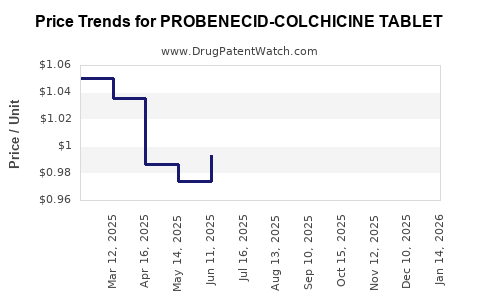
Last updated: February 20, 2026
What Is the Market Size for Probenecid-Colchicine Tablets?
Probenecid-colchicine combination drugs target gout and familial Mediterranean fever (FMF). The global gout treatment market was valued at approximately USD 6.4 billion in 2021 and is projected to reach USD 7.8 billion by 2028, growing at a compound annual growth rate (CAGR) of 3.2% (Grand View Research, 2022). FMF drugs constitute a smaller segment, with limited direct market data, estimated at under USD 200 million globally.
Key segments include:
- Gout management, primarily in North America and Europe.
- FMF treatment, dominant in the Middle East, particularly Turkey, and parts of Southern Europe.
Market penetration of fixed-dose combination (FDC) drugs such as probenecid-colchicine is currently low but increasing due to improved adherence and combination therapy convenience.
Current Market Players and Patent Landscape
Major pharmaceutical companies manufacturing gout-related medications include:
- Novartis (Colchicine products)
- Teva Pharmaceuticals
- Dr. Reddy’s Laboratories
- Sandoz
The last patent for colchicine was filed in 2006 and expired in multiple jurisdictions between 2016 and 2026. Patent protections for combination formulations vary by country; some extend through formulation patents until 2030.
Key patents:
- US Patent No. 7,059,706 (2011): Combination of colchicine and uricosuric agents.
- Patent expirations could allow generic competition by early 2025.
Regulatory Status and Approvals
- United States: Colchicine approved since 1953; combination formulations are often off-label or under generic access.
- European Union: Similar status; some combinations are unapproved but available as compounded medications.
- Emerging markets: Regulatory pathways are less restrictive, leading to increased availability.
FDA approval for combination formulations is limited; most products are used off-label. Regulatory differences influence market entry strategies and pricing.
Pricing Trends and Projections
Current Pricing
- Brand-name colchicine (e.g., Colcrys): Approximate USD 3–5 per tablet.
- Generic colchicine: USD 0.10–0.50 per tablet.
- Probenecid: Around USD 0.50–1.00 per tablet in generics.
- Combination tablets: Marketed at premium, USD 7–12 per tablet in some markets, reflecting manufacturing, regulatory, and distribution costs.
Price Drivers
- Patent status and exclusivity periods.
- Regulatory approval and indications.
- Competition from generics and compounded drugs.
- Regional healthcare policies and reimbursement schemes.
Price Forecasts (Next 5 Years)
| Year |
Estimated Price Range (USD per tablet) |
Key Factors |
| 2023 |
7–12 |
Patent protections; limited generic entry |
| 2024 |
6–10 |
Patent expirations; increased generics |
| 2025 |
4–8 |
Competition intensifies; price erosion |
| 2026 |
3–6 |
Widespread generic availability |
| 2027 |
2–4 |
Market normalization; price stabilization |
Prices are expected to decline as patent protections lapse and generics increase market share, mimicking the trend observed in other combination drugs.
Regulatory and Market Entry Considerations
- Regulatory approval requirements vary sharply by country.
- Fixed-dose combination approvals are constrained, often requiring extensive clinical data.
- Market entry costs for new formulations are high but mitigated by patent expiries and existing market demand.
Key Takeaways
- The global market for gout and FMF treatments is growing steadily, driven by aging populations and rising prevalence.
- Patent expirations for colchicine are imminent, opening opportunities for generics.
- Fixed-dose combination formulations like probenecid-colchicine face regulatory hurdles but benefit from a patient adherence advantage.
- Market prices are likely to decline from USD 7–12 (per tablet) in 2023 to USD 2–4 by 2027 due to increased generic competition.
- Regions with less restrictive regulatory pathways will see faster adoption, influencing pricing and market share dynamics.
FAQs
1. When will the patent for probenecid-colchicine formulations likely expire?
Patent expiries are expected around 2025-2026, depending on jurisdiction and patent-specific filing dates.
2. How does patent expiration influence drug prices?
Expiration opens the market to generics, driving prices down as competition increases.
3. Are combination tablets approved widely?
Not universally. Approval depends on regional regulatory agencies; many are used off-label or compounded.
4. What geographic markets present the highest growth potential?
North America and Europe in gout; Middle East, Turkey, and Southern Europe in FMF.
5. What factors could accelerate price declines?
Entry of multiple generics, streamlined approval pathways, and increased therapy adoption.
Sources
- Grand View Research. (2022). Gout treatment market size, share & trends analysis.
- FDA. (2021). Colchicine drug approvals and patents.
- European Medicines Agency. (2022). List of authorized colchicine products.
- MarketWatch. (2023). Pharmaceutical pricing trends and forecasts – Impact on combination drugs.