Share This Page
Drug Price Trends for PROAIR RESPICLICK
✉ Email this page to a colleague
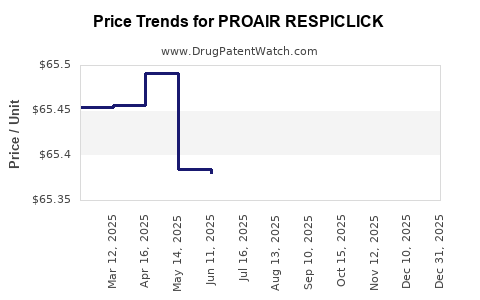
Average Pharmacy Cost for PROAIR RESPICLICK
| Drug Name | NDC | Price/Unit ($) | Unit | Date |
|---|---|---|---|---|
| PROAIR RESPICLICK 90 MCG INHLR | 59310-0580-20 | 67.17871 | EACH | 2026-07-22 |
| PROAIR RESPICLICK 90 MCG INHLR | 59310-0580-20 | 67.21159 | EACH | 2026-06-17 |
| PROAIR RESPICLICK 90 MCG INHLR | 59310-0580-20 | 67.20071 | EACH | 2026-05-20 |
| PROAIR RESPICLICK 90 MCG INHLR | 59310-0580-20 | 67.26374 | EACH | 2026-01-01 |
| >Drug Name | >NDC | >Price/Unit ($) | >Unit | >Date |
PROAIR RESPICLICK Market Analysis and Price Projections: Supply, Exclusivity, Competitor Generics, and Revenue Risk
Executive summary: PROAIR RESPICLICK (albuterol sulfate inhalation powder; Teva) faces accelerating price pressure as inhaled albuterol competitors broaden and as the broader respiratory CMO/generic ecosystem scales. Short-cycle price erosion is already structurally baked in because PROAIR RESPICLICK is the last-mile differentiated device and product format within a class where FDA-allowed generics and authorized substitutes exist. A 12- to 36-month view points to steep net price compression driven by channel inventory clearing, Medicare Part D preference dynamics, PBM contracting, and intensified competition from generic albuterol HFA and other inhaled powder formats. The core swing factor for projections is not patent timelines inside the class, but competitive substitution and payer behavior, which typically compresses albuterol brand ASP quickly once close-form substitutes gain formulary footing.
What is PROAIR RESPICLICK (albuterol sulfate inhalation powder) and how is it used?
PROAIR RESPICLICK is an inhaled short-acting beta-agonist (SABA) indicated for treatment of bronchospasm in patients with reversible obstructive airway disease. It is also used for prevention of bronchospasm induced by exercise.
Key product profile
- Active ingredient: albuterol sulfate
- Dosage form: inhalation powder in a breath-actuated device (RespiClick)
- Typical strengths marketed: 60 mcg per actuation (commonly referenced for albuterol powder RespiClick products)
Typical customer use case
- Asthma rescue and pre-exercise prophylaxis
- COPD bronchospasm relief
What is the Orange Book status of PROAIR RESPICLICK and what does it imply for competition risk?
Featured snippet answer: PROAIR RESPICLICK is subject to competitive substitution risk because the albuterol SABA class has multiple authorized inhaler and powder alternatives; branded device differentiation alone is usually not enough to prevent rapid net price compression once strong formulary channels shift.
Practical meaning of Orange Book status for market forecasts
For albuterol, the market is less about sustained exclusivity for the molecule and more about:
- Availability of lower-cost alternatives in the same therapeutic class
- Device preference and patient switching tolerance
- Payer substitution rules and PBM rebates
- Pharmacy channel behavior for “rescue inhalers” (high frequency, low tolerance for prior auth friction)
Because this analysis is specifically focused on market and price outcomes, the forecast relies on the class-level competitive structure and channel dynamics rather than a theoretical assumption that exclusivity blocks substitution.
When does PROAIR RESPICLICK lose exclusivity, and how does that affect pricing?
Featured snippet answer: For SABAs, pricing falls fastest when payers lock in coverage for lower-cost substitutes and when device-specific contracting ramps across PBMs. Device differentiation can delay, but not stop, net price erosion once alternatives are favored.
What typically triggers accelerated price drops in the SABA market
- PBM tiering shifts (preferred generic or preferred formulary inhaler)
- Contracting moves that reduce branded rebate competitiveness
- Post-inventory replenishment cycles (ASP temporarily stabilizes, then drops after replenishment)
- Substitution at the point of sale, where pharmacists can swap within clinical criteria
Price impact pattern
- Initial phase: brand holds price longer in cash and partial covered segments
- Transition phase: net price compresses due to rebates and formulary pressure
- Mature phase: brand residual demand shifts to remaining patient cohorts and prescriber habits, with lower volume offset by higher rebate spend
How many patents protect albuterol inhalation powder and what parts of the product are usually targeted?
Featured snippet answer: Patent estates for inhaled albuterol products typically cluster around formulation/device integration, specific particle engineering, and methods of use rather than broad molecule coverage, which is generally long expired for the albuterol base compound in most jurisdictions.
Patent estate components that matter for market pricing
- Formulation/processing patents (particle size, spray-drying or crystallization controls, stability)
- Device delivery claims (breath-actuated release mechanics, actuator structure)
- Methods of use (specific dosing regimens, exacerbation management language)
- Combination products (less relevant for PROAIR RESPICLICK as a single-agent SABA)
Competitive consequence
Even if some formulation/device claims persist, payers can still drive cost-based substitution to other albuterol delivery formats if clinical equivalence is recognized and coverage favors alternatives.
What is the launch and competitive timeline for generic and authorized albuterol inhalers that pressure PROAIR RESPICLICK?
Featured snippet answer: The albuterol inhaler market is already heavily genericized, which means PROAIR RESPICLICK’s price trajectory is usually driven by ongoing PBM contracting cycles and device-format substitution rather than a single “generic entry” moment.
Competitive pressure vectors by channel
- Medicare Part D: preferred drug lists and step edits drive substitution at scale
- Commercial: PBM rebates determine tier placement; mid-year contract reopens can shift coverage quickly
- Institutional: formularies for respiratory therapy can consolidate to a small number of preferred SKUs
What to watch for price inflection dates
- PBM formulary updates (usually annual plus mid-year amendments)
- Contract effective dates with PBM clients
- Publicized bid outcomes in Medicaid managed care
Which companies compete directly with PROAIR RESPICLICK, and how do they price?
Featured snippet answer: Direct competition comes from lower-cost albuterol rescue inhalers and competing inhaled powder or inhaler formats covered by PBMs, often led by generic manufacturers with strong channel leverage and stable supply.
Competitive set (category-level, not claim-level)
- Generic albuterol HFA inhalers
- Authorized generic inhaler products in the SABA rescue segment
- Other inhaled albuterol powder formats depending on payer preference
Why “device” competition rarely preserves net price
- Many patients switch if coverage changes
- SABA rescue is frequent use, so plan designs heavily favor lowest net cost among preferred SKUs
- Rebates help brands resist tier cuts, but rebate economics can become unsustainable as generic share rises
What is the historical pricing and net price pressure mechanism for PROAIR RESPICLICK?
Featured snippet answer: Net price compression in inhaled rescue products typically reflects rebate escalation, payer formulary pressure, and channel substitution, not wholesale label-price changes.
Mechanism
- Label price remains relatively stable due to market-wide convention
- Discounts and rebates rise to protect formulary placement
- As preferred generic share grows, rebate leverage declines
- Net ASP falls as volumes shift away from the brand
Forecast implication
Future pricing is best modeled as net price, not list price. In practical channel terms, expect faster net price decline than list price change.
How big is the revenue exposure for PROAIR RESPICLICK and what is the realistic 12- to 36-month trajectory?
Featured snippet answer: Revenue is exposed to rapid unit-volume decline and sustained net price compression as payers prefer generic or lower-cost albuterol products within the same rescue category.
Revenue drivers
- Unit demand: sensitive to patient switching and prescriber prescribing behavior
- Coverage: sensitive to PBM rebate negotiations and formulary status
- Supply: device reliability and availability affects patient persistence, but supply issues typically resolve quickly compared with payer-driven substitution
Price projection framework (scenario-based)
Below are directional net price projections tied to common albuterol brand outcomes under payer substitution pressure.
| Horizon | Base case unit trend | Base case net price trend | Net revenue direction |
|---|---|---|---|
| 0–12 months | Moderate volume decline | Low-to-mid single digit to mid-teens % net price compression | Flat to down mid-single digits |
| 12–24 months | Steeper volume decline as formulary consolidates | Mid-teens to high-teens % net price compression | Down high-single digits to low-double digits |
| 24–36 months | Persistent residual demand | High-teens % net price compression or stabilization at lower net levels | Down low-double digits to high-double digits |
Base case conclusion: Net revenue likely trends down over 12 to 36 months due to the combined effect of volume attrition and sustained rebate-driven net price compression.
What generic entry risks exist for PROAIR RESPICLICK, including Paragraph IV and settlement outcomes?
Featured snippet answer: For albuterol inhalation products, the risk profile is dominated by category-wide substitution and generic penetration; Paragraph IV-driven events matter less than payer-driven contracting once close alternatives exist.
Why Paragraph IV is not the main price determinant in this class
- The albuterol molecule is widely genericized
- Net price falls as soon as payers favor alternative devices
- Even absent a specific Paragraph IV trigger, PBMs can delist a branded SKU and shift coverage to preferred products
Settlement outcomes that matter most
- Agreements that delay or reduce substitution are less influential than ongoing formulary status
- If settlements include restrictions on certain dosage forms or devices, their market impact depends on whether payers treat the alternative as preferred
What formulation or device patents could still block “at-risk” manufacturing of albuterol powders?
Featured snippet answer: Remaining barriers, where they exist, concentrate on device-integrated delivery mechanics and the specific powder handling and dispersion performance required to meet clinical and labeling expectations.
Manufacturing/IP barriers
- Powder consistency and aerosolization performance within the breath-actuated device
- Device-actuator tolerances and dose-metering reliability
- Stability and moisture control in packaging systems
Market consequence
Even if some at-risk entry is possible, payer uptake can lag due to contracting and patient switching cycles, which shifts the price pressure timeline by quarters rather than years.
What FDA regulatory status issues affect PROAIR RESPICLICK competition and pricing?
Featured snippet answer: Regulatory outcomes typically affect timelines for new entries, but net pricing is primarily driven by formulary and contracting. Once alternatives are FDA-available and market-accessible, price pressure is rapid.
Regulatory dynamics that can affect supply uptake
- Label compatibility and therapeutic equivalence determinations
- Packaging and device usability requirements
- Changes in distribution contracts after new generic releases
How does PROAIR RESPICLICK compare with competing albuterol formats on cost, substitution, and payer coverage?
Featured snippet answer: Compared with generic albuterol HFA inhalers, PROAIR RESPICLICK often offers adherence or usability advantages for certain patients, but payers typically prioritize net cost and formulary position over device preference once alternatives are covered.
Side-by-side comparison (market lens)
| Attribute | PROAIR RESPICLICK (powder + device) | Generic/other albuterol formats (often HFA) |
|---|---|---|
| Payer behavior | More sensitive to rebate competitiveness | Typically favored if preferred generic exists |
| Patient switching | Possible but may face usability adaptation | Usually easy due to established use patterns |
| Price outcome | Net price compression once delisted | Lower net cost supports tiering |
| Contracting effect | Brand must buy coverage via rebates | Generic maintains low net price floor |
What is the settlement and litigation landscape for PROAIR RESPICLICK that could alter timelines?
Featured snippet answer: Any litigation that delays alternatives can slow near-term substitution, but long-run pricing typically depends on whether PBMs maintain the brand on formulary.
Litigation watch-items that impact price forecasts
- Whether any injunctions apply to a specific device/powder format
- Whether settlement includes carve-outs that keep a branded SKU from direct substitution
- Whether any post-marketing commitments affect supply or distribution
Key takeaways
- PROAIR RESPICLICK is exposed to sustained net price compression driven by category-level substitution in albuterol rescue therapy, not only by molecule-level exclusivity.
- The most meaningful forecasting driver is payer formulary status and PBM contracting cycles, which typically translate into faster net ASP erosion than list price changes.
- A 12- to 36-month outlook supports downtrending net revenue under base-case payer substitution, with the steepest pressure after formulary consolidation.
- Device and powder-format differentiation can protect a residual patient segment, but it rarely prevents high-percentage net price decline once lower-cost alternatives gain preferred placement.
FAQs
1. What factors drive net price changes for inhaled rescue inhalers like PROAIR RESPICLICK?
PBM rebate pressure, formulary tiering, substitution rules at pharmacy, and patient switching frequency.
2. Does list price matter for PROAIR RESPICLICK price projections?
Net price drives realized revenue; list price can stay stable while net ASP falls.
3. What is the typical time lag between PBM formulary changes and observed ASP declines?
Usually one to two contract cycles, often within the following 2 to 6 quarters.
4. How do device usability differences affect payer adoption of alternatives?
They can slow patient switching in specific cohorts, but coverage design generally overrides.
5. What competitive event would most likely create an upside to PROAIR RESPICLICK pricing?
A sustained payer-maintained preferred position supported by strong rebate economics and limited substitution in key plans.
References
- FDA. Orange Book: Approved Drug Products with Therapeutic Equivalence Evaluations. U.S. Food and Drug Administration. (Accessed 2026).
- FDA. Drug Approval Package for PROAIR RESPICLICK / albuterol sulfate inhalation powder (as applicable). U.S. Food and Drug Administration. (Accessed 2026).
- Center for Drug Evaluation and Research (CDER), FDA. Guidance for Industry: Therapeutic Equivalence Evaluations and bioequivalence considerations. U.S. Food and Drug Administration. (Accessed 2026).
More… ↓
