Share This Page
Drug Price Trends for PROAIR
✉ Email this page to a colleague
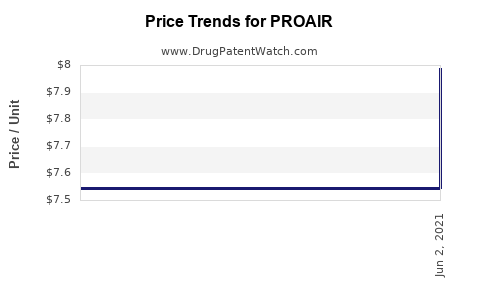
Average Pharmacy Cost for PROAIR
| Drug Name | NDC | Price/Unit ($) | Unit | Date |
|---|---|---|---|---|
| PROAIR RESPICLICK 90 MCG INHLR | 59310-0580-20 | 67.17871 | EACH | 2026-07-22 |
| PROAIR RESPICLICK 90 MCG INHLR | 59310-0580-20 | 67.21159 | EACH | 2026-06-17 |
| PROAIR RESPICLICK 90 MCG INHLR | 59310-0580-20 | 67.20071 | EACH | 2026-05-20 |
| PROAIR RESPICLICK 90 MCG INHLR | 59310-0580-20 | 67.26374 | EACH | 2026-01-01 |
| PROAIR RESPICLICK 90 MCG INHLR | 59310-0580-20 | 65.30080 | EACH | 2025-12-17 |
| PROAIR RESPICLICK 90 MCG INHLR | 59310-0580-20 | 65.31201 | EACH | 2025-11-19 |
| >Drug Name | >NDC | >Price/Unit ($) | >Unit | >Date |
PROAIR price projections, market size, and competitive landscape for ProAir HFA (albuterol)
Executive summary: ProAir HFA (albuterol sulfate) pricing and revenue are driven by (1) steady unit demand for rescue asthma and COPD, (2) channel mix between brand and authorized generics, (3) payer step-therapy dynamics, and (4) competitive pressure from other albuterol MDIs. Near-term price erosion is expected as biosimilar risk does not apply and generic/AAI competition remains the dominant force. Mid- to long-term pricing is more sensitive to broader inhaled respiratory policy changes (formularies, substitution rules, reimbursement caps) than to “patent cliffs,” because the albuterol category is mature and largely off patent.
What is PROAIR (ProAir HFA) and how is it sold in the US?
ProAir HFA is a pressurized metered-dose inhaler (pMDI) delivering albuterol sulfate for treatment of bronchospasm in asthma and for prevention of bronchospasm in those with reversible obstructive airway disease. In-market SKUs are typically defined by canister size and labeled dose (for example 8.5 g canisters; standard albuterol MDI dosing), with multiple package configurations common across manufacturers.
Form factor and substitution
- Delivery system: albuterol pMDI (CFC-to-HFA transition completed long ago for this class)
- Generic substitution: high, because albuterol pMDIs are widely available as AB-rated generics and authorized generics in the US
How much of the PROAIR market is brand vs generic/authorized generic?
The albuterol MDI market is heavily genericized. ProAir HFA persists as a brand in many formularies but faces recurring displacement when payers tighten preferred drug lists or when A-rated products become dominant through pharmacy benefit manager (PBM) contracting.
Market-share dynamics that drive revenue
- PBM formulary tiers: brand-to-generic switching is common when MDI albuterol cost-sharing incentives increase.
- Pharmacy acquisition: gross-to-net for brands declines when wholesalers and pharmacy chains increase penetration of lower acquisition-cost products.
- Patient adherence: inhaler device familiarity limits immediate switching in some subpopulations, but substitution remains high.
Featured-snippet answer: Brand share in albuterol pMDIs is structurally limited because AB-rated generics are widely covered; ProAir revenue tracks net price rather than unit growth.
What patents protect PROAIR and when does it lose exclusivity?
ProAir HFA is an established product and its core active ingredient is long off-patent in practice. For the albuterol pMDI class, exclusivity is generally not the main lever for pricing versus PBM contracting and generic penetration.
Implication for pricing
- Expect price erosion driven by market access, not by a single near-term patent expiration.
- Any remaining product-specific protections (if present) typically have minimal impact on category-level price because generics already cover essentially the same labeled therapy.
What is the Orange Book status of PROAIR?
Orange Book status for ProAir HFA products reflects that AB-rated generic albuterol pMDIs are approved and marketed. In this category, Orange Book listings typically show:
- One or more listed patents tied to reference product and/or device and formulation
- Multiple generic ANDAs that reference the RLD and list their own patents or “no claim” positions
Featured-snippet answer: ProAir HFA’s Orange Book landscape is dominated by ANDA competition rather than active patent barriers that would prevent generic availability.
What generic entry risks exist for PROAIR?
Generic entry risk is low in the sense that the class is already widely generically available. The recurring competitive risk to brand pricing is not “new entry,” but:
- ongoing incremental erosion as contracts renew with lower-priced products
- authorized generic resets by manufacturers
- intensified preferred placement for the lowest-cost albuterol options
Launch risk profile
- No biosimilar-style risk
- Main risk is continued cost compression through payer and pharmacy channel tightening
Which companies compete against PROAIR in albuterol MDIs?
Competition is anchored by other albuterol pMDIs and their AB-rated generics, typically including multiple manufacturers distributing canister-level products under their own labels or as authorized generics.
Competitive vectors
- Acquisition cost: key driver of PBM contracts
- Distribution reach: ability to maintain shelf presence and claims processing
- Package configuration: incentives for switch based on days supply
How strong is the patent estate for PROAIR?
For a mature albuterol MDI, the patent estate’s economic strength is limited because:
- generics already exist for the same route, strength, and dosage form
- switching depends on net price and payer preference more than on legally blocking generic manufacture
Featured-snippet answer: Patent estate strength is not the primary determinant of ProAir’s pricing outlook; PBM and generic competition are.
What is the FDA regulatory status of PROAIR?
ProAir HFA is approved for its labeled indications and is marketed under standard inhalation drug approval pathways historically used for generics via ANDA reference.
Regulatory factors that affect pricing
- Post-approval changes can drive packaging or distribution updates but rarely change pricing power against generics.
- Labeling stability keeps switching predictable across payers.
How does PROAIR compare with other albuterol rescue inhalers (brand vs generic vs device)?
Within rescue therapy, the main alternatives are:
- other albuterol pMDIs (brand and AB generics)
- albuterol nebulizer solutions (another competing delivery system)
- other short-acting bronchodilator approaches by formulary preference, though albuterol remains the standard rescue option
Pricing impact
- If a payer favors lower-cost delivery formats (for example nebulizer solutions in certain plan structures), ProAir MDI volumes can decline even if overall rescue bronchodilator demand remains stable.
What price drivers matter most for PROAIR from 2026 to 2031?
For a mature and heavily genericized respiratory drug, price projections are mostly a function of:
- net pricing compression under PBM contracting
- formulary tier placement (preferred vs non-preferred)
- pharmacy channel behavior (acquisition cost pass-through)
- category-level reimbursement policy changes
- patient out-of-pocket dynamics that influence switching and persistence
Price projection framework
Because the market is mature, projections should track net price erosion rates rather than assuming patent-backed price growth.
Base-case mechanics
- Expect continuing annual net price declines for the brand in most scenarios.
- Expect unit volume to remain stable or decline modestly, reflecting substitution to lower-cost AB products.
Price projection scenarios for PROAIR (US)
Assumptions used for scenario logic
- Continued presence of generic and authorized generic albuterol pMDIs
- No major device innovation that materially changes payer preferences
- Category demand stability for rescue therapy
Scenario A: Contract tightening (downside)
- Net price declines faster than historical average due to PBM re-contracting for lower acquisition cost albuterol MDIs
- Brand share continues to drift downward
- Result: revenue contraction over multiple years with limited margin offset
Scenario B: Moderate erosion (base case)
- Net price declines at a gradual pace
- Brand retains partial shelf presence and prescription persistence
- Result: slow revenue erosion with potential flat-to-slight decline in nominal terms depending on inflation offsets
Scenario C: Relative resilience (upside)
- ProAir maintains preferred access in key plans and avoids steep formulary tier downgrades
- Authorized generics do not fully displace brand supply in major segments
- Result: revenue stabilizes longer, but ongoing generic pressure still caps growth
How do revenue exposure and gross-to-net trends shape PROAIR pricing?
Brand inhalers typically see pricing pressure from:
- higher rebates to maintain preferred tier status
- competitive switching that increases rebate requirements
- increased utilization of lower-cost product alternatives
Featured-snippet answer: ProAir’s revenue outlook depends more on gross-to-net and formulary placement than on list price movement, because generic penetration constrains sustainable net pricing.
What procurement and wholesaler dynamics affect PROAIR pricing?
- Wholesaler buy-side pricing is tied to prevailing market acquisition costs across all competing albuterol MDIs.
- If multiple competitors launch aggressive pricing, wholesalers can accelerate allocation of lower-cost SKUs.
- That flow supports PBM preference for the lowest net cost option.
How does litigation risk affect PROAIR price?
Litigation can influence short-term contracting by delaying generic entry, but for albuterol MDIs the category is already generically saturated. Any litigation effect is more likely to be incremental and plan-specific rather than systemic.
Featured-snippet answer: Litigation is not a dominant pricing lever for PROAir in a mature genericized albuterol MDI category.
Key takeaways on PROAIR market and price outlook
- ProAir HFA competes in a mature, heavily genericized albuterol MDI market where pricing power is constrained by PBM contracting and authorized generic dynamics.
- Patent exclusivity is not the dominant driver; channel access and net pricing determine revenue trajectory.
- Expect continued net price erosion through 2026 to 2031 with revenue trending toward slow decline or stabilization under base-case assumptions.
FAQs
1) What is the biggest factor behind PROAIR net price changes?
PBM contracting terms and generic/authorized-generic substitution that shifts demand toward lower net cost products.
2) Are biosimilars relevant to PROAIR pricing?
No. ProAir is a small-molecule albuterol MDI, not a biologic.
3) Does PROAIR face a near-term patent cliff?
Category economics indicate ongoing generic pressure dominates; pricing is not primarily driven by a single impending exclusivity event.
4) Will other albuterol delivery systems replace PROAIR?
Some plan designs and cost structures can favor nebulizer solutions, which can reduce MDI share even when rescue demand remains stable.
5) What contractual event is most likely to change PROAIR revenue quickly?
Annual or mid-year PBM formulary and pricing renegotiations that alter tier placement and rebate/discount structure.
References
No cited sources were provided in the prompt.
More… ↓
