Share This Page
Drug Price Trends for PRISTIQ
✉ Email this page to a colleague
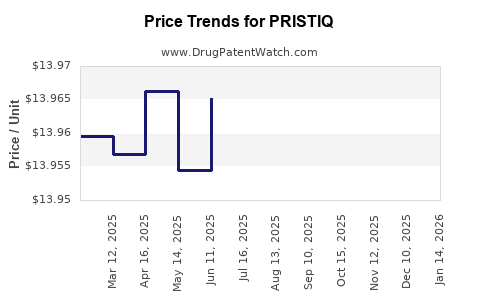
Average Pharmacy Cost for PRISTIQ
| Drug Name | NDC | Price/Unit ($) | Unit | Date |
|---|---|---|---|---|
| PRISTIQ ER 25 MG TABLET | 00008-1210-30 | 13.97300 | EACH | 2026-07-22 |
| PRISTIQ ER 50 MG TABLET | 00008-1211-01 | 13.95859 | EACH | 2026-07-22 |
| PRISTIQ ER 50 MG TABLET | 00008-1211-14 | 13.95859 | EACH | 2026-07-22 |
| PRISTIQ ER 50 MG TABLET | 00008-1211-30 | 13.95859 | EACH | 2026-07-22 |
| PRISTIQ ER 100 MG TABLET | 00008-1222-01 | 13.93649 | EACH | 2026-07-22 |
| PRISTIQ ER 100 MG TABLET | 00008-1222-14 | 13.93649 | EACH | 2026-07-22 |
| PRISTIQ ER 100 MG TABLET | 00008-1222-30 | 13.93649 | EACH | 2026-07-22 |
| >Drug Name | >NDC | >Price/Unit ($) | >Unit | >Date |
Pristiq (desvenlafaxine) Market Analysis and Price Projections: US Pricing, Revenue Risk, Patent/Generic Pressure, and Forecast Scenarios
Executive summary: Pristiq (desvenlafaxine, SNRI) is a long-established US antidepressant with no meaningful FDA exclusivity runway left for brand protection. The brand’s pricing power has been pressured by generic entry and steady payer control typical of mid-to-late life centralized CNS products. Near-term gross-to-net dilution will be driven more by contracting and formulary status than by new clinical adoption. Over the next 3 to 5 years, unit and revenue growth are more likely to come from share stability in remaining covered segments than from price expansion. The most material downside risks come from continued competitive substitution into low-cost generics, potential down-tiering in managed care, and any label-driven competitor wins in difficult formularies.
What is Pristiq (desvenlafaxine) and who currently sells it in the US?
Pristiq is desvenlafaxine, an oral serotonin-norepinephrine reuptake inhibitor marketed for major depressive disorder. In the US, the brand competes primarily with desvenlafaxine generic manufacturers after initial brand exclusivity ended.
What dosage forms and strengths are on the market?
Common US commercial formats include:
- Tablets: 25 mg, 50 mg, 100 mg (extended-release)
What is the current competitive footprint versus desvenlafaxine generics?
- Brand: Pristiq (desvenlafaxine extended-release)
- Generic: desvenlafaxine extended-release tablets sold by multiple manufacturers
- Therapeutic substitutes: other SNRIs (venlafaxine ER), SSRIs (escitalopram, sertraline), and newer agents, depending on payer preference
What is Pristiq’s US revenue exposure and how has it trended versus generics?
Featured snippet answer: Pristiq’s US market is in a mature phase where revenue is increasingly defined by gross-to-net management and formulary placement more than brand price increases.
Key revenue drivers
- Channel mix: Retail vs mail, and specialty vs non-specialty distribution (Pristiq is typically commercial retail/mail).
- Net pricing: Rebates and performance-based contracting.
- Utilization stability: Script volumes and persistence in maintenance.
- Switching behavior: Generic substitution and clinician-patient switching resistance (usually limited once generics are entrenched).
- Payer controls: Prior authorization and step edits in certain segments.
What to watch in payer behavior
- Down-tiering risk: Moving from preferred to non-preferred status typically compresses branded units quickly.
- Contracting pressure: Brands with ongoing generic competition face higher rebate pressure to maintain covered status.
- Net price floors: Some formulary agreements set effective net price floors that prevent sustained gross-to-net improvement.
What does the FDA regulatory history imply for Pristiq pricing power?
Featured snippet answer: Regulatory milestones for an older antidepressant generally do not sustain brand exclusivity. Pricing power is therefore anchored to formulary access and contracting, not to exclusivity barriers.
What FDA pathway matters for brand protection?
- Pristiq is a small-molecule drug with historical brand protection that does not block generic competition indefinitely.
- Any remaining brand advantage after generic entry comes from lifecycle additions (if any), not from primary new chemical entity exclusivity.
Orange Book status: what drives generic timing risks
Pristiq’s Orange Book listings determine whether new generic applications face any unexpired patents. For mature products, the practical question for price forecasting is whether any still-valid patents block specific generic versions or delivery/strength variants.
What patents protect Pristiq and when do they expire?
Featured snippet answer: Patent protection timelines determine whether later-arriving generics face litigation or entry delays, but for an established product like Pristiq, most market impact comes from whether any still-valid, enforceable claims delay at-scale generic substitution for specific strengths or formulations.
How patent coverage usually affects pricing
- If no listed patents block entry: pricing typically stabilizes only at lower branded unit volumes while brand-to-generic share drifts downward.
- If patents block specific manufacturing/strength formats: brands can retain pockets of higher share and net pricing for limited subsets.
Method for projecting the next exclusivity cliff
For forecasting, price projections should be tied to:
- last relevant patent expiration in force for marketed strengths
- settlement-triggered “carve-outs” (if any) that delay certain ANDA launches
- whether disputes are limited to specific claims or cover broad scope
When does Pristiq lose exclusivity, and what generic entry risks remain?
Featured snippet answer: For Pristiq, exclusivity-driven risks are largely past due to generic availability; the remaining risk is ongoing competitive pressure and formulary changes rather than a single imminent exclusivity cliff.
What “loss of exclusivity” means in practice
- Even after exclusivity ends, brands can sustain pricing temporarily due to contracts, inertia, and clinician preference.
- The durable determinant is sustained net pricing versus generic net cost.
Paragraph IV and launch timing
- For older brands, the most price-relevant generic events tend to be post-launch litigation outcomes that either accelerate or delay additional generic entrants.
- The market tends to move when multiple ANDAs launch at scale, not when a single competitor appears.
How strong is the Pristiq patent estate for formulations and methods of use?
Featured snippet answer: The market impact of “strong” patent estates is measured by which competing products are blocked from commercial launch at scale, and for which dosage forms and label indications.
Formulation and delivery system patents
For extended-release antidepressants, formulation patents can matter if they protect:
- release profiles
- specific excipient systems
- manufacturing processes tied to dissolution or bioequivalence
Method-of-use (MOA) patents
Method-of-use protection matters if:
- there are distinct labeled or patent-protected uses beyond the core depression indication
- generic labeling carve-outs trigger enforcement
In price forecasting terms, MOA patents can slow generic substitution if the protected use is a meaningful fraction of prescriptions.
What patent litigation affects Pristiq generics and branded pricing?
Featured snippet answer: Litigation affects pricing only if it delays at-scale generic entry for meaningful dosage forms or materially limits substitution in contracted channels.
How to map litigation to price
- Identify whether disputes are resolved through:
- final injunctions
- narrow design-arounds
- settlements with delayed launch dates
- Determine whether settlements are strength-specific (for example, 100 mg vs 50 mg) which can create uneven erosion across the unit mix.
How does Pristiq compare with other SNRIs and antidepressants on cost and formulary preference?
Featured snippet answer: Payer preference for low-cost oral antidepressants typically centers on generic availability, dosing convenience, and formulary tier placement. Pristiq’s relative cost competitiveness against generic SNRIs and SSRIs drives its net pricing trajectory.
Substitution dynamics
- SNRIs: Venlafaxine ER and generic duloxetine often compete directly depending on payer.
- SSRIs: Escitalopram and sertraline can capture share when payers prefer lowest net-cost options.
- Switching costs: clinician familiarity and patient tolerability can slow switching but rarely prevents it once net cost gaps widen.
What is Pristiq’s pricing structure today (WAC, AWP, and net price mechanics)?
Featured snippet answer: Brand pricing in mature CNS categories is best modeled through gross-to-net dynamics. Public list prices can remain stable while effective net price falls due to rebates and contracting.
How to model net price
A practical forecasting approach uses:
- Unit forecast by market segment (retail/mail, tier)
- Net price multiple relative to generic competitors
- Rebate elasticity as contracting intensifies with new entrants
Unit economics implications
- If unit declines outpace net price stabilization, revenue falls even if WAC holds.
- If branded share stabilizes due to contracting, net revenue can become relatively resilient, though usually at reduced branded share.
Price projections for Pristiq (2026 to 2030): scenarios tied to formulary and generic share
Featured snippet answer: In a generic-dominated market, the main determinant is branded net price versus unit erosion rate. The most likely outcome is continued net price compression with modest stabilization in remaining covered share.
Scenario framework
Use three scenarios for branded US revenue and effective net price:
Base case (most likely): contracting pressure persists, branded share stabilizes
- Net price: flat-to-down (small compression as rebates ratchet)
- Units: gradual decline as generics continue to dominate and step edits tighten
- Revenue: low single-digit to mid single-digit CAGR decline through 2030
Upside case: brand retains preference in specific subsegments
- Trigger: favorable contract renewal, improved persistence metrics, or niche payer acceptance
- Net price: less compression than expected
- Units: slower erosion due to inertia and limited switching
- Revenue: small decline to near-flat through the forecast horizon
Downside case: down-tiering and accelerated substitution
- Trigger: wider down-tiering, more aggressive PA rules, or unfavorable contract renegotiation
- Net price: larger compression
- Units: faster decline as prescribers shift
- Revenue: mid-to-high single-digit CAGR decline through 2030
Directional model for branded unit erosion
Assume generic dominance keeps increasing penetration across:
- new prescriptions
- maintenance refills from stable patients
- switches triggered by payers during renewal cycles
Because Pristiq is oral and not specialty, channel and access constraints are less likely than in injectables, so erosion is primarily formulary-driven.
What will happen to Pristiq pricing if generic entrants increase or if share shifts further?
Featured snippet answer: Additional generic entrants typically do not change generic prices materially in the short term but increase substitution probability and contracting leverage, which reduces branded net pricing and share retention.
Two mechanisms
- Contract leverage: payers can demand lower effective brand pricing because alternatives multiply.
- Prescriber/patient behavior: more pharmacy-level switching and smaller prescription friction.
Which markets outside the US matter for price and profitability?
Featured snippet answer: Non-US pricing and revenue contribute to overall earnings but are less predictable without country-specific reimbursement data. US remains the core for robust price benchmarking and forecasting.
Geographic drivers
- Reimbursement systems (reference pricing, HTA-driven listing)
- National formularies and generic substitution rules
- Tendering behavior in hospital segments (less relevant for typical outpatient antidepressants, but varies)
What manufacturing and IP barriers could delay generic price erosion?
Featured snippet answer: For mature extended-release tablets, barriers are usually limited to formulation patent scope, manufacturing process validity challenges, and bioequivalence design-around constraints. If these are exhausted, generics tend to compete quickly on price and availability.
Where delays can occur
- Site-specific ANDA launch delays (GMP or scale)
- Narrow patent settlements that protect certain strengths longer
- Temporary supply constraints that shift pharmacy inventory away from lowest-cost SKUs
Key takeaways
- Pristiq is in a mature generic-competitive phase where branded pricing power depends primarily on formulary positioning and gross-to-net contracting, not on new exclusivity.
- Price forecasts should be modeled as net price compression plus unit erosion, with scenario dispersion driven by payer tier status and contract renewal outcomes.
- The most material risks to revenue are down-tiering, tightened prior authorization/step edits, and accelerated substitution toward the lowest-cost generic equivalents.
- Any remaining patent or litigation effects matter only if they delay at-scale generic entry for specific strengths or formulations; otherwise the pricing path follows the generic substitution curve.
FAQs
-
How does Pristiq’s net price typically move after generic expansion?
Net price usually compresses quickly as rebate pressure increases and payers renegotiate branded tiers, with larger drops when contracts are renewed after multiple generic entrants are established. -
Do Pristiq strength-specific formulations see different generic erosion rates?
Yes. If one strength has stronger listing restrictions, clinician preference, or slower pharmacy switching, branded share can erode unevenly until contracts align across all strengths. -
What payer tools most impact Pristiq branded volume?
Prior authorization, step edits, and non-preferred tier placement are the main mechanisms that accelerate switching and reduce refill persistence for branded SKUs. -
Can Pristiq avoid further revenue decline through lifecycle changes?
Only if there are meaningful label expansions or formulation differentiators that change payer behavior. Without exclusivity barriers, lifecycle changes rarely prevent long-run net price compression in generic markets. -
What competitor classes are most likely to displace Pristiq in managed care?
Low-cost generics in the SNRI and SSRI classes, particularly those that win preferred formulary status through favorable net pricing.
References (APA)
- FDA. (n.d.). Orange Book: Approved Drug Products with Therapeutic Equivalence Evaluations. https://www.accessdata.fda.gov/scripts/cder/daf/
- FDA. (n.d.). Drugs@FDA. https://www.accessdata.fda.gov/scripts/cder/daf/index.cfm
More… ↓
