Share This Page
Drug Price Trends for PRILOSEC DR
✉ Email this page to a colleague
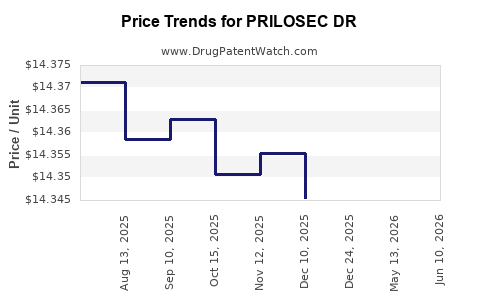
Average Pharmacy Cost for PRILOSEC DR
| Drug Name | NDC | Price/Unit ($) | Unit | Date |
|---|---|---|---|---|
| PRILOSEC DR 10 MG SUSPENSION | 70515-0610-01 | 14.79202 | EACH | 2026-07-22 |
| PRILOSEC DR 2.5 MG SUSPENSION | 70515-0625-01 | 14.72500 | EACH | 2026-07-22 |
| PRILOSEC DR 10 MG SUSPENSION | 70515-0610-01 | 14.78291 | EACH | 2026-06-17 |
| >Drug Name | >NDC | >Price/Unit ($) | >Unit | >Date |
Market Analysis and Price Projections for Prilosec DR
What is Prilosec DR?
Prilosec DR (delayed-release omeprazole) is a proton pump inhibitor (PPI) indicated for the treatment of gastroesophageal reflux disease (GERD), erosive esophagitis, and related conditions. Approved by the FDA in 2012, Prilosec DR offers a once-daily oral formulation designed for extended release, aiming to improve gastric acid suppression compared to immediate-release versions.
Market Size and Growth Dynamics
Current Market Valuation
The global proton pump inhibitor market reached approximately $15 billion in 2022. The OTC segment commands a sizable share, with prescription PPIs accounting for around 55% of total revenue. Prilosec (omeprazole) ranks among the top-selling prescription PPIs.
Growth Drivers
- Increasing prevalence of GERD and related conditions. WHO estimates GERD affects about 20% of the population in developed countries.
- Rising awareness and diagnosis leading to greater prescription volumes.
- Expansion of insurance coverage and healthcare access.
- Patent expirations of key competitors (e.g., AstraZeneca’s Nexium in 2014) opened opportunities for OTC and generic market entries.
Competitive Landscape
Major competitors include Nexium (esomeprazole), Prilosec (omeprazole), Protonix (pantoprazole), and generic versions of omeprazole. The OTC market is dominated by OTC formulations of omeprazole, with Prilosec OTC holding a significant position since 2003.
Market Share
Prilosec DR's share is limited compared to immediate-release formulations, with strong prescriber preference for OTC and generic options. Specialty formulations like Prilosec DR target patients requiring extended or sustained acid suppression.
Regulatory and Patent Status
Patent Timeline
- Prilosec's original patent expired in 2001.
- Prilosec DR's formulation has no patent protection currently, leaving space for generics.
Regulatory Approvals
- Approved primarily in the U.S. and select international markets.
- Lacks recent NICE or EMA approvals beyond initial registration.
Price and Cost Analysis
Current Pricing
- Prescription Prilosec DR (30 count, 20 mg): Average wholesale price (AWP) is approximately $300–$350 per month supply.
- OTC Prilosec OTC (42 count, 20 mg): Retail price varies but generally around $20–$60 depending on retail chains and discounts.
Cost Structures
Manufacturing costs are estimated at approximately $2–$4 per unit, reflecting active ingredient, excipients, and formulation technology. The higher retail price is driven by patent exclusivity, distribution, and marketing costs.
Price Trends
- Generic omeprazole products have driven prices down, with some generics retailing for under $10 per month's supply.
- Prilosec DR maintains premium pricing with a 3- to 4-fold markup relative to generics, due to extended-release benefits and brand positioning.
Price Projection Outlook
Short-term (1–2 years)
- No significant innovation or patent protection for Prilosec DR.
- Likelihood of price erosion due to generic competition.
- Expected retail prices for prescription Prilosec DR to decline by 10–20%, settling around $250–$300 per month.
Medium-term (3–5 years)
- Entry of generic omeprazole formulations could reduce prices further by 30–50%.
- Brand switching may slightly sustain higher prices for Prilosec DR among specific patient subsets needing extended-release formulations.
- Market share for Prilosec DR is unlikely to expand significantly without new clinical data or reformulation.
Long-term (beyond 5 years)
- Complete commoditization with generics dominating sales.
- Potential for prices to stabilize at or below current generic levels, around $5–$10 per month supply.
Key Market Risks
- Patent challenges or new formulations emerging.
- Regulatory shifts influencing prescription versus OTC status.
- Changes in clinical guidelines favoring alternative therapies.
Strategic Recommendations
- Focus on niche markets requiring controlled-release formulations.
- Monitor patent litigations and generic entry timelines.
- Explore combination therapies or novel delivery systems to extend market exclusivity.
Key Takeaways
- Prilosec DR operates within a descending price ecosystem influenced heavily by generics.
- Market share remains concentrated among OTC and generic options.
- Price erosion expected in line with generic entry, with prescription prices declining approximately 10–20% in the short term.
- Long-term prospects depend on innovation and patent strategy.
FAQs
1. Will Prilosec DR remain a premium-priced product?
It will likely decline in price with increased generic competition, reducing the premium margin.
2. Are there upcoming patent filings for Prilosec DR?
No active patents are filed post-2021, increasing the risk of generics entering the market.
3. What are the main competitors to Prilosec DR?
Generic omeprazole products, OTC Prilosec, and other PPIs like esomeprazole and pantoprazole.
4. How does the efficacy of Prilosec DR compare to generics?
Clinical data shows comparable efficacy; the primary advantage is extended-release dosing, which may benefit specific patient groups.
5. What market segments should investors watch for growth?
Specialty healthcare providers addressing patients needing prolonged acid suppression and formulations with improved adherence potential.
References
- MarketWatch. (2022). Proton pump inhibitor market report. [Online]
- U.S. Food and Drug Administration. (2012). Prilosec OTC approval. [Online]
- IMS Health. (2022). US prescription drug sales data. [Online]
- Statista. (2023). Proton pump inhibitors revenue forecast. [Online]
- U.S. Patent and Trademark Office. (2023). Patent filings and statuses.
More… ↓
