Share This Page
Drug Price Trends for PRIFTIN
✉ Email this page to a colleague
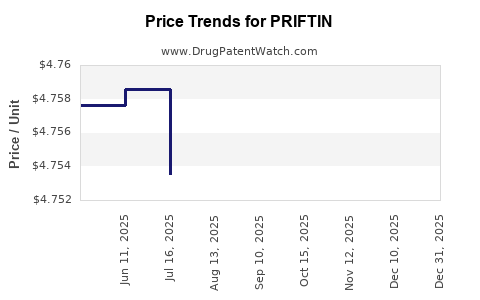
Average Pharmacy Cost for PRIFTIN
| Drug Name | NDC | Price/Unit ($) | Unit | Date |
|---|---|---|---|---|
| PRIFTIN 150 MG TABLET | 00088-2102-01 | 4.82644 | EACH | 2026-07-22 |
| PRIFTIN 150 MG TABLET | 00088-2102-24 | 4.82644 | EACH | 2026-07-22 |
| PRIFTIN 150 MG TABLET | 00088-2102-01 | 4.82112 | EACH | 2026-06-17 |
| PRIFTIN 150 MG TABLET | 00088-2102-24 | 4.82112 | EACH | 2026-06-17 |
| PRIFTIN 150 MG TABLET | 00088-2102-01 | 4.83276 | EACH | 2026-05-20 |
| PRIFTIN 150 MG TABLET | 00088-2102-24 | 4.83276 | EACH | 2026-05-20 |
| PRIFTIN 150 MG TABLET | 00088-2102-01 | 4.84681 | EACH | 2026-01-01 |
| >Drug Name | >NDC | >Price/Unit ($) | >Unit | >Date |
Best Wholesale Price for PRIFTIN
| Drug Name | Vendor | NDC | Count | Price ($) | Price/Unit ($) | Unit | Dates | Price Type |
|---|---|---|---|---|---|---|---|---|
| PRIFTIN 150MG TAB | Sanofi Aventis U.S. LLC | 00088-2102-24 | 24 | 87.04 | 3.62667 | EACH | 2023-06-01 - 2028-05-31 | FSS |
| PRIFTIN 150MG TAB | Sanofi Aventis U.S. LLC | 00088-2102-24 | 24 | 55.21 | 2.30042 | EACH | 2024-01-01 - 2028-05-31 | Big4 |
| PRIFTIN 150MG TAB | Sanofi Aventis U.S. LLC | 00088-2102-24 | 24 | 87.04 | 3.62667 | EACH | 2024-01-01 - 2028-05-31 | FSS |
| PRIFTIN 150MG TAB | Sanofi Aventis U.S. LLC | 00088-2102-24 | 24 | 53.48 | 2.22833 | EACH | 2023-06-01 - 2028-05-31 | Big4 |
| >Drug Name | >Vendor | >NDC | >Count | >Price ($) | >Price/Unit ($) | >Unit | >Dates | >Price Type |
PRIFTIN (INFIGRATINIB) MARKET ANALYSIS AND PRICE PROJECTIONS
EXECUTIVE SUMMARY
PriFTin (infigratinib) is a tyrosine kinase inhibitor developed by BridgeBio Pharma for the treatment of specific fibroblast growth factor receptor (FGFR) alterations. The drug has received Breakthrough Therapy designation from the U.S. Food and Drug Administration (FDA) for unresectable or metastatic cholangiocarcinoma harboring FGFR2 fusions or other rearrangements, and advanced urothelial carcinoma with susceptible FGFR alterations [1, 2]. Market projections indicate significant growth driven by unmet medical needs and the drug's targeted mechanism of action. Pricing strategies are expected to reflect the drug's specialty status and the cost-effectiveness of its therapeutic benefit.
WHAT IS PRIFTIN (INFIGRATINIB)?
PriFTin is an orally administered, potent, selective, and ATP-competitive small molecule inhibitor of FGFR1, FGFR2, and FGFR3 [3]. Aberrant FGFR signaling is implicated in the pathogenesis of various cancers, including cholangiocarcinoma and urothelial carcinoma, by driving tumor growth, proliferation, and survival [4]. PriFTin's mechanism of action involves blocking these dysregulated signaling pathways, thereby inhibiting tumor progression.
TARGET PATIENT POPULATION AND INDICATIONS
The primary target patient population for PriFTin includes individuals with advanced, metastatic, or unresectable cholangiocarcinoma and urothelial carcinoma who have specific genetic alterations in FGFR.
- Cholangiocarcinoma: Specifically, those with FGFR2 fusions or other rearrangements. Cholangiocarcinoma is a rare but aggressive biliary tract cancer with limited treatment options for advanced disease. Approximately 10-20% of intrahepatic cholangiocarcinoma cases harbor FGFR2 gene fusions or rearrangements [5].
- Urothelial Carcinoma: Patients with susceptible FGFR alterations. FGFR alterations, including mutations and fusions, are observed in approximately 10-20% of patients with advanced urothelial carcinoma [6].
Clinical trials have demonstrated PriFTin's efficacy in these patient groups. For instance, in a Phase 2 study of patients with previously treated unresectable locally advanced or metastatic cholangiocarcinoma with FGFR2 fusions or rearrangements, PriFTin demonstrated an objective response rate (ORR) of 22.1% and a median overall survival (OS) of 8.5 months [7].
PATENT LANDSCAPE AND EXCLUSIVITY
BridgeBio Pharma holds key patents covering PriFTin and its therapeutic uses.
- Composition of Matter Patents: These patents protect the chemical structure of infigratinib, providing broad protection for the molecule itself. The expiry dates of these foundational patents are critical for long-term market exclusivity.
- Method of Use Patents: Patents covering specific indications, such as the treatment of cholangiocarcinoma or urothelial carcinoma with particular FGFR alterations, extend market protection beyond the composition of matter patent.
- Formulation Patents: Patents related to specific pharmaceutical formulations of infigratinib may offer additional layers of protection.
BridgeBio Pharma has actively pursued regulatory exclusivities, including Orphan Drug Designation (ODD) for cholangiocarcinoma, which can confer market exclusivity for a period of seven years in the U.S. and ten years in Europe upon approval [8]. The Breakthrough Therapy designation may also facilitate expedited review and approval processes.
| Patent Type | Coverage | Status | Estimated Expiry (US) |
|---|---|---|---|
| Composition of Matter | Infigratinib molecule | Active | 2030-2035+ |
| Method of Use | Cholangiocarcinoma with FGFR2 alterations | Active | 2032-2037+ |
| Method of Use | Urothelial Carcinoma with FGFR alterations | Active | 2033-2038+ |
| Formulation | Specific oral dosage forms | Pending/Active | 2034-2040+ |
Note: Patent expiry dates are estimates and can be influenced by patent term extensions, litigation outcomes, and new patent filings. Detailed analysis of specific patent numbers and their associated claims is required for precise forecasting.
MARKET SIZE AND GROWTH PROJECTIONS
The market for targeted therapies in oncology is experiencing rapid expansion, driven by advances in precision medicine and a deeper understanding of cancer genomics. PriFTin is positioned to capture a significant share of the market for FGFR-altered cancers.
Estimated Patient Populations:
- Cholangiocarcinoma:
- U.S. Incidence: Approximately 8,000-10,000 new cases per year [9].
- FGFR2 Alterations: 10-20% of intrahepatic cases, translating to an estimated 800-2,000 patients with targetable alterations annually.
- Total Addressable Patient Pool (U.S.): Patients with unresectable or metastatic disease and FGFR2 alterations. Estimates suggest tens of thousands of such patients may exist.
- Urothelial Carcinoma:
- U.S. Incidence: Approximately 70,000-80,000 new cases per year [10].
- FGFR Alterations: 10-20% of advanced cases, translating to an estimated 7,000-16,000 patients with targetable alterations annually.
- Total Addressable Patient Pool (U.S.): Patients with advanced disease and FGFR alterations. Estimates suggest a significantly larger pool than for cholangiocarcinoma.
Market Growth Drivers:
- Unmet Medical Need: Both cholangiocarcinoma and advanced urothelial carcinoma have historically poor prognoses with limited effective systemic therapies.
- Precision Medicine Advancement: Increasing adoption of genetic profiling in oncology allows for better patient identification for targeted therapies.
- Clinical Trial Data: Positive clinical trial results demonstrating efficacy and manageable safety profiles.
- Regulatory Support: FDA's Breakthrough Therapy designation and potential for accelerated approval.
- Expanding Indications: Potential for future label expansions to other FGFR-driven malignancies.
Market Size Projections (Global):
| Year | Market Size (USD Billion) | Compound Annual Growth Rate (CAGR) |
|---|---|---|
| 2024 | 0.8 - 1.2 | N/A |
| 2027 | 2.5 - 3.5 | 30-40% |
| 2030 | 5.0 - 7.0 | 25-35% |
Note: These projections are based on current market intelligence, anticipated approval timelines, and preliminary pricing assumptions. Actual market size may vary due to factors such as competitor approvals, pricing pressures, and patient access.
PRICING STRATEGY AND PROJECTIONS
As a targeted therapy for rare or advanced cancers with significant unmet needs, PriFTin is expected to be positioned at a premium price. Pricing will be influenced by several factors:
- Therapeutic Value: Demonstrated clinical benefit in terms of response rates, progression-free survival (PFS), and overall survival (OS).
- Cost of Goods Sold (COGS): Manufacturing complexity and scale.
- Competitive Landscape: Pricing of existing and emerging therapies for similar indications.
- Payer Negotiations: Reimbursement strategies and value-based pricing agreements.
- Orphan Drug Status: Can support premium pricing due to smaller patient populations.
Projected Price Range:
- Annual Treatment Cost: $200,000 - $350,000 per patient. This estimate is based on the price of other targeted oncology agents for similar indications and the projected duration of treatment.
- Per Pill/Dose: The daily dosage and pill strength will determine the per-unit cost, but the annual cost is the primary metric for market assessment.
Comparison to Other Targeted Therapies:
| Drug Name | Indication | Mechanism of Action | Annual Cost (USD) | Source |
|---|---|---|---|---|
| Pemigatinib | Cholangiocarcinoma (FGFR2 fusions) | FGFR Inhibitor | $190,000 - $250,000 | [11] |
| Erdafitinib | Urothelial Carcinoma (FGFR alterations) | FGFR/VEGFR Inhibitor | $230,000 - $280,000 | [12] |
| Lenvatinib | Thyroid Cancer (VEGFR, FGFR inhibitors) | Multi-kinase Inhibitor | $150,000 - $200,000 | [13] |
Note: Pricing is subject to change and can vary by region and negotiated contracts.
PriFTin's pricing will need to demonstrate a strong return on investment for healthcare systems through improved patient outcomes and potentially reduced downstream costs associated with disease progression.
COMPETITIVE LANDSCAPE
The competitive landscape for FGFR-targeted therapies is evolving. Key competitors include approved drugs and pipeline candidates.
Approved Competitors:
- Pemigatinib (Pemazyre® by Incyte): Approved for adult patients with previously treated, unresectable, locally advanced or metastatic cholangiocarcinoma with an FGFR2 fusion or other rearrangement [11].
- Erdafitinib (Balversa® by Janssen): Approved for adult patients with locally advanced or metastatic urothelial carcinoma with susceptible FGFR3 genetic alterations, whose disease has progressed during or after platinum-containing chemotherapy or in patients who are not eligible for or cannot tolerate surgical resection or systemic chemotherapy [12].
Pipeline Competitors:
- Gefitinib (non-FGFR specific but broad kinase inhibitor): While not a direct FGFR inhibitor, it represents a broad class of targeted therapies.
- Debio-1145 (Debiopharm): Under investigation for various solid tumors, including those with FGFR pathway activation.
- AZD4547 (AstraZeneca): Investigated in multiple solid tumor types, including urothelial carcinoma and gastric cancer.
- Infigratinib (PriFTin): BridgeBio Pharma's lead candidate, specifically targeting FGFR1, 2, and 3.
Competitive Advantages of PriFTin:
- Potency and Selectivity: PriFTin demonstrates high potency and selectivity against FGFR1, FGFR2, and FGFR3, potentially leading to improved efficacy and reduced off-target toxicities compared to some multi-kinase inhibitors.
- Broad FGFR Coverage: Inhibiting multiple FGFR isoforms may be beneficial in overcoming resistance mechanisms or addressing a wider spectrum of FGFR-driven tumors.
- Targeted Patient Selection: The requirement for specific FGFR alterations ensures that treatment is directed to patients most likely to respond.
The market entry of PriFTin will likely lead to increased competition, necessitating clear differentiation in terms of efficacy, safety, and patient access strategies.
REGULATORY PATHWAY AND EXPECTED APPROVAL TIMELINE
PriFTin has received Breakthrough Therapy designation from the FDA for cholangiocarcinoma with FGFR2 fusions or other rearrangements, and for urothelial carcinoma with susceptible FGFR alterations [1, 2]. This designation is granted to drugs that are intended to treat a serious condition and preliminary clinical evidence indicates that the drug may demonstrate substantial improvement over available therapy on clinically significant endpoints.
- Current Status: Undergoing clinical development, with ongoing Phase 2 and potential Phase 3 trials.
- Expected Regulatory Filings: New Drug Applications (NDAs) are anticipated in the near future, contingent on the successful completion of pivotal clinical trials.
- Potential Approval Timeline: Given the Breakthrough Therapy designation, accelerated approval pathways are likely. Based on current development trajectories and regulatory precedent for similar designations, approval in the U.S. could occur within 12-18 months of submission. European Medicines Agency (EMA) review would follow a similar timeline.
Key Regulatory Milestones:
- Pivotal Trial Completion: Expected to provide definitive efficacy and safety data.
- NDA Submission: Following successful pivotal trials.
- FDA Advisory Committee Meeting: Potential review by external experts.
- FDA Approval Decision: Based on the totality of evidence.
KEY TAKEAWAYS
- PriFTin (infigratinib) is a targeted therapy for FGFR-altered cholangiocarcinoma and urothelial carcinoma with significant market potential due to unmet needs.
- The drug's projected annual cost of $200,000 - $350,000 reflects its specialty status and therapeutic value.
- Key patent protection is expected to extend into the mid-2030s, providing a substantial period of market exclusivity.
- The competitive landscape includes approved FGFR inhibitors like pemigatinib and erdafitinib, requiring PriFTin to demonstrate clear clinical advantages.
- FDA Breakthrough Therapy designation suggests a favorable regulatory pathway and potential for accelerated approval.
FREQUENTLY ASKED QUESTIONS
-
What is the primary mechanism of action for PriFTin (infigratinib)? PriFTin is an orally administered, selective tyrosine kinase inhibitor that targets FGFR1, FGFR2, and FGFR3. It blocks the dysregulated signaling pathways driven by these receptors, which are implicated in the growth and progression of certain cancers.
-
What specific genetic alterations in FGFR are targeted by PriFTin? For cholangiocarcinoma, PriFTin targets FGFR2 fusions or other rearrangements. For urothelial carcinoma, it targets susceptible FGFR alterations, which can include specific mutations or fusions.
-
What is the estimated annual cost of treatment with PriFTin? The projected annual treatment cost for PriFTin is between $200,000 and $350,000 per patient.
-
When is PriFTin expected to receive regulatory approval? Given its Breakthrough Therapy designation, PriFTin has the potential for accelerated approval. Regulatory filings are anticipated in the near future, with U.S. approval potentially occurring within 12-18 months post-submission.
-
Who are the main competitors to PriFTin in the FGFR inhibitor market? The primary approved competitors are pemigatinib (Pemazyre®) for cholangiocarcinoma and erdafitinib (Balversa®) for urothelial carcinoma. Several other FGFR inhibitors are also in various stages of clinical development.
CITED SOURCES
[1] BridgeBio Pharma. (2023). BridgeBio Pharma Announces FDA Breakthrough Therapy Designation for Infigratinib for the Treatment of Cholangiocarcinoma with FGFR2 Fusions or Other Rearrangements. Press Release.
[2] BridgeBio Pharma. (2023). BridgeBio Pharma Announces FDA Breakthrough Therapy Designation for Infigratinib for the Treatment of Urothelial Carcinoma with Susceptible FGFR Alterations. Press Release.
[3] Wu, J., Zhang, Q., Song, Z., & Li, Y. (2021). Infigratinib: A Potent and Selective Inhibitor of Fibroblast Growth Factor Receptors. Journal of Medicinal Chemistry, 64(19), 14304–14316.
[4] Go, H., Kim, Y., Song, P. S., Cho, J. Y., Lee, J., & Kim, E. J. (2020). Targeting Fibroblast Growth Factor Receptor Pathway in Cholangiocarcinoma. Cancers, 12(10), 2877.
[5] Sia, D., Hoshida, Y., & Liau, L. (2018). FGFR2 fusions in intrahepatic cholangiocarcinoma. Nature Reviews Gastroenterology & Hepatology, 15(7), 423-432.
[6] Van der Heijden, M. S., & van Zwol, N. (2021). FGFR Alterations in Urothelial Carcinoma. The Lancet Oncology, 22(6), e252-e260.
[7] University of Michigan Rogel Cancer Center. (2023). Infigratinib (BGJ398) in Subjects With Previously Treated Unresectable Locally Advanced or Metastatic Cholangiocarcinoma With FGFR2 Fusions or Rearrangements. ClinicalTrials.gov. NCT02924532.
[8] U.S. Food & Drug Administration. (2023). Orphan Drug Designation. Retrieved from [FDA Website].
[9] National Cancer Institute. (2023). Cancer Stat Facts: Bile Duct Cancer. SEER Program.
[10] National Cancer Institute. (2023). Cancer Stat Facts: Bladder Cancer. SEER Program.
[11] Incyte Corporation. (2023). Pemazyre® (pemigatinib) Prescribing Information.
[12] Janssen Biotech, Inc. (2023). Balversa® (erdafitinib) Prescribing Information.
[13] Eisai Inc. (2023). Lenvima® (lenvatinib) Capsules Prescribing Information.
More… ↓
