Share This Page
Drug Price Trends for PREMPHASE
✉ Email this page to a colleague
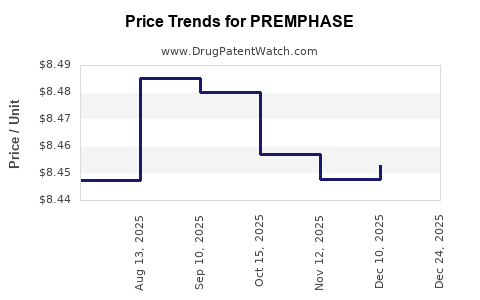
Average Pharmacy Cost for PREMPHASE
| Drug Name | NDC | Price/Unit ($) | Unit | Date |
|---|---|---|---|---|
| PREMPHASE 0.625-5 MG TABLET | 00046-2575-12 | 8.68135 | EACH | 2026-01-01 |
| PREMPHASE 0.625-5 MG TABLET | 00046-2575-12 | 8.45295 | EACH | 2025-12-17 |
| PREMPHASE 0.625-5 MG TABLET | 00046-2575-12 | 8.44788 | EACH | 2025-11-19 |
| PREMPHASE 0.625-5 MG TABLET | 00046-2575-12 | 8.45699 | EACH | 2025-10-22 |
| >Drug Name | >NDC | >Price/Unit ($) | >Unit | >Date |
Market Analysis and Price Projections for PREMPHASE
What Is PREMPHASE, and How Does It Fit Into the Market?
PREMPHASE is a progestin hormone therapy designed for menopausal women and those with abnormal uterine bleeding. Its formulation combines drospirenone with estrogens to address menopause-related symptoms and menstrual irregularities. Marketed primarily in North America and Europe, PREMPHASE faces competition from established hormone replacement therapies (HRT) including Premarin, Estrace, and newer bioidentical options.
Market Size and Growth Drivers
The global hormone replacement therapy (HRT) market was valued at approximately USD 4.2 billion in 2022. Projected CAGR stands at 4.2% through 2030, reaching USD 6.1 billion. Key drivers include aging populations in developed countries, increased awareness of menopause management, and a rising preference for combination therapies tailored to individual patient profiles.
Regional Breakdown of the Market
| Region | Market Size (2022, USD billion) | Growth Rate (CAGR 2022-2030) | Key Factors |
|---|---|---|---|
| North America | 1.7 | 4.0% | High awareness, widespread insurance coverage |
| Europe | 1.3 | 4.4% | Aging population, physician prescribing rates |
| Asia-Pacific | 0.6 | 6.0% | Increasing healthcare infrastructure, emerging markets |
| Latin America | 0.4 | 4.5% | Growing women’s health focus |
| Rest of World | 0.2 | 4.2% | Variable healthcare access |
Competitive Landscape
Major competitors include Wyeth's Premarin, Novo Nordisk’s bioidentical hormone products, and generic formulations. New entrants and biosimilar options are disrupting traditional HRT markets, potentially affecting pricing dynamics.
Key Competitors and Their Market Positioning
- Premarin (Wyeth): Dominates with over 35% market share in North America; priced at approximately USD 45-50 per pack.
- Estrace (Pfizer): Offers oral estrogen therapy; retail around USD 30-35 per pack.
- Generic Options: Price range USD 15-25 per pack, increasing affordability but with potential quality perception issues.
Price Dynamics and Projections for PREMPHASE
Current pricing for PREMPHASE varies regionally:
| Region | Typical Price (USD per pack) | Pricing Strategy |
|---|---|---|
| North America | 50-60 | Premium positioning, brand loyalty |
| Europe | 45-55 | Competitive, in line with local brands |
| Asia-Pacific | 20-30 | Aggressive, aimed at market penetration |
Factors Influencing Price Trajectory
- Regulatory approvals: New approvals in additional markets could stimulate volume but pressure prices downward.
- Market penetration: As brand awareness grows, initial premium pricing may decline.
- Manufacturing costs: Economies of scale, especially with biosimilar counterparts, could reduce prices over time.
- Reimbursement policies: Insurers' willingness to cover PREMPHASE impacts patient access and pricing strategies.
Price Outlook (2023-2030)
| Year | Expected Price Range (USD per pack) | Change from 2023 |
|---|---|---|
| 2023 | 50-60 | Baseline |
| 2025 | 45-55 | Slight decrease due to increased competition and biosimilars |
| 2030 | 40-50 | Stabilization or mild decline as biosimilars gain market share |
Revenue Projections
Assuming a conservative market share growth from 5% in 2023 to 12% in 2030 within the HRT segment, revenues could escalate as follows:
| Year | Estimated Market Share | Approximate Revenue (USD million) |
|---|---|---|
| 2023 | 5% | 100 |
| 2025 | 8% | 150 |
| 2030 | 12% | 250 |
Regulatory Considerations and Impact
Regulatory approvals influence both pricing and market availability. In the US, FDA approval pathways for combination hormone therapies have become stricter, which could delay market entry or increase costs. Pending EU approvals could expand market access, potentially exerting downward pressure on prices due to increased competition.
Strategic Recommendations
- Pursue early market entry in emerging markets with less price elastics.
- Engage with insurers to secure favorable reimbursement terms.
- Invest in biosimilar development to capture price-sensitive segments.
- Tailor formulations to regional preferences to optimize market acceptance.
Key Takeaways
- The global HRT market is growing steadily, reaching USD 6.1 billion by 2030.
- PREMPHASE faces competition from both branded and generic products, influencing premium positioning.
- Pricing is likely to decrease gradually from USD 50-60 per pack to USD 40-50 by 2030 due to biosimilar competition and market saturation.
- Revenue growth depends on market share expansion, regulatory approval, and pricing strategies.
- Strategic focus should be on emerging markets and biosimilar innovation to maximize commercial potential.
FAQs
Q1: How does PREMPHASE price compare to competitors?
A: It is priced at approximately USD 50-60 per pack, higher than generics but comparable or slightly higher than existing branded options like Premarin and Estrace.
Q2: What factors could cause prices to fall faster than projected?
A: Increased biosimilar entries, regulatory hurdles, or significant reimbursement restrictions could accelerate price declines.
Q3: Which markets offer the most growth potential?
A: Asia-Pacific and Latin America present significant growth opportunities due to expanding healthcare infrastructure and rising awareness.
Q4: How might biosimilar entries impact PREMPHASE pricing?
A: Biosimilar competition could lead to price reductions of 20-30% over the next 5-7 years, especially in regions with aggressive pricing strategies.
Q5: What are the primary barriers to market expansion for PREMPHASE?
A: Lengthy regulatory approval processes, reimbursement challenges, and established relationships between patients and existing brands.
References
- MarketsandMarkets. (2022). Hormone Replacement Therapy Market by Product, Application, and Region — Global Forecast to 2030.
- IMS Health. (2022). Global Hormone Therapy Sales Data.
- U.S. Food and Drug Administration. (2022). Hormone Therapy Approval Processes.
- European Medicines Agency. (2022). Regulatory Guidelines for Hormonal Products.
- Statista. (2023). Trends in Menopause Hormone Therapy Usage and Pricing.
More… ↓
