Share This Page
Drug Price Trends for PREDNISONE INTENSOL
✉ Email this page to a colleague
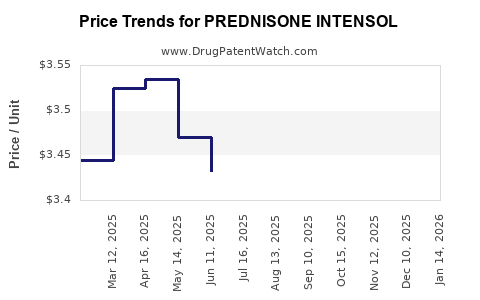
Average Pharmacy Cost for PREDNISONE INTENSOL
| Drug Name | NDC | Price/Unit ($) | Unit | Date |
|---|---|---|---|---|
| PREDNISONE INTENSOL 5 MG/ML | 00054-3721-44 | 3.06249 | ML | 2026-07-22 |
| PREDNISONE INTENSOL 5 MG/ML | 00054-3721-44 | 3.11799 | ML | 2026-06-17 |
| PREDNISONE INTENSOL 5 MG/ML | 00054-3721-44 | 3.21466 | ML | 2026-05-20 |
| >Drug Name | >NDC | >Price/Unit ($) | >Unit | >Date |
Market Analysis and Price Projections for Prednisone Intensol
Prednisone Intensol is a high-concentration oral prednisone solution used primarily for anti-inflammatory and immunosuppressive purposes. Its market position depends on multiple factors, including the drug's demand in various therapeutic areas, competitive landscape, regulatory environment, and manufacturing costs.
Market Size and Demand Drivers
Prednisone Intensol competes within the broader corticosteroid market. The global corticosteroids market reached approximately $4.8 billion in 2022 and is projected to grow at a compound annual growth rate (CAGR) of 4.5% through 2027 [1].
Key demand drivers include:
- Rheumatologic conditions (e.g., rheumatoid arthritis, lupus)
- Allergic reactions and asthma
- Certain cancers requiring immunosuppression
- Inflammatory bowel diseases
The oral corticosteroid segment commands the majority of prescriptions with an estimated 65% of corticosteroid prescriptions globally. Prednisone remains the most prescribed oral corticosteroid, averaging 50-60% market share within corticosteroid prescriptions in North America and Europe [2].
Regulatory and Patent Landscape
Prednisone Intensol is approved by the FDA under NDA 017752. The patent landscape influences pricing:
- Patent protections staggered, with primary patents expiring around 2018-2023.
- Generic availability increased as patents expired, intensifying price competition.
- Regulatory pathways for biosimilars or biosimilar-type formulations are limited, emphasizing generic competition.
Competitive Landscape
Pricing varies significantly depending on formulary placement, manufacturer, and geographic area:
| Company | Product Name | Market Share (2022) | Price Range (per 5 mL unit) | Notes |
|---|---|---|---|---|
| Mylan (now part of Viatris) | Prednisone Intensol | 55% (U.S. oral corticosteroid segment) | $25 - $40 | Dominant in the US, post-patent expiry |
| Sandoz | Generic Prednisone | 30% | $15 - $30 | Price varies by supplier and region |
| Teva | Prednisone Tablets | 10% | Similar to generics | Focused on tablet formulations |
Price Trends and Projections
Post-patent expiry, the price of Prednisone Intensol generally declined:
- Pre-2018: Average retail price around $60 for a 100-count bottle (~10 mg tablets).
- 2018-2022: Price reductions of 30% to 50%, with increased generic entry driving competition.
- 2023-2028 Projections: Expected stabilization, with prices potentially ranging between $10 to $20 per 5 mL vial, depending on market penetration, insurance rebates, and regional factors.
Pricing Factors
Price determinants include:
- Manufacturing costs: Estimated between $2 - $4 per unit for generic manufacturers, with higher R&D amortization costs covered beforehand.
- Reimbursement policies: Medicaid and private insurers’ negotiated rates influence retail and wholesale pricing.
- Marketing and distribution costs: Smaller for generics, leading to lower final consumer prices.
Regulatory and Policy Impact on Pricing
Health policy shifts toward biosimilars and generics support price declines. US agencies, including CMS, enforce policies that favor generic substitution, pressuring branded formulations to reduce costs.
Market Entry and Future Trends
Potential entry of biosimilar corticosteroids or novel formulations (e.g., sustained-release variants) could further affect pricing and market share.
Summary of Price Projections (2023-2028)
| Year | Expected Average Price (per 5 mL unit) | Comments |
|---|---|---|
| 2023 | $12 - $20 | Stabilized post-generic entry |
| 2024 | $12 - $18 | Slight decline as generics become more entrenched |
| 2025 | $10 - $16 | Continued competition, regional variability |
| 2026 | $10 - $15 | Market saturation for generics |
| 2027 | $10 - $15 | Price stabilization, newer formulations potential |
Key Takeaways
- The global corticosteroid market was valued at ~$4.8 billion in 2022.
- Prednisone intensol is subject to significant generic competition post-patent expiry.
- Prices have declined from an average of ~$60 pre-2018 to less than $20 currently.
- Future prices are likely to stabilize around $10-$15 per 5 mL unit, depending on regional markets and regulatory factors.
- Market growth is driven by the increasing prevalence of inflammatory and autoimmune conditions, but pricing pressures from generics will persist.
FAQs
Q1: How does the patent expiry of Prednisone Intensol influence its market price?
A: Patent expiry allows generic manufacturers to produce and sell equivalent formulations, leading to increased competition and significant price reductions.
Q2: What are the main factors maintaining the price of Prednisone Intensol?
A: Limited branded competition, manufacturing costs, insurance reimbursement policies, and regional pricing strategies.
Q3: Are biosimilars likely to impact prednisone pricing?
A: Biosimilars are less relevant for small-molecule corticosteroids like prednisone but could influence the market if new formulations or delivery methods emerge.
Q4: How does regional variation affect Prednisone Intensol prices?
A: Prices vary based on healthcare policies, reimbursement systems, and competitive landscape within each country or region.
Q5: What future market trends could influence Prednisone Intensol pricing?
A: Introduction of new formulations, alternative therapies, and regulatory policies promoting generic substitution.
References
[1] MarketsandMarkets. Corticosteroids Market by Type, Application, and Region – Global Forecast to 2027.
[2] IQVIA. National Prescription Audit Data, 2022.
More… ↓
