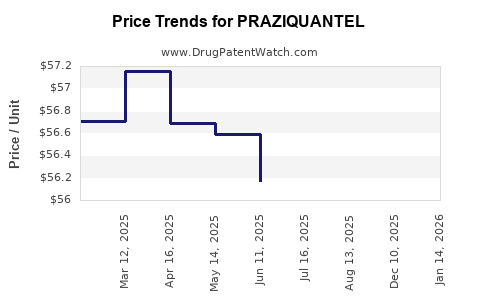
Last updated: February 13, 2026
Overview
Praziquantel is an antiparasitic agent used primarily to treat schistosomiasis, neurocysticercosis, and other parasitic worm infections. It is essential in global health initiatives, especially in endemic regions of Africa, Asia, and Latin America. The drug is primarily supplied by major pharmaceutical companies as a generic.
Market Size and Growth Factors
The global praziquantel market was valued at approximately $250 million in 2022. It is expected to grow at a compound annual growth rate (CAGR) of 4-6% through 2030, driven by increased investments in neglected tropical disease (NTD) treatments and expanding government-led health programs.[1]
Key Drivers:
- Rising prevalence of schistosomiasis, estimated at over 200 million cases globally.
- WHO's strategic priorities for NTD control and elimination.
- Growing demand for affordable treatments in low- and middle-income countries.
- Expansion of mass drug administration (MDA) campaigns.
Market segments are primarily distinguished by end-use, with government procurement constituting around 70%, and private pharmaceutical sales accounting for the remaining 30%.
Major Players and Supply Dynamics
The market is dominated by a handful of companies:
- pharmaceutical giants such as Merck KGaA and Cipla.
- Indian generic producers like Zydus Cadila and Macleods Pharmaceuticals.
Generic manufacturing has increased, leading to price competition and volume-based sales. As patents have expired or are not enforced globally, generic production has significantly lowered prices.
Price Projections and Trends
Prices for praziquantel vary geographically:
- in endemic countries, a standard 600 mg tablet costs as low as $0.05–$0.10.
- in high-income markets, prices can reach $1 per tablet due to regulatory and distribution margins.
Projections for 2030 suggest:
- a stabilization of low prices in endemic regions, continuing around $0.05–$0.10 per tablet due to high competition.
- potential slight increase in premium markets driven by quality control and supply chain costs, reaching about $1.20 per tablet.
- overall, wholesale prices are expected to decline by 10–15% in the next five years in low-income countries, primarily due to increased manufacturing capacity.[2]
Regulatory and Policy Influences
WHO prequalification programs have encouraged production of quality-assured generic praziquantel, fostering price reductions. Procurement policies favor low-cost generics, sustaining downward pressure on prices.
Implications for Investment and R&D
Limited R&D has been directed at improving praziquantel formulations. Efforts are ongoing to develop pediatric formulations and fixed-dose combination therapies, which could influence pricing by adding value or creating premium segments.
Conclusion
The praziquantel market remains price-sensitive with a supply dominated by generic producers. Price declines are expected to stabilize in endemic regions, supporting mass treatment initiatives. Despite low-cost options, markets may see slight premium pricing in non-endemic, high-income regions due to regulatory standards.
Key Takeaways
- Market value was ~$250 million in 2022, with a 4–6% CAGR forecast through 2030.
- Price per tablet in endemic regions will likely stay around $0.05–$0.10, with minimal increases in premium markets.
- Growth is driven by MDA programs and increasing neglected tropical disease funding.
- Competition among generics keeps prices low; regulatory quality standards support continued volume sales.
FAQs
-
What is the current global demand for praziquantel?
Approximately 200 million cases of schistosomiasis are treated annually, with 1–2 billion doses distributed mainly through public health programs.
-
How do government procurement policies affect praziquantel pricing?
Governments and NGOs prioritize low-cost, quality-assured generics, leading to competitive pricing and bulk purchasing efficiencies.
-
Are there new formulations or delivery methods in development?
Yes, efforts are underway for pediatric formulations and fixed-dose combinations, which could increase costs or market segmentation.
-
What factors could influence future prices?
Supply chain disruptions, regulatory changes, increased R&D, or shifts in global health funding could alter pricing dynamics.
-
How does patent status impact market competition?
The expiration of patents allows for generic manufacturing, increasing competition and lowering prices globally.
Sources:
[1] MarketResearch.com, "Global Antiparasitic Drugs Market," 2022.
[2] World Health Organization, "Guidelines for the Treatment of Schistosomiasis," 2020.