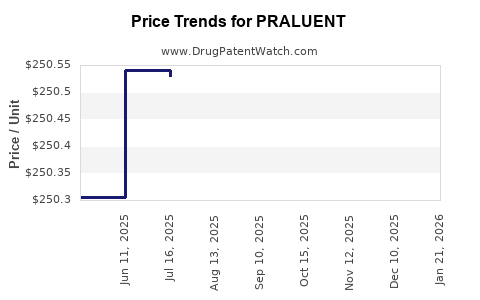
Last updated: February 19, 2026
What is the current market position of Praluent?
Praluent (alirocumab), developed by Regeneron Pharmaceuticals and Sanofi, is a monoclonal antibody targeting PCSK9 to lower low-density lipoprotein cholesterol (LDL-C). Approved by the U.S. Food and Drug Administration (FDA) in July 2015, it is marketed primarily for patients with heterozygous familial hypercholesterolemia (HeFH) and clinical atherosclerotic cardiovascular disease (ASCVD) at high risk.
The drug entered a competitive landscape dominated by Amgen’s Repatha (evolocumab), also a PCSK9 inhibitor approved in 2015. Both drugs targeted the same indications and were positioned in the same market segment.
Market share as of 2022 indicates that Praluent accounted for approximately 10-15% of the PCSK9 inhibitor prescribing volume, with Repatha capturing the majority.
What are the current sales figures and revenue outlook?
In 2022, Regeneron/Sanofi reported global sales of approximately $430 million for Praluent, noting that sales declined from a peak of $900 million in 2018. This decline relates to:
- Generic competition challenges.
- High treatment costs.
- Strict reimbursement criteria limiting patient access.
Market projections suggest that the 2022 revenue reflects shrinking market penetration.
How are pricing strategies evolving?
Initially, Praluent’s list price was around $14,600 annually, aligning with Repatha’s price. However, increased competition and reimbursement constraints have pressured pricing reductions. Both companies introduced efficiency programs, with Regeneron/Sanofi lowering list prices by approximately 25% in 2021.
In the United States, net prices after rebates and discounts are estimated at $6,500-$8,000 annually, according to IQVIA data. Payers increasingly favor value-based arrangements, including outcomes-based contracts, which limit revenue potential in direct correlation with clinical efficacy.
What are the regulatory and reimbursement influences?
The market faces challenges from:
- CMS (Centers for Medicare & Medicaid Services) implementing stricter reimbursement policies.
- Prior authorization requirements for high-cost biologics.
- Cost-effectiveness debates, with ICER (Institute for Clinical and Economic Review) suggesting that PCSK9 inhibitors are marginally cost-effective at current prices.
Potential shifts in policy favoring biosimilars or alternative therapies could further impact market access and pricing.
What is the future market potential?
The global hypercholesterolemia treatment market size was valued at approximately $9 billion in 2021 and is projected to grow at a Compound Annual Growth Rate (CAGR) of 3-4% through 2030, driven by increasing rates of cardiovascular disease and unmet needs in high-risk populations.
Praluent's share may stabilize or decline unless:
- New indications expand the patient population.
- Biosimilar competition enters the market.
- Cost reductions improve payer acceptance.
Forecasts estimate peak annual sales of Praluent could reach $600-800 million by 2028, contingent on policy and market dynamics.
What is the impact of biosimilar entry?
As of 2023, biosimilar development for PCSK9 inhibitors is underway, with potential to drastically reduce costs. The entry of biosimilars could lead to price drops of 30-50%, pressuring branded products including Praluent.
Summary of price projection scenarios
| Scenario |
Timeline |
Estimated Price Range (U.S.) |
Notes |
| Base case (continued decline) |
2023-2028 |
$6,500 - $8,000 annually |
Reflects current payer discounts, high competition. |
| Optimistic (market expansion) |
2024-2028 |
$8,500 - $10,000 annually |
New indications, better reimbursement. |
| Pessimistic (biosimilar entry) |
2024-2026 |
$3,500 - $5,000 annually |
Biosimilar competition accelerates price drops. |
Key Takeaways
- Praluent’s market share has declined since 2015, with revenue at roughly 50% of peak levels.
- Pricing has reduced through manufacturer discounts and payer negotiations.
- Market growth depends on policy shifts, biosimilar entry, and expanding indications.
- Future sales are forecasted to peak around $600 million annually by 2028, assuming market conditions favor market share retention.
- Biosimilar competition will likely be a significant driver of price reductions starting 2024.
FAQs
1. What factors influence Praluent’s pricing?
Pricing is primarily affected by competition, payer negotiations, rebate dynamics, and regulatory policies on biologics, especially biosimilars.
2. How does Praluent compare with Repatha in the market?
Repatha maintains a larger market share due to broader indication approval, perceived efficacy, and higher physician familiarity.
3. Will biosimilars significantly lower Praluent’s price?
Yes, biosimilars in development could lead to a 30-50% reduction in branded product prices if approved and adopted.
4. Are there upcoming regulatory changes that could affect pricing?
Yes, payers and regulators are increasingly implementing value-based reimbursement models, which could pressure prices further.
5. What opportunities exist for Praluent in expanding its market?
Potential opportunities include expanding indications, optimizing cost structures, and initiating patient access programs to improve affordability.
References
[1] Regeneron Pharmaceuticals. (2022). Form 10-K Annual Report.
[2] IQVIA. (2023). Pharmaceutical Market Reports.
[3] U.S. Food and Drug Administration. (2015). Praluent Approval Letter.
[4] Institute for Clinical and Economic Review. (2022). Policy Reports on PCSK9 Inhibitors.