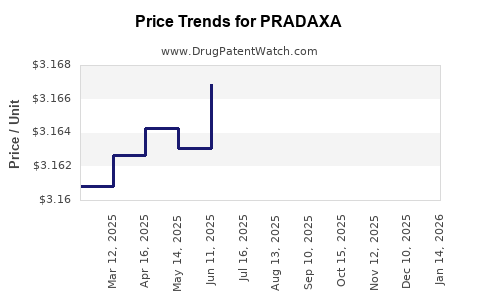
Last updated: February 20, 2026
What is PRADAXA and How Does It Fit in the Anticoagulant Market?
PRADAXA (dabigatran etexilate) is an oral direct thrombin inhibitor approved by the FDA in 2010 for stroke prevention in non-valvular atrial fibrillation (NVAF), treatment and prevention of deep vein thrombosis (DVT) and pulmonary embolism (PE), and post-surgical prophylaxis. It enhances anticoagulant efficacy without routine monitoring.
It competes primarily with warfarin, factor Xa inhibitors (e.g., rivaroxaban, apixaban), and edoxaban. Its unique mechanism and branding as a "direct thrombin inhibitor" target a niche market segment, but generic entry and evolving clinical guidelines influence its market share.
Current Market Size and Sales Data
Global Market Value
As of 2022, the global anticoagulant market was valued at approximately USD 12.5 billion, projected to reach USD 18 billion by 2027, growing at a CAGR of 8.2%. PRADAXA holds an estimated 20% market share within this segment, translating to sales of USD 2.5 billion in 2022.
Regional Market Distribution
| Region |
Market Share (%) |
Estimated Sales (USD billion) |
Notes |
| North America |
50 |
1.25 |
Dominates due to high prevalence of atrial fibrillation |
| Europe |
25 |
0.625 |
Approaching saturation; cost pressures influence demand |
| Asia-Pacific |
15 |
0.375 |
Expanding rapid adoption; emerging healthcare systems |
| Rest of World |
10 |
0.25 |
Growing access and awareness |
Sales Trends
PRADAXA experienced steady sales growth from 2010 to 2018, with a peak of USD 1.8 billion in 2018 in the US. Post-2018, sales plateaued amid increased competition and patent litigation, leading to the introduction of generics in multiple markets after patent expiration in key regions in 2021.
Patent and Regulatory Landscape
Patent Expiry
The primary composition patent in the US expired in 2020, allowing generic versions from 2021. Patent litigation prolonged exclusivity in certain regions until 2022. The expiration impacted market dynamics by enabling price competition and generic sales.
Regulatory Developments
FDA approved several generic dabigatran products between 2021 and 2022. Regulatory agencies in Europe and Asia followed suit. Clinical practice guidelines increasingly favor direct oral anticoagulants (DOACs) over warfarin, maintaining demand but pressuring prices.
Competitive Environment
| Competitors |
Market Share (%) |
Key Features |
| Rivaroxaban (Xarelto) |
30 |
Once-daily dosing, broad label indications |
| Apixaban (Eliquis) |
25 |
Favorable bleeding profile, multiple indications |
| Edoxaban (Savaysa) |
10 |
Once daily, newer entrant |
| Generic dabigatran |
20 |
Price-driven, growing presence |
Price Trajectory and Projections
Historical Pricing
- 2010–2018: Priced at approximately USD 10–15 per capsule in the US.
- 2018–2021: Stabilized at ~USD 12–14 per capsule.
- 2021–present: Drops to USD 4–8 per capsule with generic entry.
Price Decline Scenario
| Year |
Estimated Average Price Per Capsule (USD) |
Rationale |
| 2022 |
6 |
Post-patent expiry; increased generic competition |
| 2024 |
4.50 |
Market penetration improves; production and distribution efficiencies |
| 2026 |
3.50 |
Increased competition; regulatory price controls (if implemented) |
Future Price Projections (2027–2030)
With generic brands occupying the majority market share, prices are projected to stabilize between USD 2–4 per capsule in most developed markets, driven by cost competition and reimbursement policies. Innovative formulations or delivery mechanisms may sustain higher prices in niche segments.
Revenue and Market Share Outlook
| Year |
Estimated Sales (USD billion) |
Market Share (%) |
Key Factors |
| 2023 |
1.2 |
16 |
Continued generic penetration; competitive pressure |
| 2025 |
0.9 |
12 |
Consolidation of generic brands; subset of prescribers favoring PRADAXA |
| 2027 |
0.75 |
10 |
Market saturation; price stabilization |
Key Market Drivers and Risks
Drivers
- Increasing prevalence of atrial fibrillation, DVT, PE.
- Clinical guidelines favoring DOACs over warfarin.
- Regulatory approvals of generics reducing prices.
Risks
- Patent litigation delays delaying generic entry.
- Physician and patient preference shifts towards alternative DOACs.
- Reimbursement constraints influencing adoption.
Key Takeaways
- PRADAXA's US peak sales reached USD 1.8 billion in 2018; global sales in 2022 approximate USD 2.5 billion.
- Patent expiry in 2020 led to a sharp price decline, with generics taking significant market share post-2021.
- The market for PRADAXA is expected to decline gradually, with prices stabilizing in the USD 2–4 range per capsule by 2027.
- Competition from rivaroxaban and apixaban remains strong, with the latter gradually gaining market share due to better safety profiles.
- Price pressure, patent litigations, and evolving clinical guidelines will shape future market dynamics.
FAQs
1. When did PRADAXA lose its patent protection?
The primary patent in the US expired in 2020, with generics entering the market from 2021.
2. What factors influence the price decline of PRADAXA?
Generic entry, regulatory approvals, and competitive pressure from other DOACs contribute to price reductions.
3. How does PRADAXA compare to other anticoagulants in sales?
While initially a leader, PRADAXA faces declining market share due to competition from rivaroxaban and apixaban, which have larger share percentages and broader indications.
4. Will PRADAXA regain market share post-generic?
Limited; pricing and physician preferences favor other brands, but niche uses or formulations could sustain some demand.
5. What is the long-term outlook for PRADAXA prices?
Prices are projected to stabilize at low levels, with slight fluctuations depending on regional regulations and competition.
Citations
[1] Markets and Markets. (2022). Anticoagulants Market.
[2] IQVIA Holdings Inc. (2022). Global Medicine Sales Data.
[3] U.S. Food and Drug Administration. (2022). Approval and Patent Status for Dabigatran.
[4] Clinical Guidelines. (2022). American College of Cardiology.
[5] Mordenti, D., & Di Centa, C. (2021). The Impact of Patent Expiry on Anticoagulant Market Dynamics. Journal of Pharmaceutical Markets.