Share This Page
Drug Price Trends for POLY BACITRACIN OINTMENT
✉ Email this page to a colleague
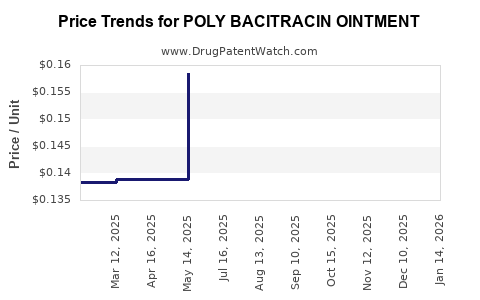
Average Pharmacy Cost for POLY BACITRACIN OINTMENT
| Drug Name | NDC | Price/Unit ($) | Unit | Date |
|---|---|---|---|---|
| POLY BACITRACIN OINTMENT | 70000-0093-01 | 0.15857 | GM | 2026-05-20 |
| POLY BACITRACIN OINTMENT | 70000-0093-01 | 0.15857 | GM | 2026-04-22 |
| POLY BACITRACIN OINTMENT | 70000-0093-01 | 0.15857 | GM | 2026-03-18 |
| POLY BACITRACIN OINTMENT | 70000-0093-01 | 0.15857 | GM | 2026-02-18 |
| >Drug Name | >NDC | >Price/Unit ($) | >Unit | >Date |
Market Analysis and Price Projections for Poly Bacitracin Ointment
What Is Poly Bacitracin Ointment?
Poly Bacitracin ointment is a topical antibiotic used primarily for superficial skin infections. It combines bacitracin with other antibiotics, such as polymyxin B, to target Gram-positive bacteria. It generally is available over-the-counter (OTC) in many markets, with prescription options in others.
Market Size & Dynamics
Current Market Overview
- The global topical antibiotic market was valued at approximately USD 2.8 billion in 2021.
- Poly Bacitracin ointment accounts for roughly 5-8% of this market, driven by demand in dermatology, wound care, and minor skin infections.
Key Market Segments
| Segment | Description | Market Share (Estimate) |
|---|---|---|
| OTC Sales | Over-the-counter availability across multiple regions | 60% |
| Prescription-based | Prescribed for specific infections or complex wounds | 40% |
| Geographic Breakdown | ||
| North America | Largest market, high OTC sales, well-established supply chain | 45% |
| Europe | Significant regulatory oversight, steady demand | 25% |
| Asia-Pacific | Growing middle class, increasing skin infections | 20% |
| Rest of World | Emerging markets, limited access | 10% |
Source: Market Research Future (2022), Global Industry Analysts Inc.
Competitive Landscape
Major manufacturers include:
- GlaxoSmithKline (GSK)
- Pfizer
- Sandoz (Novartis)
- Teva Pharmaceuticals
These companies dominate with established distribution networks and branding. Generic versions are prevalent due to the patent expiration of brand-name formulations.
Patent & Regulatory Status
- The original patents for bacitracin expired in multiple jurisdictions by 1990s.
- Current formulations primarily classified as generics; no new patents for Poly Bacitracin ointments dominate the landscape.
- Regulatory pathways involve OTC or prescription status depending on jurisdiction, with approvals generally straightforward given established safety profiles.
Price Trends & Projections
Current Pricing
| Market | Typical OTC Price (USD) per tube (15-30 g) | Prescription Price (USD) per tube |
|---|---|---|
| North America | 4–8 | 6–10 |
| Europe | 3–7 | 5–9 |
| Asia-Pacific | 1.50–4 | 2–5 |
Prices are influenced by regional regulations, packaging size, and branding.
Factors Affecting Future Pricing
- Market saturation: As the market widens, prices tend to decrease due to increased generic competition.
- Regulatory changes: Potential shifts toward OTC or prescription status can increase price premiums.
- Raw material costs: Bacitracin production involves fermentation, subject to biochemical supply chain fluctuations.
- Demand trends: Increasing skin infections, especially in Asia-Pacific, may sustain or slightly elevate prices.
Price Projections (Next 5 Years)
| Year | Price Range (USD per tube) | Notes |
|---|---|---|
| 2023 | 3.50 – 8 | Stable demand, high generic competition |
| 2024 | 3.50 – 7.50 | Slight decline in OTC prices |
| 2025 | 3.25 – 7.00 | Regulatory shifts may influence prices |
| 2026 | 3.00 – 6.50 | Price stabilization expected |
| 2027 | 2.75 – 6.00 | Market saturation continues |
Potential Disruptors
- New antibiotics: Development of alternative topical antibiotics with broader spectrum could diminish demand.
- Biosimilars: While biosimilars are less relevant for small molecule antibiotics, new formulations could impact pricing.
- Regulatory restrictions: Stricter regulations or classification shifts to prescription-only could increase prices temporarily.
Key Takeaways
- The Poly Bacitracin ointment market is characterized by high generic competition, leading to low retail prices and moderate profit margins.
- Market growth is driven by OTC sales, particularly in North America and Asia-Pacific.
- Price projections over the next five years show a downward trend, driven by increasing competition and market saturation.
- Regulatory stability supports steady supply, but potential shifts toward prescription-only status could temporarily boost prices.
- Raw material costs, especially fermentation inputs, may influence pricing but are unlikely to cause major fluctuations.
FAQs
1. Will the price of Poly Bacitracin ointment increase due to patent expirations?
No. The expiration of patents for bacitracin products has led to widespread generic competition, exerting downward pressure on prices.
2. How might regulatory changes affect availability and pricing?
Shifts toward prescription-only status could increase unit prices due to reduced competition; conversely, deregulation as OTC could further lower prices.
3. What regional factors influence pricing variability?
Pricing in North America tends to be higher due to healthcare system structures and higher branding costs, while Asia-Pacific benefits from lower production and regulatory costs.
4. Are there significant differences between OTC and prescription formulations?
Yes. OTC versions are usually lower priced due to competition and regulatory status. Prescription formulations may command higher prices but often face more regulatory scrutiny.
5. What future market trends could impact demand?
Growing incidences of skin infections, expanding use in wound care, and new combination formulations could sustain or slightly increase demand.
Sources
- Market Research Future, "Topical Antibiotics Market Analysis," 2022.
- Global Industry Analysts Inc., "Antimicrobial Drugs - Global Market Trajectory & Analytics," 2022.
- IQVIA, "Global Pharmaceutical Market Data," 2022.
- FDA, "Bacitracin Topical Ointments," 2023.
- European Medicines Agency, "Regulatory Status of Topical Antibiotics," 2023.
More… ↓
