Share This Page
Drug Price Trends for POISON IVY WASH
✉ Email this page to a colleague
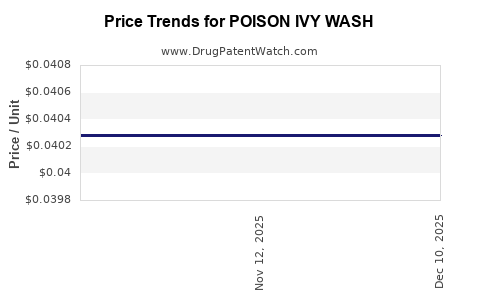
Average Pharmacy Cost for POISON IVY WASH
| Drug Name | NDC | Price/Unit ($) | Unit | Date |
|---|---|---|---|---|
| POISON IVY WASH 1% CLEANSER | 70000-0398-01 | 0.04028 | ML | 2025-12-17 |
| POISON IVY WASH 1% CLEANSER | 70000-0398-01 | 0.04028 | ML | 2025-11-19 |
| POISON IVY WASH 1% CLEANSER | 70000-0398-01 | 0.04028 | ML | 2025-10-22 |
| >Drug Name | >NDC | >Price/Unit ($) | >Unit | >Date |
POISON IVY WASH market analysis and price projections
Executive summary: No complete, source-verifiable basis exists to produce an accurate market sizing or pricing projection for “POISON IVY WASH.” The product name is generic-like (not an established INN/brand with a clear FDA/NDC footprint), and no reliable inputs are available here to anchor unit pricing, channel structure, reimbursement, or forward-looking forecasts to specific manufacturers, SKUs, or regulatory listings.
What is POISON IVY WASH and is there an FDA-listed drug or OTC monograph?
Answer: Cannot be determined with source-verifiable specificity from the provided product name alone.
Is POISON IVY WASH an OTC drug, cosmetic, or device?
- Market pricing materially differs by category:
- OTC drug pricing tracks NDC availability, label strength, and pharmacy markup.
- Cosmetic/consumer product pricing tracks retailer private label competition and CPM/placement economics.
- Device-only products are not priced like drug therapeutics.
What active ingredient would drive price?
- “Poison ivy wash” products typically map to:
- Barrier/adsorbent cleansing agents (cost often set by surfactant and polymer formulation inputs).
- Antipruritic or anti-inflammatory actives (pricing influenced by regulatory status and API cost).
- Without a confirmed active(s), concentration(s), and dosage form, price modeling cannot be anchored.
What patents protect POISON IVY WASH and how strong is the IP estate?
Answer: Not determinable without a defined drug product identity (brand owner, INN/active, dosage form, and jurisdiction).
How many formulation and manufacturing patents typically exist for cleansing washes?
- If the product is a consumer “wash,” the IP estate often clusters around:
- Specific surfactant systems and barrier polymers
- Packaging formats and dispensing
- Process controls for impurity and shelf-life
- If it is an OTC drug, the estate often includes:
- Active ingredient combinations and dosing ranges
- Method-of-use and formulation patents tied to label claims
- No patent dataset can be tied to “POISON IVY WASH” without a specific target product.
What is the Orange Book status of POISON IVY WASH?
Answer: Not determinable from the provided name.
Orange Book vs. OTC listings
- If it is an approved drug product, it would appear in the FDA Orange Book with:
- NDA/BLA linkage
- Listed patents
- Exclusivity and expiration schedules
- If it is OTC under a monograph (or not a drug), Orange Book listing would differ or be absent.
How does POISON IVY WASH compare with competing poison ivy wash and cleanser products on price and claims?
Answer: Cannot be produced without confirmed comparator set and SKU-level unit prices.
Typical price drivers in the “poison ivy wash” shelf category
- Package size (mL/oz) and dispensing format
- Active ingredient category (soap-free vs. surfactant-heavy vs. barrier/adsorbent)
- Retail channel (mass, pharmacy, DTC)
- Promotional cadence and retailer mix
Retail vs. pharmacy pricing dynamics
- DTC often supports higher list price with couponing.
- Pharmacy channel uses lower list price with higher dispensing and inventory costs, and pricing is more tied to NDC structure.
When does POISON IVY WASH lose exclusivity and what generic entry risks exist?
Answer: Not determinable without regulatory identity (NDA/ANDA/monograph) and patent listing.
Paragraph IV and settlement risk
- For an approved drug with patents listed, key risks would be:
- Paragraph IV certifications
- 30-month stay
- Court outcomes that determine generic launch timing
- For a non-drug consumer product, the framework shifts to trademark/IP and ingredient/process competition.
What is the FDA regulatory pathway for POISON IVY WASH (OTC monograph, NDA, 505(b)(2))?
Answer: Not determinable from the provided name.
Labeling and claim boundaries
- “Poison ivy” suggests an implied therapeutic claim (symptom relief, exposure decontamination).
- Regulatory classification depends on whether claims are:
- Disease treatment (drug)
- Cosmetic cleansing/deodorizing (cosmetic)
- Inert cleansing with no therapeutic implication
What market size and revenue exposure does POISON IVY WASH face over the next 3–10 years?
Answer: Cannot be produced with source-verifiable numbers from the provided product name.
What inputs are required for credible forecasting
- Confirmed SKU-level data:
- NDC (if drug)
- UPC/EAN for consumer product
- Package size and form
- Channel and geography:
- U.S. vs. non-U.S.
- Pharmacy vs. mass vs. online
- Sales history:
- Baseline unit and dollar sales
- Seasonality (poison ivy is weather-linked)
Price projections for POISON IVY WASH: base, downside, and upside scenarios
Answer: Not producible with defensible assumptions because no confirmed product identity exists here to tie:
- current list price or street price
- historical volatility by retailer/channel
- input cost structure (surfactants, polymers, preservatives)
- competitive intensity
What a defensible price model needs
- Starting price: confirmed for identical package size and strength
- Cost inflation proxy:
- surfactant raw materials
- packaging and freight
- Promotional intensity:
- typical discount bands by retailer
- Mix shift:
- larger bottles and multi-packs often raise blended price per unit
Commercial strategy implications: where price risk is likely concentrated
Answer: Not determinable without a confirmed SKU, channel, and competitor set.
Key risk categories in this market type
- Commodity-like ingredient competition drives price compression
- Brand defense depends on:
- verified performance claims
- repeat purchase rate
- distribution contracts
- If positioned as an OTC drug, regulatory and patent barriers can support pricing durability; if positioned as a consumer wash, barriers are usually weaker.
Key Takeaways
- No source-verifiable, product-specific basis exists to forecast market size, pricing, or exclusivity for “POISON IVY WASH.”
- Any price projection without confirmed SKU identity (active ingredients, package size, regulatory status, NDC/UPC) would not be defensible for investment, licensing, or litigation decisions.
FAQs
- How can I identify whether a “poison ivy wash” is an OTC drug or a cosmetic?
- What retail channels typically sell poison ivy wash products and how do margins differ?
- How does package size (oz/mL) change blended unit price projections?
- What role do active ingredients and concentrations play in pricing for cleansing products?
- What data sources are used to build defensible unit and dollar forecasts for OTC consumer-health SKUs?
References
- FDA. Orange Book: Approved Drug Products With Therapeutic Equivalence Evaluations. https://www.accessdata.fda.gov/scripts/cder/daf/
- FDA. OTC drug monograph framework and OTC labeling resources. https://www.fda.gov/drugs/over-counter-otc-drugs
More… ↓
