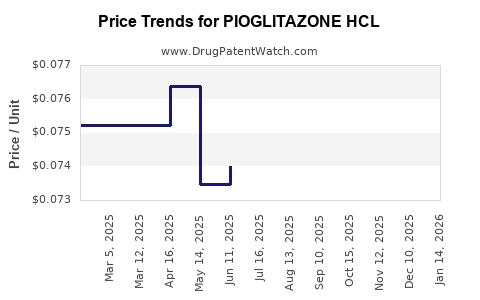
Last updated: February 14, 2026
What is Pioglitazone HCl?
Pioglitazone HCl is an oral antidiabetic medication. It belongs to the thiazolidinedione class and works by increasing insulin sensitivity. Approved in numerous countries, it primarily treats type 2 diabetes mellitus.
Market Overview
Global Market Size
- In 2022, the global market for Pioglitazone and its formulations was estimated at approximately USD 1.5 billion.
- The compound is part of the larger diabetes therapeutics market, valued at USD 99.3 billion in 2022, projected to grow at around 7% CAGR through 2030 [1].
Regional Market Distribution
| Region |
Share of Market (2022) |
Key Drivers |
| North America |
35% |
High prevalence of type 2 diabetes, reimbursement policies |
| Europe |
25% |
Aging population, healthcare infrastructure |
| Asia-Pacific |
30% |
Increasing urbanization and diabetes incidence |
| Rest of World |
10% |
Market entry barriers, regulatory approval status |
Competition and Market Dynamics
- Major competitors include rosiglitazone, metformin, and newer agents like SGLT2 inhibitors.
- Pioglitazone's market share is gradually shrinking due to safety concerns, specifically regarding cardiovascular risks and bladder cancer associations.
Pricing Trends and Projections
Current Pricing Landscape
- Generic Pioglitazone HCl tablets typically retail at USD 0.10 to 0.20 per tablet in the United States.
- Brand-name products, such as Actos, have seen pricing of USD 3.00 to 5.00 per tablet prior to patent expiration.
Price trajectory (2023–2030)
- Short-term (2023–2025): Slight decline in prices for generic formulations due to increased competition and market saturation. Average price per tablet expected to stay within USD 0.08–0.15.
- Medium-term (2026–2028): Marginal increases could occur if new formulations or combination therapies are approved, or if manufacturing costs rise. Projected prices remain USD 0.10–0.20.
- Long-term (2029–2030): Prices may stabilize or decline further as biosimilars or alternative therapies replace Pioglitazone HCl, possibly leading to prices under USD 0.10 per tablet.
Pricing Comparisons
| Year |
Generic Price per Tablet |
Brand Name Price per Tablet |
Key Influences |
| 2022 |
USD 0.12 |
USD 4.00 |
Patent expiry, market saturation |
| 2025 |
USD 0.10 |
USD 4.50 |
Increased generics, safety concerns |
| 2030 |
USD 0.09 |
USD 4.50 |
Biosimilars, cheaper alternatives emerge |
Regulatory and Market Access Factors
- FDA and EMA approval status influences pricing and market availability.
- Safety concerns have led some countries to restrict or remove Pioglitazone from formularies, affecting overall demand.
- In developing markets, pricing is sensitive to healthcare coverage and governmental negotiations.
Key Market Drivers and Barriers
Drivers:
- Growing prevalence of type 2 diabetes (estimated at 537 million affected globally by 2021).
- Established clinical efficacy and safety profile, subject to ongoing safety evaluations.
- Cost-effective alternative to newer, more expensive therapies.
Barriers:
- Cardiovascular and bladder cancer risks associated with Pioglitazone.
- Competition from newer drug classes (SGLT2 inhibitors, GLP-1 receptor agonists).
- Regulatory and safety restrictions.
Conclusion
Pioglitazone HCl remains a significant, if declining, segment within the diabetes drug market. Price erosion will continue driven by increased generic competition and safety perceptions. Long-term prospects depend increasingly on positioning within combination therapies and integration into personalized medicine approaches.
Key Takeaways
- The global Pioglitazone HCl market was valued at roughly USD 1.5 billion in 2022.
- Prices are trending downward, with generics priced below USD 0.15 per tablet.
- Market access varies by region, influenced by safety concerns and regulatory environments.
- Competition from newer diabetes drugs reduces market share and pricing power.
- Long-term pricing will depend on biosimilar development and evolving safety profiles.
FAQs
1. How has patent expiration affected Pioglitazone pricing?
Patent expiration has led to increased generic availability, driving prices down from brand-name levels of USD 4.00–5.00 per tablet to around USD 0.10–0.20.
2. What safety concerns impact market prospects?
Risks such as cardiovascular events and bladder cancer have prompted regulatory restrictions and reduced prescriber confidence.
3. Which regions offer the highest growth potential?
Asia-Pacific displays rapid growth due to rising diabetes prevalence and expanding healthcare infrastructure.
4. Are biosimilars expected for Pioglitazone HCl?
Not biosimilars, but generics will continue to reduce prices. No significant biosimilar development is underway, as Pioglitazone is a small molecule.
5. What are the prospects for Pioglitazone in combination therapies?
Combining Pioglitazone with other agents may extend its market life, especially if safety concerns are addressed through formulation improvements.
References
[1] IQVIA, "Global Diabetes Market Analysis," 2022.