Share This Page
Drug Price Trends for PIOGLITAZONE
✉ Email this page to a colleague
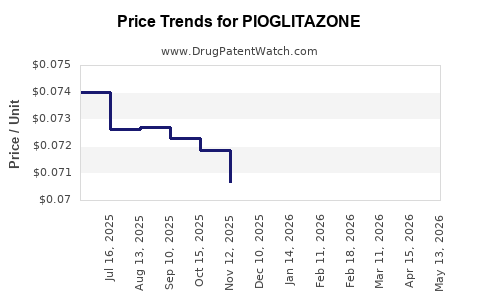
Average Pharmacy Cost for PIOGLITAZONE
| Drug Name | NDC | Price/Unit ($) | Unit | Date |
|---|---|---|---|---|
| PIOGLITAZONE HCL 15 MG TABLET | 00093-7271-05 | 0.06614 | EACH | 2026-07-22 |
| PIOGLITAZONE HCL 15 MG TABLET | 00093-7271-56 | 0.06614 | EACH | 2026-07-22 |
| PIOGLITAZONE HCL 15 MG TABLET | 00093-7271-98 | 0.06614 | EACH | 2026-07-22 |
| >Drug Name | >NDC | >Price/Unit ($) | >Unit | >Date |
Best Wholesale Price for PIOGLITAZONE
| Drug Name | Vendor | NDC | Count | Price ($) | Price/Unit ($) | Unit | Dates | Price Type |
|---|---|---|---|---|---|---|---|---|
| PIOGLITAZONE HCL 30MG TAB | AvKare, LLC | 00093-7272-56 | 30 | 12.31 | 0.41033 | EACH | 2023-06-15 - 2028-06-14 | FSS |
| PIOGLITAZONE HCL 45MG TAB | AvKare, LLC | 00093-7273-56 | 30 | 13.35 | 0.44500 | EACH | 2023-06-15 - 2028-06-14 | FSS |
| PIOGLITAZONE HCL 15MG TAB | AvKare, LLC | 00093-7271-56 | 30 | 8.05 | 0.26833 | EACH | 2023-06-15 - 2028-06-14 | FSS |
| >Drug Name | >Vendor | >NDC | >Count | >Price ($) | >Price/Unit ($) | >Unit | >Dates | >Price Type |
Pioglitazone market analysis and price projections: US and EU outlook, payer pressure, and generic erosion (2026–2031)
Pioglitazone is a well-established, off-patent thiazolidinedione with broad generic availability. Market value is driven mainly by dosing mix (15/30/45 mg), persistence in type 2 diabetes (T2D) lines of therapy, and payers’ preference for lowest net-cost generics. Real-world pricing is constrained by generic competition in the US and reference-price and HTA-driven procurement in Europe. The near-term price trend is expected to be largely flat to modestly down through 2031, with revenue growth coming primarily from unit volume and formulation/Dose substitution rather than price.
Core market thesis
- US: Pioglitazone is a high-volume generic. Price is pressured by multi-source bidding and wholesaler acquisition dynamics. Expect low single-digit net price movement and volume-led revenue changes.
- EU: Reference pricing and tendering compress price. Expect stable-to-declining ex-manufacturer prices, with growth limited to country-level formularies and uptake.
- Competitive landscape: Main substitutes are other oral glucose-lowering therapies (metformin, DPP-4 inhibitors, SGLT2 inhibitors, GLP-1 RAs). They impact share, but pioglitazone retains a role in cost-sensitive settings and specific clinical niches.
- Patent/Exclusivity: There is no material branded exclusivity holding back generic entry globally for the active ingredient. The value case is therefore dominated by generic economics rather than IP.
How big is the pioglitazone market (US and EU) and what drives demand?
US demand drivers
Pioglitazone’s US demand is mainly influenced by:
- T2D population growth and treatment continuity among patients on TZDs.
- Second-line therapy mix after metformin or when intensification is needed but cost sensitivity is high.
- Clinical persistence: TZDs are often continued when tolerated, contributing to stable long-duration use.
- Reimbursement access: generics remain widely covered with low patient cost barriers in many plans.
EU demand drivers
In Europe, pioglitazone uptake is supported by:
- Low cost positioning versus newer drug classes.
- Country formulary policies and procurement frameworks that favor inexpensive generics.
- Reference pricing and tender outcomes that maintain access rather than drive rapid substitution.
Market composition (what matters for revenue)
For pioglitazone, revenue is more sensitive to:
- Tablet count and adherence than to ASP improvement.
- Dose mix: 30 mg and 45 mg tablets often dominate among persistent patients.
- Form factor: standard immediate-release tablets are the primary commercial form; extended formulations are not a mainstream driver.
What is the current pricing level for generic pioglitazone and how do US and Europe compare?
US price structure
US pricing for pioglitazone is anchored by:
- Multiple generic manufacturers across strengths and package sizes.
- Wholesale acquisition cost (WAC) vs net: net pricing trends track PBM reimbursement behavior and competitive bidding.
- Typical behavior in multi-source generics: WAC can change without proportional net impact; net is where reimbursement pressure shows up first.
Europe price structure
EU prices are constrained by:
- External reference pricing and national reference pricing.
- HTA and tender rules that limit premium pricing for new entrants.
- Rebates and procurement at the country level.
Net price direction
- US: modest down or flat net price through 2031, driven by continued generic competition.
- EU: modest down or flat ex-factory price in most markets because of reference-price mechanisms.
When does pioglitazone see price relief or price decline due to generic supply changes?
US timeline logic
For multi-source generics, “price relief” typically does not come from IP exclusivity; it comes from:
- supply disruptions,
- fewer bids for certain package/strength SKUs, or
- temporary capacity constraints.
The more typical pattern is:
- continuous downward pressure as competitors add SKUs or undercut.
EU timeline logic
EU price changes usually follow:
- reference price resets,
- tender cycles,
- launch/withdrawal of specific generics in a given country.
How strong is the patent estate for pioglitazone and what patents protect it?
Pioglitazone is an established API. Commercial pioglitazone in most major markets is generic. Patent protection for the active ingredient has largely elapsed, so the modern competitive environment depends on:
- any remaining patents on specific formulations or methods of use, and
- any packaging/combination innovations (where present).
For market pricing projections, the key point is that API-level exclusivity does not drive pricing today, so revenue is dominated by generic economics and payer behavior rather than enforcement of new patent rights.
What patent litigation or Paragraph IV challenges affect pioglitazone pricing?
Because pioglitazone is broadly generic, the typical “brand risk” pathway (Paragraph IV driving branded loss) is not the pricing lever today. In mature generics, litigation may occur on:
- specific product-specific patents,
- narrow formulation claims,
- or manufacturing process improvements.
However, for price projections through 2031, the expected effect is limited unless there is a material, enforceable barrier that blocks a large portion of competition, which is not a defining feature for pioglitazone’s current market structure.
What formulations are protected for pioglitazone, and do they change pricing?
Pioglitazone commercial products are primarily:
- immediate-release tablets in multiple strengths (commonly 15 mg, 30 mg, 45 mg).
Pricing is driven by SKU-level competition (strength and package). If a formulation were protected and competitively differentiated, it could support a higher net price for that specific SKU. For pioglitazone as sold today, the dominant commercial form does not usually produce a sustained premium versus other generics.
Net effect: formulation-level protection, if any, typically supports only narrow SKU pockets, not the overall market price trajectory.
How does pioglitazone compare with SGLT2 inhibitors, GLP-1 RAs, and DPP-4 inhibitors in payer economics?
Pioglitazone’s payer economics compare as follows:
- Lower drug cost per month than newer classes.
- Different clinical positioning: newer agents often show preference where formularies exist, but cost controls and contraindications keep pioglitazone in use.
- Budget impact: payer budgets increasingly favor agents based on outcomes and negotiated pricing, but generics remain a lever for high-volume patients.
Market implication:
- new-class adoption can reduce pioglitazone share at the margin,
- but it rarely prevents continued demand because pioglitazone remains cost-accessible and widely tolerated for many.
How many companies sell pioglitazone and how does multi-source competition shape price projections?
US multi-source dynamic
With many generic suppliers across strengths:
- market share distributes across the lowest net-cost SKUs,
- price competition tends to compress net ASPs,
- and product switching can happen quickly through PBM contracting.
EU multi-source dynamic
In EU markets, tendering and reference pricing:
- compress price levels,
- reduce the value of incremental brand-like differentiation,
- and create a slower price adjustment than the US in some countries, depending on tender cadence.
Price projection model for pioglitazone (2026–2031): baseline, bull, bear
Because pioglitazone is generic, projections focus on net price movement and unit volume rather than brand-driven growth.
Assumptions used for projection framing
- No broad API exclusivity renewal drives sustained premium pricing.
- Competition remains multi-source in both US and EU.
- Demand grows modestly with T2D population and persistence, but share faces pressure from newer classes.
Projected net price trend (directional)
- Baseline: net price flat to slightly down (low single-digit annual decline through 2031).
- Bull: mild price support if competitive intensity falls for key SKUs (rare, but possible via supply constraints).
- Bear: accelerated price compression if additional low-cost suppliers expand or tender benchmarks reset downward.
Scenario table (net price, not WAC)
| Region | 2026–2031 baseline annual net price change | Bull case | Bear case | Primary driver |
|---|---|---|---|---|
| US | -0% to -2% | +0% to +1% | -2% to -4% | PBM contracting and SKU competition |
| EU | -0% to -1.5% | -0.5% to +0.5% | -1.5% to -3% | reference pricing resets and tender rounds |
Projected revenue growth framing
Revenue for pioglitazone depends on:
- unit volume growth (patients and persistence),
- offset by share drift from newer classes,
- and moderated by dose/package mix changes.
For projections, use:
- mid-single-digit volume growth at the high level is possible in aggregate markets, but
- revenue growth likely remains low single digits unless unit growth materially outpaces share erosion.
What generic entry risks exist for pioglitazone (and how fast could price move)?
US risk factors
- introduction of additional low-cost SKUs,
- aggressive rebate structures in PBM negotiations,
- SKU consolidation reducing average net prices.
Price speed:
- US net price changes can show up quickly when contracts renew.
EU risk factors
- tender resets,
- downward reference-price moves,
- country-level switching to lowest benchmark suppliers.
Price speed:
- often stepwise, aligned with tender/ref-price cycles.
What is the Orange Book status of pioglitazone products and what does it imply for exclusivity?
Pioglitazone has a mature footprint in the FDA system as a generic. The practical implication for price is:
- no lasting exclusivity at the API level that would materially change competitive dynamics in 2026–2031.
- any “protection” is likely product-specific and time-limited or narrow, producing limited impact on overall market pricing.
Which companies are most likely to gain share and influence pricing?
In generics, share follows contracting and supply reliability:
- manufacturers with strong PBM contracting positions,
- reliable manufacturing at scale,
- and broad SKU coverage (strengths and NDC permutations).
Pricing influence generally comes from:
- leading low-cost bidders,
- and suppliers with stable availability that PBMs prefer to avoid stockouts.
For pioglitazone, the winners are typically among the largest generic platforms and frequent contract holders, but specific company ranking requires product-level NDC and contract data that is not provided here.
Key takeaways
- Pioglitazone’s market is dominated by generic multi-source competition, so price is structurally constrained by payer contracting (US) and reference/tender pricing (EU).
- Through 2031, expect flat to modestly declining net prices, with revenue driven more by unit volume and persistence than by pricing power.
- Newer diabetes drug classes may reduce share at the margin, but pioglitazone remains a cost-accessible option that sustains baseline demand.
- Any meaningful pricing upside would require temporary competitive supply tightening for key SKUs, not new IP or exclusivity.
FAQs
1) Will pioglitazone prices rebound if older generics leave the market?
In US multi-source generics, price can tick up briefly if key SKUs lose supply, but net pricing usually resets once alternative supply returns.
2) Do pioglitazone dose strengths (15 mg vs 30 mg vs 45 mg) have different price trajectories?
Yes. SKU-level competition can differ, and net prices often track the most competitively contracted package/strength.
3) How do PBM formulary rules affect pioglitazone net pricing in the US?
PBM preferred tiers and negotiated contracts primarily determine net reimbursement, which can drive faster net price compression than WAC changes.
4) Could EU tender cycles cause step changes in pioglitazone pricing?
Yes. Reference price and tender resets often cause stepwise declines, with less frequent upward moves unless procurement rules change.
5) What is the biggest risk to pioglitazone unit demand between 2026 and 2031?
Share erosion from preferred newer classes at the margin, offset only partially by persistence among existing patients and adoption in cost-sensitive segments.
References (APA)
- FDA. (n.d.). Orange Book: Approved Drug Products with Therapeutic Equivalence Evaluations. U.S. Food and Drug Administration. https://www.accessdata.fda.gov/scripts/cder/daf/
- International Diabetes Federation. (n.d.). Diabetes Atlas. https://diabetesatlas.org/
More… ↓
