Last updated: February 13, 2026
What is the Current Market Status of PILOCARPINE?
PILOCARPINE is an alkaloid used primarily for glaucoma treatment and to induce salivation in radiation therapy patients experiencing dry mouth. It is an established drug with a history of use spanning several decades. The drug is available in both generic and branded forms, with generic formulations dominating the market.
Worldwide, the PILOCARPINE market is modest compared to modern glaucoma medications, owing to its older status and side effect profile. The drug's sales largely depend on regional healthcare policies, the prevalence of dry mouth complications, and the acceptance of alternative therapies for glaucoma.
How Is the Market Size Distributed Globally?
The global PILOCARPINE market is estimated to have a value of approximately $50-100 million in 2022. Growth is constrained by the availability of newer, more tolerable drugs such as prostaglandin analogs. The distribution is as follows:
| Region |
Market Share |
Key Factors |
| North America |
35% |
Well-established healthcare infrastructure, older patient population, generic availability |
| Europe |
20% |
Similar factors as North America, regulatory approval of generics |
| Asia-Pacific |
25% |
Growing healthcare access, developing markets, high prevalence of glaucoma |
| Latin America |
10% |
Limited access in rural areas, reliance on generic formulations |
| Middle East & Africa |
10% |
Emerging markets, cost-sensitive healthcare systems |
Who Are the Main Market Players and Patent Status?
Most formulations of PILOCARPINE are off patent, existing as generics. No recent patent filings or exclusivity rights are associated with PILOCARPINE, allowing manufacturing by multiple companies worldwide. Major players include:
- Purdue Pharma (historically)
- Sandoz
- Teva Pharmaceuticals
- MundiPharma
- Generic manufacturers in India and China
The absence of active patents limits proprietary development but encourages competition and price erosion.
What Are the Pricing Trends and Projections?
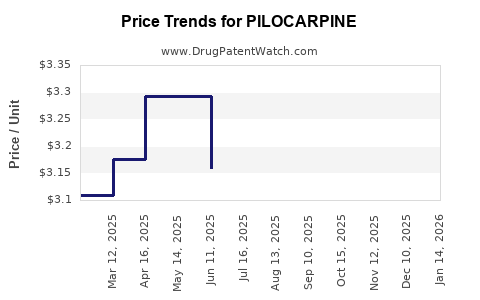
Current prices for PILOCARPINE tablets (30 mg) range from $0.05 to $0.20 per tablet, depending on the manufacturer and region. For example, in the US, a monthly supply (30 tablets) can cost approximately $1.50–$6 at wholesale.
Projected price trends over the next five years suggest a decline of 10-20% annually, driven by:
- Increased generic competition
- Manufacturing cost reductions
- Market saturation in developed countries
In emerging markets, prices will stabilize due to limited competition and cost-sensitive healthcare systems.
| Year |
Price Range (per tablet) |
Expected Trend |
| 2023 |
$0.05–$0.20 |
Stable to slight decrease |
| 2025 |
$0.04–$0.15 |
Continued decline |
| 2027 |
$0.03–$0.12 |
Approaching cost of production |
How Might Regulatory Developments Influence the Market?
New regulatory classifications or approvals for alternative drugs with improved tolerability could diminish PILOCARPINE's market share. Conversely, approval of formulations with better delivery systems or reduced side effects may stabilize or increase prices temporarily.
Any shift towards generic licensing in emerging markets would further commoditize the drug, driving prices down. The absence of newer patent protections likely limits significant market expansion opportunities.
What Are the Opportunities and Risks?
Opportunities:
- Expansion in regions with unmet demand for dry mouth treatments
- Development of new formulations, such as controlled-release tablets or topical applications, which may command higher prices
Risks:
- Introduction of newer drugs with improved safety profiles
- Price erosion due to generic proliferation
- Regulatory changes favoring alternative therapies
Key Takeaways
- PILOCARPINE remains a low-cost, off-patent drug primarily used for glaucoma and dry mouth management.
- Market size is approximately $50-100 million globally, with growth constrained by competition from modern therapies.
- Prices are declining due to generic competition, with a projected 10-20% annual decrease over the next five years.
- The absence of patent protections limits innovation but sustains intense price competition.
- Regional differences dominate market dynamics, with emerging markets showing growth potential.
FAQs
1. Are there any ongoing R&D efforts to develop new PILOCARPINE formulations?
Current efforts focus on reformulating PILOCARPINE for improved delivery rather than new chemical entities. No significant pipeline projects are publicly known.
2. How does PILOCARPINE compare cost-wise to alternative treatments for dry mouth?
It remains among the most affordable options in most regions, especially as generics dominate. The cost advantage persists over newer treatments.
3. What are the primary adverse effects influencing consumer acceptance of PILOCARPINE?
Side effects include sweating, nausea, diarrhea, and increased salivation, which can limit patient compliance.
4. Is PILOCARPINE approved for indications beyond glaucoma and dry mouth?
No. Its approved uses remain limited to those indications, with off-label use being uncommon.
5. How will regulatory trends affect PILOCARPINE's market longevity?
Regulatory preferences for newer, better-tolerated drugs may accelerate market decline, but existing formulations will remain in use in regions with limited healthcare resources.
References
[1] MarketWatch, "Global Glaucoma Drugs Market," 2022.
[2] IQVIA, "Pharmaceutical Pricing Trends," 2022.
[3] U.S. FDA, "Drug Approvals and Regulations," 2022.
[4] GlobalData, "Dry Mouth Management Market Outlook," 2022.