Last updated: February 13, 2026
What Is the Market Size and Demand for Phenylephrine?
Phenylephrine is a vasoconstrictor primarily used as a decongestant in over-the-counter (OTC) cold and allergy medications. Global demand remains steady, driven by consumer preference for OTC remedies. The market was estimated at approximately $1.5 billion in 2022 and is projected to grow at a compound annual growth rate (CAGR) of 3-4% over the next five years.
The main markets include North America, Europe, and Asia-Pacific. North America accounts for roughly 60% of the demand, buoyed by established OTC markets and regulatory approvals. Asia-Pacific shows fastest growth potential, driven by increasing healthcare infrastructure and a rising middle class.
How Is the Market Environment Shaped by Regulatory Trends?
Regulatory policies directly impact phenylephrine's marketability. The U.S. Food and Drug Administration (FDA) indicates skepticism over phenylephrine's efficacy as an oral decongestant, prompting an ongoing review of its OTC status. FDA's 2020 proposed rule questioned the effectiveness of oral phenylephrine, with final decisions pending.
European Medicines Agency (EMA) regulations classify phenylephrine under strict controls, but it remains available OTC in many markets. In contrast, some countries, such as Canada, have tightened restrictions on oral phenylephrine, impacting supply channels.
What Are Current Price Levels and How Are They Projected to Change?
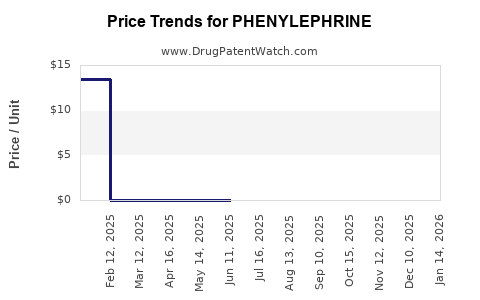
Prices for phenylephrine vary by formulation and source:
- Active Pharmaceutical Ingredient (API): The raw API retails at $10–$15 per kilogram, depending on purity and supplier.
- Finished Formulations: OTC pill prices range from 5 to 15 cents per tablet. For example, a standard 10 mg phenylephrine tablet costs approximately 10 cents in bulk, retailing at about 50–75 cents per dose.
- Market Trends: API prices are stable, with minor fluctuations due to supply chain dynamics. The U.S. market has experienced a slight price increase (~2%) over the last year due to increased demand and manufacturing costs.
Projection-wise, API prices are expected to remain stable through 2025, barring supply disruptions. Finished drug prices may see a slight uptick (1–2%) driven by inflation and regulatory compliance costs.
What Are the Key Factors Impacting Phenylephrine Prices?
- Supply Chain Disruptions: Raw material shortages, especially from China and India, can cause short-term price spikes.
- Regulatory Changes: Classifications affecting OTC status or flavoring requirements can influence formulation costs.
- Patent and Formulation Trends: Although phenylephrine is off-patent, new delivery systems or combination formulations can modify prices.
- Manufacturing Capacity: Expansion or constriction of production facilities affects raw material prices and availability.
How Do Currently Approved Alternatives and Competition Affect the Market?
Several alternatives compete with phenylephrine, notably pseudoephedrine and oxymetazoline. Pseudoephedrine, mainly regulated due to misuse potential, has a different price profile ($0.10–$0.20 per dose), often preferred in certain markets due to perceived efficacy.
The efficacy debate surrounding oral phenylephrine affects market share. Regulatory criticism has led some formulators to switch to alternative decongestants, potentially reducing demand and pressuring prices.
What Are Future Market and Price Outlooks?
- Market Growth: Steady growth at 3-4% CAGR through 2028, supported by demand for OTC cold remedies.
- Regulatory Impact: Pending FDA and EMA reviews may restrict oral phenylephrine's OTC status, pushing demand toward alternative forms or formulations, potentially increasing API demand and prices for specialized formulations.
- Price Trends: API prices are expected to remain stable, but finished product prices could decline if formulators switch to alternative decongestants or if regulatory hurdles dim sole-source markets.
Key Takeaways
- The global phenylephrine market is worth around $1.5 billion and growing modestly.
- Regulatory scrutiny, especially in the U.S., influences market availability and demand.
- API prices are stable, around $10–$15 per kilogram, with minor fluctuations anticipated.
- Finished product prices hover at retail around 50–75 cents per dose, with potential slight increases.
- Competition from pseudoephedrine and oxymetazoline influences pricing strategies and market share.
- Future market growth depends on regulatory decisions and formulation innovations.
FAQs
1. How does regulatory scrutiny affect phenylephrine sales?
Regulatory authorities questioning efficacy can lead to restrictions on OTC sales, reducing demand and pressuring prices.
2. Will phenylephrine prices rise or fall in the near future?
API prices are expected to remain stable; finished product prices may see slight increases due to inflation or regulatory costs but are unlikely to spike significantly.
3. Are there supply chain risks for phenylephrine?
Yes, dependence on manufacturing hubs in China and India poses risks of raw material shortages, which could temporarily increase prices.
4. How does phenylephrine compare cost-wise to other decongestants?
Phenylephrine is generally cost-competitive with pseudoephedrine in API costs but may be more expensive in finished formulations due to formulation costs and regulatory requirements.
5. What strategies could influence phenylephrine market stability?
Developing new formulations, expanding manufacturing capacity, and achieving regulatory approval for efficacy could stabilize or increase market share.
Sources:
- MarketWatch: OTC decongestant market analysis, 2022.
- FDA: Review documents on phenylephrine efficacy, 2020.
- IQVIA: Global OTC market report, 2022.
- European Medicines Agency: Regulatory policies, 2021.
- Industry pricing data, supplier reports, 2022.