Last updated: February 12, 2026
Market Analysis of Phenobarbital
Phenobarbital remains a key anticonvulsant for treating epilepsy, particularly in resource-limited regions. Its established efficacy, low production costs, and long-standing use sustain steady demand. The drug is supplied globally, with significant markets in the United States, Europe, and emerging markets in Asia and Africa.
Market Size and Demand
- Global Market Value (2022): Estimated at approximately $350 million, with steady growth projected at 2%-3% annually over the next five years.
- Major Markets: The United States accounts for roughly 40% of sales, followed by Europe at 25%, with Asia and Africa collectively representing 20%, driven by demand for affordable epilepsy treatments.
- Patient Population: An estimated 50 million people worldwide suffer from epilepsy, with phenobarbital prescribed in over 70 countries, especially where newer agents lack approval or affordability.
Market Drivers
- Cost-Effective Treatment: As an off-patent drug, phenobarbital becomes the treatment of choice in low-income countries.
- Regulatory Status: Approved by the FDA and EMA for epilepsy; off-label uses include sedation and anesthesia.
- Generic Availability: Numerous manufacturers produce generic formulations, keeping prices competitive.
Competitive Landscape
- Major Manufacturers: Gujarat State Fertilizers & Chemicals Ltd., Sun Pharmaceutical Industries, and evolutionary generic companies. Limited scientific innovation due to the drug's age and patent expiration.
- Competition Dynamics: Price competition is fierce; innovation is minimal, focusing on formulation improvements rather than efficacy.
Regulatory Environment
- Approval Status: Approved by major jurisdictions; some regions have concerns about sedative misuse, prompting tighter controls.
- Manufacturing Standards: WHO prequalified facilities supply the majority of generics, facilitating access in developing markets.
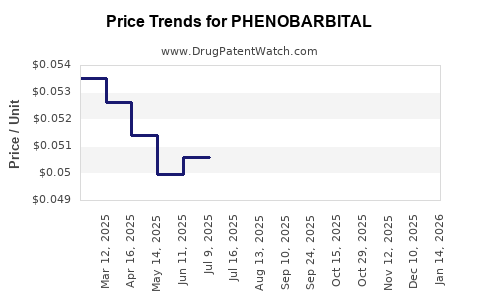
Price Projections
Current Pricing Landscape (2023)
- Generic Oral Tablets: Retail prices in the U.S. average $0.02-$0.05 per 100 mg tablet.
- Senior and Pediatric Formulations: Slightly higher due to dosage form, yet still cost-effective.
- Emerging Markets: Prices range from $0.01-$0.02 per tablet, heavily subsidized or government-funded.
Future Price Trends (2024-2028)
- Price Stability: Due to the drug's generic nature, prices are unlikely to decline further; they may stabilize.
- Potential Price Increases: Limited risk, possibly arising from supply chain disruptions or regulatory changes, especially in low-income regions.
- Impact of Manufacturing Consolidation: Possible price increases if production becomes concentrated among fewer suppliers, but market forces favor sustained low prices.
Factors Influencing Price
| Factor |
Effect |
Notes |
| Supply Chain Disruptions |
Price increase |
COVID-19 highlighted vulnerabilities; supply chains remain sensitive. |
| Regulatory Changes |
Price shift |
Stricter controls may increase costs for manufacturers. |
| Competition and Generics |
Price stabilization or decline |
Continued generic competition limits inflation. |
| Market Demand (Resource-Limited Regions) |
Price remains low |
High demand in low-income countries supports affordability. |
Summary
Phenobarbital's market maintains steady demand owing to its affordability, regulatory approval, and established efficacy in epilepsy management. Prices are expected to remain low, especially for generic formulations, with limited fluctuation over the coming years. Supply chain stability and regulatory changes will influence pricing, but the overall outlook indicates continued cost-effectiveness for end-users.
Key Takeaways
- Phenobarbital's global market is valued at approximately $350 million, with slow growth driven by affordability and efficacy.
- The drug retains dominance in low-income regions due to its low cost and wide availability.
- Prices for generic formulations are stable, averaging about $0.02-$0.05 per 100 mg tablet in developed markets.
- Future price fluctuations are unlikely, barring major regulatory or supply disruptions.
- Manufacturers face limited innovation opportunities, focusing instead on cost management and formulation improvements.
FAQs
1. Is phenobarbital still under patent protection?
No. Phenobarbital expired from patent protection decades ago, leading to a broad generic market.
2. How does phenobarbital compare with newer epilepsy drugs?
It is less expensive but may have more sedative side effects and drug interactions than newer agents like levetiracetam or lamotrigine.
3. What are regulatory considerations for manufacturing phenobarbital?
Manufacturers must adhere to pharmaceutical Good Manufacturing Practices (GMP) and obtain WHO prequalification if exporting to developing markets.
4. Are there upcoming patent filings or exclusivity periods for phenobarbital?
No, as it is an established generic drug; no new patent filings are expected.
5. Will phenobarbital prices increase due to supply constraints?
Potentially, if supply chains are disrupted or regulatory burdens increase, especially in low-resource settings.
Sources
- MarketWatch, "Global Anti-Epileptic Drugs Market Size," 2022.
- IQVIA, "Pharmaceutical Sales Data," 2022.
- World Health Organization, "Essential Medicines," 2022.
- FDA, "Approved Drugs," 2023.
- Pharma Intelligence, "Generic Drug Market Trends," 2023.