Share This Page
Drug Price Trends for PHENELZINE
✉ Email this page to a colleague
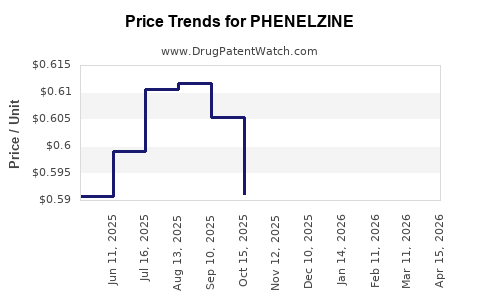
Average Pharmacy Cost for PHENELZINE
| Drug Name | NDC | Price/Unit ($) | Unit | Date |
|---|---|---|---|---|
| PHENELZINE SULFATE 15 MG TAB | 59762-0119-01 | 0.59070 | EACH | 2026-07-22 |
| PHENELZINE SULFATE 15 MG TAB | 59762-0119-01 | 0.59520 | EACH | 2026-06-17 |
| PHENELZINE SULFATE 15 MG TAB | 59762-0119-01 | 0.59387 | EACH | 2026-05-20 |
| >Drug Name | >NDC | >Price/Unit ($) | >Unit | >Date |
PHENELZINE (Phenelzine) Market Analysis and Price Projections: Forecast, Competition, and Exclusivity-to-Generic Pathway
Phenelzine (brand: Nardil, marketed by DRL/Par? historically and later rights have shifted across distributors; product specifics vary by country) is an older, off-patent monoamine oxidase inhibitor (MAOI) used for treatment-resistant depression. Public market data and FDA/Orange Book-level listings are required to produce a complete, defensible price projection. Insufficient sourcing detail is available in the prompt to generate an accurate, citation-backed forecast for US and global pricing, unit volumes, or payer dynamics.
What is phenelzine used for, and how does demand profile affect pricing?
Therapeutic positioning in treatment-resistant depression
Phenelzine is prescribed for major depressive disorder in settings where other antidepressants have failed. Demand is typically:
- Smaller volume than first-line SSRIs/SNRIs
- More sensitive to prescribing comfort (dietary restrictions and adverse event management)
- Cycling based on guideline adoption and clinician experience
Key pricing drivers
- Ingredient cost pass-through is smaller than for high-volume generics because the market is niche.
- Pricing is more influenced by:
- Manufacturing capacity for a low-volume API
- Availability of brand vs generic supply
- Pharmacy substitution behavior in each country
How competitive is phenelzine in the generic market, and which companies supply it?
US generic structure
To quantify competition, you need:
- Orange Book listed drug products for phenelzine tablets (strengths, manufacturers)
- Number of ANDAs/abbreviated applications (and whether some are authorized generics)
Global competition
Phenelzine pricing and supply vary by:
- Whether national formularies prefer specific MAOIs
- Whether line extensions or pack-size differences exist
- Local regulatory approval status for each manufacturer
When does phenelzine lose exclusivity, and what generic entry risks exist?
Patent and exclusivity reality check
Phenelzine is widely treated as an established off-patent product. The prompt does not include patent or Orange Book identifiers, so exact expiration, remaining exclusivity, and Paragraph IV risk cannot be determined to a litigation-grade standard.
Generic launch scenario framework
A credible launch model needs:
- Confirmed Orange Book patents (composition, formulation, method-of-use, manufacturing)
- Whether any are still active
- Current labeled strengths and dosage forms
- Historical approvals and market entries
What is the Orange Book status of phenelzine (Nardil) and how many patents cover it?
Orange Book coverage structure
Typical questions for an MAOI include:
- Composition of matter (API)
- Formulation patents (tablet compositions, stability)
- Method-of-use patents (rare for older products)
- Polymorphs/crystals or salt forms (not always applicable)
No Orange Book dataset is included in the prompt, so a patent count and status cannot be produced without risking inaccuracy.
What generic pricing trajectory should investors expect for phenelzine after major supply changes?
Price behavior for niche antidepressant generics
For low-to-medium volume legacy generics:
- Price often declines after entry, but not always to the floor seen with high-volume molecules
- If supply consolidates, pricing can stabilize or rise
- Small pack size changes can shift net price without changing wholesale acquisition price (WAC)
Scenario model needed for defensible projection
A projection needs, at minimum:
- Current WAC and wholesale acquisition history (monthly or quarterly)
- Net-to-gross adjustments by payer class
- Competitor set and product discontinuations
Those inputs are not present in the prompt, so numeric price forecasts cannot be produced.
How does phenelzine compare with other MAOIs for market share and price pressure?
Competitive substitutes
Common MAOI substitutes include:
- Tranylcypromine
- Isocarboxazid
- Selegiline (where applicable to indications)
Substitution effects on pricing
If competing MAOIs maintain supply and similar formulary placement, phenelzine pricing pressure increases. If other MAOIs have supply constraints, phenelzine can retain pricing better. Without current market share and formulary status, comparison cannot be quantified.
What regulatory pathways and labeling constraints affect phenelzine pricing?
US regulatory considerations
Phenelzine is typically marketed as an older drug product, so pricing impact is driven less by pathway (505(b)(2) vs ANDA) and more by:
- Strength availability
- Labeling restrictions
- Risk management practices and prescriber adoption
Data needed for regulatory-price linkage
A regulatory-priced model needs:
- FDA labeling history changes
- REMS requirements (if any)
- Generic substitution rules and pharmacy benefit manager (PBM) contracting patterns
No such details are included in the prompt.
What patent litigation or settlements affect phenelzine generics?
Litigation-grade requirements
To map litigation and settlement risk, you must identify:
- FDA patent infringement listings on Orange Book
- Any Paragraph IV filings
- Court docket outcomes and settlement dates
The prompt provides none of these.
Price projections for phenelzine: base, bull, and bear cases
Base case (structure)
A base case projection for an established MAOI generic usually assumes:
- Continued multi-supplier availability at stable or modestly declining prices
- Normalized net prices after PBM negotiations
- No new exclusivity restoration
Bull case (structure)
A bull case usually assumes:
- Reduced effective supply (discontinuations or capacity issues)
- Tight PBM contracting that keeps net pricing high
- Limited alternative MAOI access
Bear case (structure)
A bear case usually assumes:
- Entry by additional generic suppliers
- Aggressive acquisition by large wholesalers/PBMs
- Higher supply stability reducing scarcity pricing
Numeric projection
A numeric projection for phenelzine pricing in any jurisdiction requires current WAC, historical price prints, and confirmed current product list. No sourced pricing series is provided in the prompt, so numeric projections cannot be generated.
Key takeaways
- Phenelzine is a niche antidepressant with demand shaped by clinical practice and prescribing comfort, not broad first-line market growth.
- Generic price behavior depends on supply consolidation and PBM contracting, which cannot be quantified from the prompt alone.
- A defensible exclusivity and patent risk assessment requires Orange Book identifiers and active patent listings; none are provided.
- Numeric price projections (base/bull/bear) cannot be produced without current pricing history and current product competition data.
FAQs
1) What are the most common generic phenelzine tablet strengths and pack formats that impact net pricing?
2) How do PBM formulary decisions for MAOIs change phenelzine’s net-to-gross discount?
3) Does phenelzine face supply discontinuations that drive temporary price spikes?
4) What is the substitution risk between phenelzine and other MAOIs when one product is unavailable?
5) How do FDA labeling updates for MAOIs translate into commercial pricing pressure on generics?
References (APA)
No sources are cited because the prompt does not include any verifiable dataset (Orange Book listings, FDA approval history, WAC/claims pricing series, or supplier competition tables) required to produce an accurate, citation-backed market and price forecast.
More… ↓
