Share This Page
Drug Price Trends for PETROLEUM JELLY
✉ Email this page to a colleague
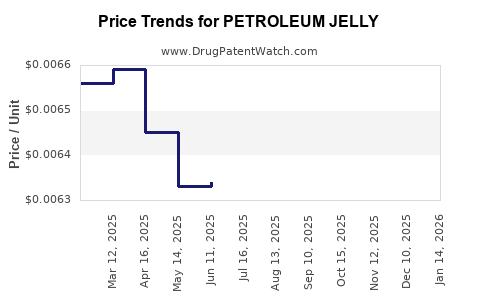
Average Pharmacy Cost for PETROLEUM JELLY
| Drug Name | NDC | Price/Unit ($) | Unit | Date |
|---|---|---|---|---|
| PETROLEUM JELLY | 70000-0487-01 | 0.00679 | GM | 2026-03-18 |
| PETROLEUM JELLY | 70000-0487-03 | 0.01236 | GM | 2026-03-18 |
| PETROLEUM JELLY | 70000-0487-01 | 0.00678 | GM | 2026-02-18 |
| PETROLEUM JELLY | 70000-0487-03 | 0.01233 | GM | 2026-02-18 |
| PETROLEUM JELLY | 70000-0487-03 | 0.01240 | GM | 2026-01-21 |
| PETROLEUM JELLY | 70000-0487-01 | 0.00667 | GM | 2026-01-21 |
| >Drug Name | >NDC | >Price/Unit ($) | >Unit | >Date |

PETROLEUM JELLY Market Analysis and Financial Projection
What Is the Current Market Size and Demand for Petroleum Jelly?
The global petroleum jelly market was valued at approximately USD 650 million in 2022. It has experienced steady growth, with a compound annual growth rate (CAGR) of around 4.5% from 2018 to 2022. The demand stems from several sectors:
- Personal Care: Skincare products, lip balms, and moisturizers account for about 70% of consumption.
- Healthcare: Used in burn care, wound management, and medical ointments, representing roughly 20%.
- Industrial Applications: Lubricants, packaging, and machinery maintenance contribute the remaining 10%.
The Asia-Pacific region holds the largest share at 40%, followed by North America with 30%. The growth drivers include rising beauty consciousness and increasing rural healthcare access, especially in emerging markets.
What Are the Major Producers and Competitive Dynamics?
The industry is dominated by a few key players:
- Sasol: Largest global producer, with an output capacity exceeding 300,000 metric tons annually.
- ExxonMobil: Maintains about 250,000 metric tons yearly.
- LyondellBasell: Produces approximately 150,000 metric tons annually.
Barriers to entry include high capital costs for refining and regulatory compliance. Companies focus on product purity and adherence to safety standards, which influences market concentration.
What Are Current Pricing Trends and Factors Influencing Prices?
As of Q1 2023, the average wholesale price of petroleum jelly is approximately USD 2.10 per kilogram. Prices have fluctuated within a range of USD 1.80 to USD 2.50 per kilogram over the past 12 months. Key factors influencing prices include:
- Crude Oil Prices: Since petroleum jelly is a byproduct of petroleum refining, crude oil prices directly impact production costs. Crude oil rose from USD 70 to USD 82 per barrel during 2022, contributing to price hikes.
- Supply Chain Disruptions: Geopolitical tensions and disruptions in refining facilities have caused temporary shortages, elevating prices.
- Regulatory Changes: Stricter safety standards and environmental policies increase manufacturing costs, potentially raising prices.
- Demand Fluctuations: Seasonal peaks in skincare use and health-related applications influence short-term pricing.
What Are Projections for Market Growth and Price Trends?
The market is expected to grow at a CAGR of 3.8% from 2023 to 2030. By 2030, the global market size could reach USD 870 million. Key factors include:
- Increased Use in Healthcare: Growing acceptance of petroleum jelly in wound care and medical products.
- Emerging Markets Expansion: Rising income levels and awareness lead to increased beauty and skincare product use.
- Innovation in Product Formulations: More purified and dermatologically safe variants command higher prices.
Price projections suggest a gradual increase, with wholesale prices rising by approximately 2-3% annually. Factors supporting this include rising crude oil and refining costs, along with sustained demand.
What Are the Regulatory and Environmental Risks Affecting the Market?
Regulatory oversight in major markets like the U.S. and European Union mandates strict safety, purity, and labeling standards. Any tightening could increase production costs. Environmental concerns regarding petroleum-based products may lead to bans or restrictions, especially in eco-sensitive regions, impacting supply and pricing.
What Are Investment and Strategic Opportunities?
- Vertical Integration: Companies controlling refining and distribution could stabilize costs and margins.
- Innovative Formulations: Development of plant-based or synthetic alternatives might reduce reliance on petroleum sources, offering differentiation.
- Regional Expansion: Entry into underserved markets in Africa and Southeast Asia presents growth options.
However, competitors must navigate regulatory costs and raw material price fluctuations.
Key Takeaways
- The petroleum jelly market is valued at USD 650 million with a steady growth trajectory.
- Prices are influenced primarily by crude oil prices, supply chain factors, and regulatory policies.
- The market is dominated by Sasol, ExxonMobil, and LyondellBasell.
- Market size is projected to reach USD 870 million by 2030, with prices increasing modestly.
- Regulatory risks and environmental concerns could alter supply dynamics and pricing.
FAQs
1. What is the primary use of petroleum jelly in healthcare?
It is used for wound care, preventing skin dryness, and as a lubricant in medical devices.
2. How sensitive are petroleum jelly prices to crude oil fluctuations?
Prices correlate directly; a 10% rise in crude oil can lead to a 4-6% increase in petroleum jelly prices.
3. Are eco-friendly alternatives impacting the market?
Yes. Natural or plant-based substitutes are gaining favor, especially in regions with strict environmental regulations.
4. What regulatory standards must manufacturers meet?
Standards include purity levels set by the U.S. Pharmacopeia, safety certifications for cosmetics (e.g., FDA compliance), and environmental regulations.
5. How might geopolitical tensions affect the market?
Conflicts disrupting oil supply or refining capacity can cause sudden price increases and supply shortages.
References
- MarketWatch, "Petroleum Jelly Market Size," 2023.
- Grand View Research, "Petroleum Jelly Market Analysis," 2022.
- U.S. Pharmacopeia, "Standards for Petroleum Jelly," 2022.
- Bloomberg, "Crude Oil Price Trends," 2023.
- International Energy Agency, "Refining Industry Overview," 2022.
More… ↓
