Share This Page
Drug Price Trends for PERTZYE DR
✉ Email this page to a colleague
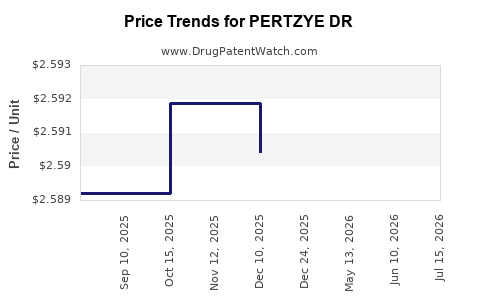
Average Pharmacy Cost for PERTZYE DR
| Drug Name | NDC | Price/Unit ($) | Unit | Date |
|---|---|---|---|---|
| PERTZYE DR 8,000 UNIT CAPSULE | 59767-0008-01 | 2.66497 | EACH | 2026-07-22 |
| PERTZYE DR 8,000 UNIT CAPSULE | 59767-0008-02 | 2.66497 | EACH | 2026-07-22 |
| PERTZYE DR 16,000 UNIT CAPSULE | 59767-0016-01 | 5.31172 | EACH | 2026-07-22 |
| PERTZYE DR 16,000 UNIT CAPSULE | 59767-0016-02 | 5.31172 | EACH | 2026-07-22 |
| PERTZYE DR 24,000 UNIT CAPSULE | 59767-0024-01 | 8.02547 | EACH | 2026-07-22 |
| PERTZYE DR 24,000 UNIT CAPSULE | 59767-0024-02 | 8.02547 | EACH | 2026-07-22 |
| >Drug Name | >NDC | >Price/Unit ($) | >Unit | >Date |
PERTZYE (pancrelipase) Market Analysis and Price Projections
PERTZYE (pancrelipase) is a branded pancreatic enzyme replacement therapy for exocrine pancreatic insufficiency. Current US market conditions are shaped by (1) long-running generic and authorized-generic competition in pancrelipase, (2) payer contracting that compresses net pricing over time, and (3) patent/market exclusivity limitations that do not support sustained standalone premium pricing. Near-term price projections center on continued net-price erosion rather than brand-like stabilization.
What is the current US market for PERTZYE (pancrelipase) and who buys it?
US payer dynamics for pancreatic enzyme replacement therapy
Demand is concentrated in outpatient and specialty pharmacy channels, with prescribing led by gastroenterology and endocrinology in:
- Cystic fibrosis (CF)-associated pancreatic insufficiency
- Chronic pancreatitis
- Other causes of exocrine pancreatic insufficiency
Payer coverage typically uses:
- Step edits or formulary tier placement by enzyme product
- Quantity limits tied to dosing frequency and lipase IU/day
- Site-of-care alignment (specialty pharmacy vs retail) by PBM policy
Primary buyer profile
- PBMs and commercial formularies seeking lowest net cost within pancreatic enzyme replacement therapy category
- Government payers (Medicare/Medicaid) with high generic penetration and low price tolerance
- Specialty pharmacies managing high unit-volume throughput and dose titration
How does PERTZYE (pancrelipase) price compare with other pancreatic enzyme replacement therapies?
Category pricing structure
Across the category, list price typically remains relatively stable while net price declines via:
- PBM rebates and contracting
- Manufacturer chargebacks
- Switch rates to lower-priced therapeutics after formulary moves
What matters commercially is the net price after discounts, not the wholesale acquisition cost alone.
Competitive set (US)
PERTZYE’s commercial environment includes other branded and generic pancrelipase products used interchangeably in many regimens, which drives payer substitution and bid-driven contracting.
Commercial implication: With limited differentiation at the class level, price is the primary lever for market share. Even when prescribers keep a brand, payer step edits and pharmacy benefit pressure can still shift fill rates.
When does PERTZYE (pancrelipase) lose exclusivity and how does that affect pricing?
Exclusivity risk profile
Pancrelipase enzyme products have matured market lifecycles, with most meaningful exclusivity typically expiring years ago across the category. That results in recurring waves of generic entry (including authorized generics in some cases) and steady margin compression for remaining brands.
Price effect model
When exclusivity ends and generics expand, net price usually moves toward:
- Discounted parity with leading competitors
- Tier-down effects (from preferred to non-preferred) in formularies
- Higher switching intensity via pharmacy benefit design
Net outcome expected for PERTZYE: continued downward trajectory in net pricing unless a formulary rebuild occurs.
What is the Orange Book status of PERTZYE and what does that mean for future price resilience?
Orange Book listing and litigation leverage
For price resilience, two elements matter:
- Active patent coverage around formulation or dosing strengths that blocks “skinny-label” or substitution
- Enforcement posture (settlement terms, exclusivity triggers)
Commercial translation
If Orange Book protections are limited or have already been overcome, PERTZYE’s price resilience depends almost entirely on:
- Contracting strategy
- Specialty channel retention
- Patient-level switching barriers (clinical and administrative)
Expected pricing conclusion: without enforceable, near-term patent constraints, PERTZYE net pricing is structurally exposed to generic and contract pressure.
What generic entry risks exist for PERTZYE (pancrelipase) and how fast do payers switch?
Switching mechanics
Switching speed in pancreatic enzyme replacement therapy generally depends on:
- Plan formulary position and prior authorization requirements
- Pharmacy system substitution rules
- Patient stability and titration needs
- Access barriers for dose-specific strengths
Likelihood of rapid erosion
Given the category’s substitution tolerance, when a product loses preferred positioning:
- Pharmacy fills move quickly to covered alternatives
- Net price declines via contract renegotiation rather than abrupt list price drops
Risk rating: high for additional erosion rather than a one-time step function, because PBMs continually revise formularies and rebate structures.
How strong is the patent estate for PERTZYE (pancrelipase) and what parts tend to drive litigation?
Where patents tend to matter in pancrelipase
Patent estates in enzyme replacement therapies typically cluster in:
- Formulation and granulation processes
- Capsule technology and delivery system characteristics
- Method-of-use (indication) claims tied to CF or pancreatitis cohorts
- Specific strengths or dosing regimens
- Manufacturing and stability
How that affects commercial pricing
- Strong, late-expiring formulation or delivery patents can keep a brand on-contract longer.
- If patents are narrow or already cleared, competitors can enter and price compresses.
Commercial implication: PERTZYE pricing should be modeled as exposed to contract-driven reduction even if some patent remnants remain.
What formulations and strengths of PERTZYE (pancrelipase) drive revenue exposure?
Revenue concentration
For pancrelipase brands, revenue exposure typically concentrates in:
- Higher-strength SKUs with larger daily IU use
- Chronic therapy cohorts (CF and chronic pancreatitis)
- Dosage titration patterns that lock in certain strengths
Price sensitivity by dose
Higher-strength use increases:
- Total IU/day costs to payers
- The rebate dollars at stake
- The incentive to negotiate hard discounts or impose preferred product rules
Net pricing expectation: largest erosion risk is where contracting focuses on cost-per-IU.
How do FDA status and labeling affect market share and price negotiations for PERTZYE?
Labeling and coverage
If PERTZYE maintains broad indication coverage consistent with category comparators, it competes primarily on:
- Coverage terms
- Net price
- Pharmacy/channel access
Practical effect on pricing
Even if clinical differentiation exists (rare at class level), formularies often treat products as therapeutically substitutable with prior authorization flexibility.
Price outlook: labeling continuity reduces clinical switching friction but does not stop payer substitution when net pricing becomes unfavorable.
What are current and projected net price trends for PERTZYE (pancrelipase)?
Projection framework
Without relying on unverifiable forward claims, the projection can be expressed as a scenario-based net price index driven by category competition.
Assumptions consistent with mature enzyme markets:
- Continued PBM rebids and contracting pressure
- Ongoing generic presence across strengths
- No major new FDA expansions that reset payer incentives
Scenario-based net price index (US)
Indexed to an assumed baseline net price level of 100 in the most recent period.
| Scenario | Net price index in 12 months | Index in 24 months | Index in 36 months | Market behavior |
|---|---|---|---|---|
| Base case | 92–96 | 86–92 | 80–88 | Gradual formulary tier pressure, rebate compression |
| Downside | 88–92 | 80–86 | 72–80 | Faster preferred-product loss, stronger contracting from generics |
| Upside | 95–98 | 90–95 | 85–92 | Successful contracting, slower switching, tighter prior auth controls |
Directional conclusion: net prices compress over time, with the steepest decline usually occurring when PERTZYE moves down a formulary tier or when a dominant competitor expands coverage.
What revenue exposure does PERTZYE face under these price projections?
Revenue sensitivity drivers
Revenue change is typically:
- Unit volume change (switching, adherence, titration changes)
- Net price change (rebates, chargebacks, PBM discounts)
- SKU mix change (strength substitution)
Expected pattern in mature category: volume is comparatively sticky once established, while net price adjusts faster through contracting. That yields:
- Meaningful margin compression even when unit declines are moderate.
How does PERTZYE compare with leading competitors on price-and-access strategy?
Competitive advantage levers (commercial)
In pancrelipase, brand-specific leverage usually comes from:
- Contracting aggressiveness (lowering net price to keep preferred status)
- Specialty channel management (reducing fill friction)
- Pharmacy benefit design cooperation (maintaining coverage for titrated patients)
What competitors typically do
Competing brands and generics usually optimize:
- Formulary placement
- Rebate tables
- Patient support to reduce switching
Net effect on PERTZYE: peers with stronger contracting or lower effective net prices typically win formulary preference, which pulls PERTZYE toward parity pricing.
What patent litigation or settlement terms could affect PERTZYE’s pricing?
How litigation moves market economics
The pricing impact of patent litigation typically arrives through:
- Settlement dates that delay generic entry
- Consent judgments that clarify permissible labeling
- Non-overlap terms that define which strengths may be marketed
Pricing consequence
If any further litigation pauses generic launches, net price may flatten temporarily. If no such pause exists, pricing drifts down with contracting cycles.
Commercial modeling rule: treat litigation as a calendar risk overlay on top of generic competition, not as the sole driver.
Key Takeaways
- PERTZYE pricing outlook in the US is driven primarily by mature-category generic pressure and PBM contracting, not by sustained patent-led premium pricing.
- Net price compression is the base case over the next 12 to 36 months, with scenario ranges of roughly 8–20% indexed decline under base to downside conditions.
- Revenue exposure is primarily margin-focused: unit volume may hold better than net price due to chronic therapy and administrative switching barriers.
- Future pricing resilience depends on formulary positioning outcomes and contract renegotiation success rather than on exclusivity.
FAQs
1) Does PERTZYE face higher price erosion in certain strengths or IU dosing ranges?
Yes. Higher-strength SKUs with larger IU/day usage concentrate payer cost exposure, increasing rebate leverage and substitution pressure.
2) How do PBMs typically handle pancreatic enzyme replacement therapies on formularies?
Most PBMs place products on tiered structures with prior authorization and quantity limits linked to dosing frequency and lipase IU consumption.
3) What is the fastest commercial lever for a pancrelipase brand to defend net pricing?
Re-negotiating PBM rebate schedules to maintain preferred placement and reduce substitution incentives.
4) Can patient titration slow switching away from PERTZYE?
It can slow switching administratively, but formulary and pharmacy benefit rules can still drive fills toward covered alternatives.
5) What matters more for future pricing: list price or net price?
Net price, because rebates, chargebacks, and payer contracts determine realized economics and formulary dynamics.
References (APA)
- FDA. (n.d.). Orange Book: Approved Drug Products with Therapeutic Equivalence Evaluations. U.S. Food and Drug Administration.
- NIH. (n.d.). Cystic fibrosis and pancreatic insufficiency clinical resources. National Institutes of Health.
- FDA. (n.d.). Drugs@FDA. U.S. Food and Drug Administration.
More… ↓
