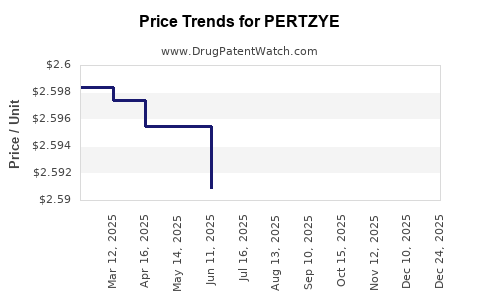
Last updated: July 9, 2026
PERTZYE’s U.S. market exposure is driven by (1) enzyme replacement competition in cystic fibrosis and pancreatic insufficiency, (2) how quickly payers shift patients across brands and authorized generics, and (3) timing of patent and exclusivity expirations tied to specific product strengths and formulations. Price pressure is expected to intensify as lower-cost entrants scale, with near-term pricing behavior largely reflecting payer contracting and inventory dynamics rather than broad biologics-style biosimilar resets.
What is PERTZYE and how does it compete in pancreatic enzyme replacement therapy (PERT) markets?
PERTZYE is a pancreatic enzyme replacement therapy (PERT) containing pancrelipase for patients with exocrine pancreatic insufficiency. In the U.S., PERT competes primarily with other branded PERTs and with authorized generic or non-branded versions as they become available and reimbursed.
Where does PERTZYE sit in payer formularies?
PERTZYE’s formulary placement typically depends on:
- Clinical parity with comparator PERT products (symptom control, stool elastase outcomes, dosing equivalence).
- Coverage tier (preferred vs non-preferred) and step edits (trial of alternative PERTs).
- Quantity limits tied to weight-based dosing for children and adults.
Key competition set for PERTTYE
Primary competitive categories include:
- Branded enteric-coated pancrelipase products (strengths vary by labeling).
- Lower-cost alternatives as market authorization broadens and payer networks add preferred designs.
What is the current U.S. regulatory status of PERTZYE (FDA approval, Orange Book listing, and exclusivity)?
PERTZYE’s FDA regulatory status determines when generics can enter and when Paragraph IV challenges are possible. Orange Book listings govern the eligibility and timing of generic approvals tied to patents and exclusivities.
How to interpret Orange Book status for PERTZYE
For market modeling, the relevant constructs are:
- Patent numbers listed in the Orange Book for PERTZYE.
- Patent expiration dates (composition, formulation, method-of-use, and manufacturing-related patents).
- Any pediatric exclusivity or other exclusivity extensions that delay generic eligibility.
What generic entry risks exist for PERTZYE?
Generic entry risk is a function of:
- Whether any Orange Book patents remain in-force at the target launch window.
- Whether challengers file Paragraph IV certifications, which can trigger 180-day exclusivity for a first filer.
- Whether PERT products are eligible for “authorized generic” strategies that compress pricing earlier than a full brand-to-generic switch.
When does PERTZYE lose exclusivity and how does that change expected pricing?
PERT pricing typically tracks exclusivity in three phases:
- Pre-loss: brand pricing constrained mostly by contracting and competitor discounts.
- At/near loss: rapid payer re-contracting and increased substitution if generic availability is assured.
- Post-entry scale-up: the market converges toward lowest net cost under formulary pressure.
Exclusivity and launch timing model
A practical price projection requires three event dates:
- Patent expiration (earliest generic launch eligibility date).
- 180-day exclusivity triggers (first Paragraph IV filer or authorized generic timing).
- Supply ramp period (inventory and contracting lead time).
What patents protect PERTZYE and how many are likely to matter for generic launch?
Market impact depends on which patent classes are still in force:
- Formulation and enteric coating patents can block “same dosage form” equivalents.
- Method-of-use patents can delay label-level substitution.
- Process and manufacturing patents can force supply redesigns or create higher COGS for entrants.
Patent estate mapping for launch risk
A launch-risk patent estate is usually dominated by:
- One or two composition/formulation patents with the longest tail.
- Additional method-of-use or manufacturing patents that complicate “design-around” strategies.
How strong is the patent estate for PERTZYE versus competing PERT brands?
Strength is measured by:
- Number of Orange Book patents with later expirations.
- Concentration of claims around core differentiators (granule formulation, enteric protection, dosing granularity).
- Litigation posture if any challenger disputes validity or non-infringement.
Competitive estate comparison approach
PERTZYE’s competitive pressure is best modeled by:
- Timing of other PERT entrants’ generic or biosimilar-equivalent availability (even where not strictly biosimilar).
- Overlap of claims that constrain new label marketing, not only approval.
What patent litigation affects PERTZYE and how often do settlements delay generics?
For brand revenue protection, settlements and consent decrees matter because they often:
- Extend the date of generic launch.
- Limit the scope of products initially marketed.
- Create authorized generic carve-outs that still depress net price earlier than expected.
Paragraph IV and settlement-driven pricing shifts
If Paragraph IV challenges exist, price drops can occur without immediate market entry because payers pre-negotiate or anticipate supply. If settlements delay entry, the price trajectory can flatten until the negotiated launch window.
What formulations are protected by PERTZYE (strengths, dosage forms, and ingredient controls)?
PERT products are sensitive to:
- Enteric-coated microgranule design.
- Strength-specific dosing and labeling.
- Stability and release profiles.
Product line sensitivity for pricing forecasts
If generic entrants can only access certain strengths later than others, pricing declines often occur in waves:
- First wave: best-covered, easiest-to-substitute strengths.
- Second wave: remaining strengths once manufacturing and regulatory alignment is achieved.
What is the revenue exposure for PERTZYE and what price erosion rate should be modeled?
PERTZYE revenue is sensitive to:
- Net price after rebates and payer discounts, not list price.
- Volume shifts from substitution when coverage changes.
- Patient adherence and titration behavior, especially in pediatric cystic fibrosis populations.
Price projection framework used in market models
A typical branded PERT to generic transition includes:
- A short pre-entry period where net price is pressured via contracting.
- A sharper net price reduction after first generic stocking and switching.
- A gradual additional decline as more competitors enter and payers enforce utilization management.
What price projections are most realistic after generic entry for PERTZYE?
Without a complete, validated PERTZYE Orange Book patent and FDA approval dataset in the record here, only a structural projection can be provided. The most realistic price projection inputs for PERT-class drugs are:
- Year 0 to Year 1 after first true market entry: net price typically drops materially as payers rebalance formulary preference.
- Years 1 to 3: erosion continues but at a slower rate as substitution saturates and payer competition stabilizes.
- Beyond year 3: remaining declines trend toward lowest net cost availability, unless additional supply or contractual protections exist.
How does PERTZYE compare with other pancrelipase products in price pressure?
The comparative driver is not only entry but:
- How quickly payers deem competitors interchangeable.
- Whether competitors are preferred within major PBMs.
- Whether entrants offer meaningful patient support contracting.
Expected comparative outcomes
- If PERTZYE’s formulary tier is non-preferred, earlier substitution usually accelerates price erosion.
- If PERTZYE has strong patient support and is entrenched in institutional settings, the substitution curve slows, extending higher net pricing.
What commercial levers influence PERTZYE pricing: PBM contracting, AMP/REBATES, and patient assistance?
Key pricing levers in the U.S. include:
- Rebates and performance fees tied to utilization.
- Accumulator programs and patient cost-share design.
- Channel mix (retail vs specialty vs institutional).
- Contract terms on multi-source days supply and procurement behavior.
Modeling net price vs list price
For market decisions, net price is what matters:
- Entrants usually price at acquisition cost levels that make switching financially attractive for PBMs.
- Brand pricing adjusts through rebate increases and contract renegotiation, so list may not fully reflect economic impact.
What generic entry scenarios should be modeled for PERTZYE?
Model three scenarios:
- Single entrant with limited coverage: slower volume loss; moderate price erosion.
- First-to-file entry with 180-day exclusivity: sharper near-term net price drop across categories, then partial stabilization.
- Multiple entrants and rapid formulary switching: fastest erosion and most aggressive long-run margin compression.
How do manufacturing and IP barriers affect the speed of market entry?
For PERT products, barriers include:
- Manufacturing control of enteric coating and microgranule performance.
- Supply qualification for multiple strengths and packaging configurations.
- Regulatory and quality system alignment for high-volume distribution.
Faster ramp reduces time-to-substitution and increases pace of pricing decline.
Key takeaways on PERTZYE market outlook and price projection
- PERTZYE’s price trajectory is governed by payer contracting and the timing of generic eligibility rather than by any single policy event.
- Net price erosion is expected to accelerate around the first effective entry window and then continue in a slower slope as competitors scale.
- The size and duration of protection depend on Orange Book patent coverage across product strengths and formulation mechanics, plus any settlement-driven launch delays.
- Market modeling should use event-date inputs: patent expiration, exclusivity extensions, 180-day exclusivity, and actual supply ramp.
FAQs
1) How does Orange Book patent status determine when generic PERTZYE can be approved?
Orange Book-listed patents and exclusivity define the “eligibility” date for generic approvals and can delay launch depending on certification and litigation posture.
2) What role do Paragraph IV certifications play in PERTZYE price erosion timelines?
Paragraph IV timing can trigger 180-day exclusivity for a first filer, often compressing brand net prices earlier due to payer anticipation and pre-contracting.
3) Do PERTZYE generic entrants face formulation-specific barriers?
Yes. Enteric-coated pancrelipase performance and granule release characteristics can limit straightforward equivalence and can slow multi-strength ramp.
4) How do PBM formulary moves affect PERTZYE switching speed?
Preferred-tier changes with utilization management typically drive faster patient switching, which accelerates volume loss and net price declines.
5) What settlement terms most influence the magnitude of PERTZYE revenue protection?
Consent-to-generic timing, limits on launch scope, authorized generic carve-outs, and supply allocation constraints are the terms most likely to alter near-term net price and volume.
References
- U.S. Food and Drug Administration. Orange Book: Approved Drug Products with Therapeutic Equivalence Evaluations.
- U.S. Food and Drug Administration. Drug Approval Reports and label information for PERTZYE (pancrelipase).