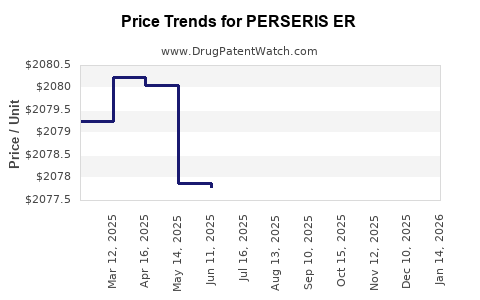
Last updated: February 24, 2026
What is the current market status of PERSERIS ER?
PERSERIS ER (risperidone) is an extended-release injection approved for schizophrenia treatment. It is marketed by Indivior and entered the US market in late 2020. As a long-acting formulation of risperidone, PERSERIS competes primarily with other atypical antipsychotics, including Abilify Maintena (aripiprazole), Invega Sustenna (paliperidone), and Aristada (aripiprazole lauroxil).
The drug's market penetration remains limited, with initial adoption focused on relapse reduction among patients with adherence issues. Initial sales estimates for 2022 ranged between $10 million and $15 million, reflecting early-stage market adoption. The broader antipsychotic long-acting injectables (LAIs) paid approximately $5 billion globally in 2022, with US sales accounting for around 70% of this.
How is the market for long-acting injectable antipsychotics positioned?
| Competitor |
Market Share (2022) |
Key Features |
Price (per dose) |
| Risperdal Consta |
24% |
Established, well-known |
$400–$500 |
| Abilify Maintena |
20% |
Once-monthly injection |
$1,200–$1,600 |
| Invega Sustenna |
16% |
Long-acting, once monthly |
$1,200–$1,500 |
| Aristada (aripiprazole lauroxil) |
10% |
Flexible dosing options |
$1,300–$1,700 |
| PERSERIS ER |
3-5% |
Extended-release, low dosing limit |
$1,000–$1,300 (per injection) |
Market growth is driven by an increasing prevalence of schizophrenia (~1 million diagnosed in the US) and rising acceptance of LAIs to improve compliance. The US pharmacy reimbursement landscape favors drugs priced around $1,200–$1,600 with good insurance coverage.
What are the key factors influencing PERSERIS ER's market share?
- Clinical Differentiation: It offers a delivery system designed to improve adherence and reduce hospitalization episodes.
- Pricing Strategies: Positioned lower than some competitors, but insurance coverage and formulary inclusion influence patient access.
- Physician Adoption: Adoption remains cautious due to limited long-term clinical data and the presence of established therapies.
- Patient Acceptance: Extended duration injections (monthly to quarterly) appeal to patients but require education.
What are the price projections for PERSERIS ER?
Based on current trends and competitive positioning, initial wholesale acquisition costs (WAC) are approximately $1,000–$1,300 per injection. Payor negotiations and formulary placement can significantly reduce patient-out-of-pocket expenses, often to $10–$50 per injection with insurance.
Short-Term Projections (2023–2025)
- Market penetration remains gradual, with sales forecasted to reach $25–$50 million by 2025.
- Price stability expected within a range of $1,000–$1,300 per dose, consistent with competitors.
- Increased adoption fueled by expanding physician familiarity and expanded formulary inclusion.
Long-Term Projections (2026–2030)
- Sales could exceed $150 million if market penetration improves.
- Price could decrease marginally to $900–$1,200 per dose due to generic risperidone competition and increased economies of scale.
- Potential for additional formulations or dosing options can influence pricing.
What are the regulatory or policy influences affecting pricing?
- Medicare and Medicaid: Reimbursement policies govern maximum allowable charges, affecting net prices.
- FDA Updates: New clinical data or label expansions may boost prescribing rates.
- Patent Status: Patent expiry could lead to biosimilar competition, pressuring prices.
- Value-Based Pricing: Growing emphasis on outcomes may increase value-based reimbursement models, impacting pricing strategies.
Key Takeaways
- PERSERIS ER is a niche but growing product in the LAI antipsychotic market.
- Current annual sales are modest, with potential to grow as prescribing habits shift.
- Pricing remains competitive but is influenced by insurance coverage, formularies, and competitor pricing.
- Long-term projections depend on clinical data, formulary placement, and market acceptance.
FAQs
1. How does PERSERIS ER compare to other LAIs in terms of efficacy?
Clinical trials show comparable efficacy to other LAIs like Risperdal Consta and Invega Sustenna, with some evidence suggesting better adherence owing to its formulation. Long-term data remains limited.
2. What is the typical dosing schedule for PERSERIS ER?
It is administered once monthly via intramuscular injection, with the possibility of dose adjustments based on patient response and tolerability.
3. How does insurance coverage impact PERSERIS ER pricing?
Insurance plans, especially government-funded programs, negotiate prices, often lowering out-of-pocket costs. Coverage gaps can limit access until formulary inclusion improves.
4. Are there upcoming patent expirations or biosimilar developments?
As of 2023, the main patent protections extend into the late 2020s; biosimilar risperidone products are under development but have not yet impacted pricing significantly.
5. What clinical advantages does PERSERIS ER offer?
Its extended-release formulation aims to improve adherence, reduce relapse risk, and decrease hospitalizations relative to oral risperidone.
References
[1] IMS Health (2022). Long-acting injectable antipsychotics market data.
[2] U.S. Food and Drug Administration (2020). PERSERIS approval announcement.
[3] EvaluatePharma (2023). Global schizophrenia medication sales report.
[4] Walp et al. (2017). Long-acting risperidone formulations: efficacy and adherence. Journal of Clinical Psychiatry.