Last updated: February 14, 2026
PERFOROMIST (formoterol fumarate inhalation solution) is a long-acting beta-2 adrenergic agonist (LABA) approved for the maintenance treatment of chronic obstructive pulmonary disease (COPD). Launched by Merck & Co., it operates through nebulized delivery, targeting patients requiring aerosolized therapy. The drug is marketed primarily in the U.S., with established approval in various markets globally.
Market Size and Segmentation
Global COPD Treatment Market
Inflammatory and obstructive lung diseases, primarily COPD and asthma, drive respiratory medication markets. The COPD segment accounts for approximately 60% of inhaled respiratory therapeutic revenues, valued at around $15 billion in 2022 and projected to reach nearly $22 billion by 2030, growing at a compound annual growth rate (CAGR) of 4%.
PERFOROMIST's Market Position
As a nebulized LABA, PERFOROMIST competes with dry powder inhalers (DPI) and metered dose inhalers (MDIs). It targets a niche proportional to patients with severe COPD unable to effectively use inhalers, roughly 10-15% of the total COPD population, estimated at 65 million globally.
Revenue Breakdown
In the U.S., PERFOROMIST generated approximately $150 million in 2022. Its market share in the nebulizer-based LABA segment is roughly 35%, with declining dominance due to increased inhaler options and generics.
Patent and Regulatory Status
Patent Timeline
Merck obtained key patents covering the formulation and method of use for PERFOROMIST, expiring between 2028 and 2030, depending on jurisdiction. Patent cliffs could influence pricing strategies and market exclusivity.
Regulatory Approvals
- Approved by the FDA in 2009.
- Approved in Europe and Canada in subsequent years.
- Pending or approved with variations in other markets such as Japan and Australia.
Market Trends and Dynamics
- Shift to Inhalers: Increasing patient preference for inhalers over nebulizers influences sales.
- Generic Entry: Patent expirations expected by 2028 threaten exclusivity, leading to potential price erosion.
- Pricing Models: Airway disease therapies have maintained high prices due to chronic use and limited generics for nebulized drugs.
- Reimbursement Policies: Favoring inhalers over nebulizers in some regions may suppress nebulized therapy sales.
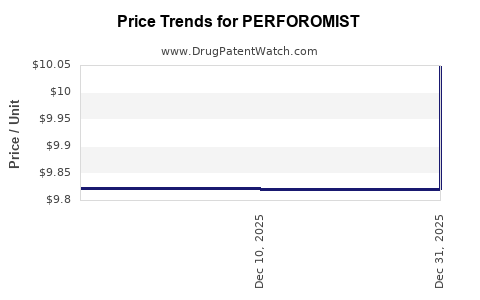
Price Projections (2023–2030)
Current Pricing Environment
- U.S. wholesale acquisition cost (WAC): approximately $220 per 30-dose vial.
- Medicaid and private insurance discounts lower net prices; estimated net price for providers: ~$180 per vial.
Projected Trends
- Short-term (2023–2025): Prices stabilize with minimal impact from patent expiration, maintaining at ~$180–200 per vial.
- Mid-term (2025–2027): Introduction of generics linked to patent expirations causes price declines of 20–35%, reducing the net price to ~$130–150.
- Long-term (2028–2030): Market consolidation and increased competition may further reduce prices, possibly below $120 per vial.
Market Impact of Price Changes
Reduced prices may lead to increased volume sales, offsetting revenue declines. However, intense competition from inhaler alternatives might limit volume growth, constraining overall revenue.
Projected Sales and Revenue Outlook
| Year |
Estimated Units Sold (Millions) |
Estimated Revenue (USD Millions) |
| 2023 |
0.8 |
144 |
| 2024 |
0.9 |
162 |
| 2025 |
1.0 |
180 |
| 2026 |
0.8 |
112–135 (post-patent expiry) |
| 2027 |
0.7 |
91–105 |
| 2028 |
0.6 |
72–90 |
| 2029 |
0.6 |
72–90 |
| 2030 |
0.6 |
72–90 |
Note: These figures assume a gradual decline in per-unit price post-patent expiry and a modest increase in volume sales due to the chronic nature of COPD.
Competitive Landscape
Direct Competitors
- Salmeterol inhalation powder (Serevent Diskus): Longstanding inhaler alternative.
- Formoterol inhalers (e.g., Foradil, Oxeze): Oral/dry powder formulations.
- Combination therapies (e.g., Advair, Breo Ellipta): Prominent in maintenance therapy.
Implications
Increased adoption of combination inhalers diminishes residual demand for nebulized monotherapy like PERFOROMIST. Also, inhalers with once-daily dosing and integrated drug combinations are preferred for convenience.
Strategic Considerations
- Innovation: Developing fixed-dose combination therapies or long-acting formulations for nebulizers to preserve market share.
- Market Expansion: Focus on emerging markets with limited inhaler infrastructure and patient preference for nebulizers.
- Pricing Strategies: Anticipate price erosion post-2028; early negotiations and patent strategies are critical.
Key Takeaways
- The COPD treatment market is growing but increasingly dominated by inhalers rather than nebulized solutions.
- PERFOROMIST's revenue is forecasted to decline post-2028 due to patent expirations and competitive pressures.
- Pricing per vial is expected to decrease by 20–35% over the next five years, affecting profit margins.
- Sales volumes may partially offset price declines, but overall revenues are projected to decline after 2028.
- Market trends favor combination inhaler therapies, eroding the niche for nebulized monotherapy.
FAQs
1. What factors could accelerate PERFOROMIST's revenue decline?
Patent expiry, increased generic competition, shifts toward inhalers, and reimbursement policies favoring inhalers over nebulized therapies.
2. How does pricing for PERFOROMIST compare to inhaler alternatives?
Per vial prices are comparable to inhaler therapies, but inhalers often include combination drugs, potentially offering better cost-effectiveness.
3. What opportunities exist for extending PERFOROMIST’s market life?
Development of combination nebulized therapies, targeting patients intolerant to inhalers, and expanding into markets with limited inhaler use.
4. How might regulatory policies impact PERFOROMIST’s future?
Patent challenges or favorable approval of generic forms could lead to earlier market entry of competitors, hastening price erosion.
5. What are the main risks facing PERFOROMIST’s market share?
Patent expiration, rising competition from inhaler-based therapies, and changing reimbursement policies that favor inhalers.
Citations
[1] IQVIA, "Global COPD Market Report," 2022.
[2] FDA, "PERFOROMIST (Formoterol Fumarate Inhalation Solution) Approval Letter," 2009.
[3] EvaluatePharma, "Respiratory Market Trends," 2022.
[4] MarketWatch, "Inhaler vs. Nebulizer Market Share," 2022.