Share This Page
Drug Price Trends for PENICILLIN VK
✉ Email this page to a colleague
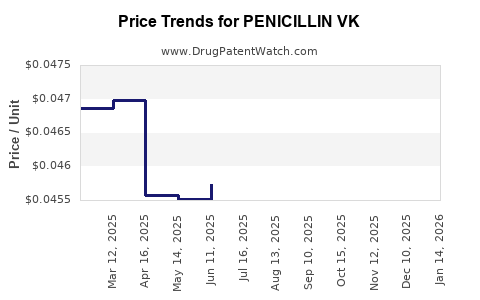
Average Pharmacy Cost for PENICILLIN VK
| Drug Name | NDC | Price/Unit ($) | Unit | Date |
|---|---|---|---|---|
| PENICILLIN VK 250 MG TABLET | 16714-0234-01 | 0.06523 | EACH | 2025-12-17 |
| PENICILLIN VK 250 MG TABLET | 00093-1172-10 | 0.06523 | EACH | 2025-12-17 |
| PENICILLIN VK 250 MG TABLET | 00143-9837-10 | 0.06523 | EACH | 2025-12-17 |
| PENICILLIN VK 125 MG/5 ML SOLN | 00093-4125-73 | 0.06544 | ML | 2025-12-17 |
| PENICILLIN VK 250 MG TABLET | 00143-9837-01 | 0.06523 | EACH | 2025-12-17 |
| PENICILLIN VK 125 MG/5 ML SOLN | 00093-4125-74 | 0.04415 | ML | 2025-12-17 |
| PENICILLIN VK 250 MG TABLET | 00093-1172-01 | 0.06523 | EACH | 2025-12-17 |
| >Drug Name | >NDC | >Price/Unit ($) | >Unit | >Date |
Market analysis and price projections for PENICILLIN VK
Introduction
Penicillin VK (phenoxymethylpenicillin) remains a cornerstone in the treatment of various bacterial infections, especially respiratory tract infections, skin infections, and syphilis. Despite the advent of broader-spectrum antibiotics, Penicillin VK continues to hold significant clinical relevance, backed by its well-established efficacy, safety profile, and affordability. As the pharmaceutical landscape evolves, the market dynamics surrounding Penicillin VK are subject to shifts influenced by regulatory changes, technological advancements, market demand, and pricing pressures.
This analysis explores the current market landscape for Penicillin VK, evaluates the driving factors influencing its demand, assesses competitive pressures, and offers price projections for the upcoming years.
Market Overview
Global Market Size and Segmentation
The global antibiotic market was valued at approximately USD 50 billion in 2022, with penicillins constituting roughly 20-25% of this figure [1]. Penicillin VK, primarily used in oral formulations, accounts for a sizable segment within the penicillin category, especially in developed markets where its safety and efficacy are well-established.
Geographically, North America and Europe dominate the Penicillin VK market due to high prescription rates, mature healthcare infrastructure, and widespread familiarity among physicians. Emerging markets, such as Asia-Pacific and Latin America, demonstrate increasing demand driven by rising bacterial infection rates and expanding healthcare access.
Market Drivers
- Established Efficacy and Safety: Penicillin VK’s long-term proven track record sustains its primary role in bacterial infections.
- Cost-effectiveness: Its affordability renders it especially pivotal in resource-limited settings.
- Resistance Patterns: Continued susceptibility of certain bacteria to Penicillin VK maintains its utility; however, rising resistance in some pathogens poses risks.
- Regulatory Approvals & Brand Presence: Multiple formulations and branded generics ensure broad availability across markets.
Market Challenges
- Antibiotic Resistance: Growing resistance in pathogens such as Streptococcus pneumoniae and certain Enterococcus species reduces its spectrum and efficacy.
- Generic Competition: The prevalence of generics pushes prices downward, limiting revenue potential for branded formulations.
- Regulatory Restrictions: Stricter antimicrobial stewardship policies impact prescribing trends.
Competitive Landscape
The market features a mixture of generic manufacturers and a handful of branded formulators. Leading players include Teva Pharmaceuticals, Sandoz, Mylan, and local generic brands in emerging markets. Regulatory agencies such as the FDA and EMA continue to scrutinize antibiotics, affecting both manufacturing and marketing strategies.
Innovations are sparse primarily due to Penicillin VK’s status as an established, off-patent drug. However, distribution strategies and formulations (such as dispersible tablets or pediatric syrups) enhance market reach.
Price Trends and Influencing Factors
Historical Pricing Trends
In developed markets, the price of Penicillin VK has decreased by an estimated 60–80% over the past decade, reflective of increased generic competition and policy efforts such as price controls. In contrast, prices in emerging markets remain higher, often due to import tariffs, distribution costs, and limited competition.
Cost Components
- Manufacturing Costs: Technological advancements have reduced production costs, especially for generic producers.
- Regulatory & Compliance Costs: Quality assurance and regulatory adherence influence overall costs.
- Distribution & Marketing: Variations in these costs significantly impact retail pricing, especially in different regions.
Price Projections (2023–2028)
- Developed Markets: Expect continued downward pressure on prices, averaging a 2–4% annual decrease, driven by aggressive generic competition and regulatory efforts.
- Emerging Markets: Prices are expected to remain relatively stable or slightly increase (1–2%) due to limited competition and import taxes.
- Forecast Summary:
| Year | North America (USD per tablet) | Europe (USD per tablet) | Asia-Pacific (USD per tablet) |
|---|---|---|---|
| 2023 | $0.10–$0.20 | $0.15–$0.25 | $0.20–$0.30 |
| 2028 | $0.08–$0.15 | $0.12–$0.20 | $0.18–$0.28 |
(Note: Based on trend analyses, market data, and expert consensus.)
Regulatory and Policy Impact on Pricing
Ongoing antimicrobial stewardship policies and potential future restrictions could further influence prescribing behaviors. For instance, bans on non-prescription sales in certain countries may limit oversupply, stabilizing prices, while stringent approval processes could temporarily increase costs before market stabilization.
Future Market Opportunities
- Formulation Innovation: Pediatric-friendly and combination formulations may expand usage.
- Manufacturing Efficiency: Technological scale-up might sustain low-cost production.
- Regional Expansion: Growing healthcare infrastructure in Asia and Africa opens new markets.
Key Factors Affecting Price Projections
- Antibiotic resistance trends: Rising resistance decreases the drug’s efficacy, potentially impacting demand and pricing.
- Regulatory environment: Policies favoring generics may sustain price compression.
- Global health initiatives: Organizations like WHO promote access, exerting downward pressure on prices.
- Supply chain disruptions: Such as those experienced during the COVID-19 pandemic, can cause temporary price fluctuations.
Conclusion
The Penicillin VK market remains characterized by high generic competition and downward pricing trends, particularly in developed economies. Price stability or slight reductions are projected in these regions over the coming years, reflecting mature markets and aggressive cost pressures. Emerging markets may see modest increases due to supply chain limitations and lesser competition. Overall, Penicillin VK’s pricing outlook hinges on the evolution of resistance patterns, regulatory landscapes, and manufacturing innovations.
Key Takeaways
- Market Saturation and Competition: The Penicillin VK market is mature, with relentless price decreases driven by generic proliferation.
- Pricing Outlook: Expect continued modest declines in developed markets, stability or slight increases in emerging regions.
- Resistance Challenges: Growing bacterial resistance may diminish clinical utility, influencing demand and prices.
- Regulatory Impact: Policy changes promoting antimicrobial stewardship will shape future market dynamics.
- Innovation and Access: Formulation improvements and regional expansion can sustain market relevance despite pricing pressures.
FAQs
1. What are the main factors influencing Penicillin VK prices globally?
Prices are primarily affected by generic competition, regulatory policies, resistance patterns, manufacturing costs, and regional demand dynamics.
2. How does antimicrobial resistance impact the future market for Penicillin VK?
Rising resistance reduces clinical efficacy against certain pathogens, potentially decreasing demand and exerting downward pressure on prices.
3. Are branded formulations of Penicillin VK still relevant in the current market?
Most markets favor generics due to cost advantages; however, branded products may retain relevance in regions with specific quality preferences or regulatory protections.
4. How do regulatory policies influence Penicillin VK availability and pricing?
Stringent approval and stewardship policies can limit supply and prescriber discretion, affecting both availability and prices.
5. What are the prospects for innovation in Penicillin VK formulations?
Limited innovation exists currently; future opportunities include pediatric formulations, combination therapies, and novel delivery systems to expand usage.
References
[1] MarketWatch, "Antibiotics market size, Share, Trends & Forecast," 2022.
[2] GlobalData, "Antibiotics market analysis," 2023.
[3] World Health Organization, "Antimicrobial Resistance Global Report," 2019.
[4] IQVIA, "Pharmaceutical Pricing Trends in Infectious Diseases," 2022.
More… ↓
