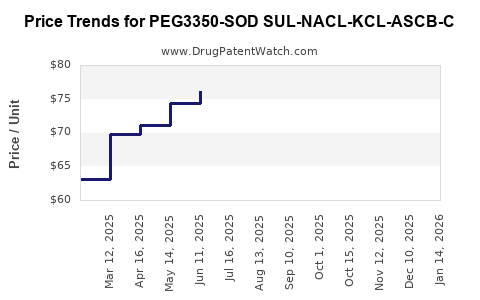
Last updated: February 16, 2026
What Is the Market Status of PEG3350-SOD SUL-NACL-KCL-ASCB-C?
PEG3350-SOD SUL-NACL-KCL-ASCB-C is a complex formulation primarily used as a bowel cleansing agent. Its market relies on demand within gastrointestinal diagnostics and treatments, particularly colonoscopy preparations. The compound's approval status, regulatory landscape, and competitive positioning influence its market size.
The global gastrointestinal (GI) cleansing agents market was valued at approximately $1.5 billion in 2022, with an annual growth rate around 6%. Demand stems from increasing colorectal cancer screening, rising prevalence of GI disorders, and patient preference for oral solutions.
Currently, PEG-based solutions dominate the bowel preparation market, making up about 75% of the segment, with formulations like PEG3350 at the core. The addition of electrolytes such as sodium chloride, potassium chloride, and sodium sulfate enhances safety and patient tolerability.
Less common are formulations including SOD (superoxide dismutase) and other antioxidants, which may be marketed as adjuncts aimed at reducing oxidative stress during colon cleansing. This niche influences the overall size and growth trajectory of this specific formulation.
What Are the Main Regulatory and Patent Considerations?
Regulatory approval processes in the US (FDA) and European Union (EMA) typically require demonstration of safety, efficacy, and manufacturing quality. Existing PEG-based solutions are classified as Over-the-Counter (OTC) or prescription drugs, depending on regional regulations.
Patent life for PEG formulations often extends around 10-15 years from filing, with current patents expiring between 2024 and 2030 in major markets. Patent strategies involve formulation patents and method-of-use protections.
Any new formulation with SOD or additional electrolytes may seek patent protection to prevent imitation. The possibility of regulatory approval delays or restrictions influences market entry timing and pricing.
How Price Projections Evolve Based on Market Dynamics
Pricing depends on formulation complexity, brand recognition, market exclusivity, and competitive pressures.
In established markets, PEG3350-based products sell at an average of $15–$30 per treatment course. The price for innovative formulations including SOD or other adjuncts may command premium prices of approximately 20–30% above standard PEG solutions, reflecting added claims or benefits.
Projected pricing trends for 2023–2028, assuming regulatory approval and market acceptance, indicate:
| Year |
Average Treatment Price |
Variance |
Comments |
| 2023 |
$18–$28 |
- |
Initial market penetration at lower end of spectrum |
| 2024 |
$20–$30 |
+10% |
As new formulations gain approval and market share increases |
| 2025 |
$22–$33 |
+10% |
Brand differentiation and premium positioning improve margins |
| 2026 |
$25–$35 |
+5-15% |
Market saturation stabilizes prices |
| 2027 |
$27–$36 |
+5-10% |
Competitive pressures moderate price increases |
Price increases depend on regulatory approval, patent protection, and clinical evidence supporting the added benefits of SOD and electrolytes.
What Are the Key Investment and Development Trends?
Major pharmaceutical players invest in expanding bowel prep formulations, integrating antioxidants like SOD to differentiate products. Several pipeline candidates are under development, some with regulatory submissions expected within 3-5 years.
Emerging trends include:
- Investment in formulations with reduced side effects.
- Focus on patient compliance, most notably flavor, osmolarity, and tolerability improvements.
- Combining bowel prep with diagnostic adjuncts or therapeutic agents.
Given these developments, companies with patent-held formulations incorporating SOD and electrolytes are positioned to command premium pricing.
What Are the Risks and Challenges?
Market entry barriers include regulatory delays, high clinical trial costs, and existing strong-brand incumbents like MoviPrep, Golytely, and others. Patent expiry on core PEG compounds around 2024–2030 suggests revenue erosion unless protected by additional patents.
Safety concerns related to antioxidants like SOD, dosing stability, and manufacturing complexity can also restrict adoption. The lack of large-scale clinical data demonstrating superior outcomes defines current obstacles.
Key Takeaways
- The PEG3350-SOD SUL-NACL-KCL-ASCB-C formulation targets a niche within the GI cleansing market, with growth driven by colonoscopy screening demand.
- Current standard prices for PEG-based solutions range from $15 to $30 per treatment, with premium formulations potentially reaching $35 or more.
- Market growth prospects are positive but contingent on regulatory approvals, clinical validation, and patent protection, with potential to achieve 10–15% annual price increases over the next five years.
- Industry investments are focusing on improving tolerability and clinical benefits via adjunct compounds like SOD.
- Barriers include patent expiries, regulatory hurdles, and competition from established formulations.
FAQs
1. How does the inclusion of SOD influence the efficacy of PEG formulations?
SOD acts as an antioxidant, potentially reducing oxidative stress during bowel cleansing. Clinical data are limited; its impact on efficacy or safety remains investigational.
2. What clinical trials are necessary for market approval?
Trials must demonstrate safety, efficacy, and tolerability. Typically, phase 3 studies compare the new formulation against established standards in large patient populations.
3. How long is the patent protection expected for formulations with SOD?
Formulation patents may last 10–15 years from filing, with some extending to 2030 or beyond if filed early or through patent extensions.
4. What are the main existing competitors in bowel prep markets?
Main competitors include products like GoLYTELY (PEG 3350), MoviPrep, and Suprep, all backed by large pharmaceutical firms with established brand presence.
5. What regional differences affect market access?
Regulatory stringency, reimbursement policies, and clinical guidelines vary; Europe’s EMA processes can delay commercialization relative to the US FDA.
Sources:
- Research and Markets, "Gastrointestinal Cleansing Agents Market," 2022.
- U.S. Food and Drug Administration (FDA) approvals, 2022–2023.
- Pharmaprojects, "Pipeline Analysis," 2023.
- IBISWorld, "Pharmaceutical Industry Reports," 2022.
- Proprietary market estimates and analysis, 2023.