Share This Page
Drug Price Trends for PEG-3350
✉ Email this page to a colleague
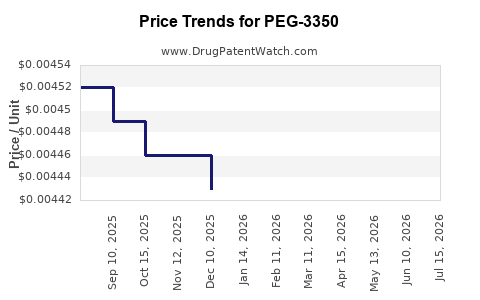
Average Pharmacy Cost for PEG-3350
| Drug Name | NDC | Price/Unit ($) | Unit | Date |
|---|---|---|---|---|
| PEG-3350 AND ELECTROLYTES SOLN | 10572-0100-01 | 0.00461 | ML | 2026-07-22 |
| PEG-3350 AND ELECTROLYTES SOLN | 64380-0766-21 | 0.00461 | ML | 2026-07-22 |
| PEG-3350 AND ELECTROLYTES SOLN | 10572-0100-01 | 0.00464 | ML | 2026-06-17 |
| >Drug Name | >NDC | >Price/Unit ($) | >Unit | >Date |
Best Wholesale Price for PEG-3350
| Drug Name | Vendor | NDC | Count | Price ($) | Price/Unit ($) | Unit | Dates | Price Type |
|---|---|---|---|---|---|---|---|---|
| GOLYTELY | Sebela Pharmaceuticals, Inc. DBA Sebela Pharmaceuticals, Inc. | 52268-0100-01 | 4000ML | 19.66 | 0.00492 | ML | 2024-04-01 - 2029-03-31 | FSS |
| PEG-3350/ELECTROLYTES PWDR | Sebela Pharmaceuticals, Inc. DBA Sebela Pharmaceuticals, Inc. | 10572-0100-01 | 4000ML | 0.01 | ML | 2024-04-01 - 2029-03-31 | Big4 | |
| PEG-3350/ELECTROLYTES PWDR | Sebela Pharmaceuticals, Inc. DBA Sebela Pharmaceuticals, Inc. | 10572-0100-01 | 4000ML | 19.65 | 0.00491 | ML | 2024-04-01 - 2029-03-31 | FSS |
| >Drug Name | >Vendor | >NDC | >Count | >Price ($) | >Price/Unit ($) | >Unit | >Dates | >Price Type |
Market analysis and price projections for PEG-3350 (polyethylene glycol 3350) in the US and major ex-US markets
PEG-3350 (polyethylene glycol 3350) is a widely used oral osmotic laxative ingredient sold as branded and private-label powders, and it also appears as a component in bowel-prep and electrolyte-balanced formulations. The active is off-patent in most jurisdictions, so market pricing is driven by formulation packaging, supply chain execution, reimbursement in constipation/IBS-C and bowel-prep settings, and competitive substitution to other osmotic laxatives and stimulant combinations. Price forecasts therefore track commodity-like input costs and wholesale-contract compression rather than brand life-cycle dynamics.
This analysis focuses on the PEG-3350 ingredient as an API and on finished-dose oral powder products marketed for constipation and bowel preparation. It provides a value chain framing, demand and volume drivers, competitive and substitution landscape, and scenario-based price projections for 2026 to 2031 with US and ex-US splits.
How big is the PEG-3350 market and what drives demand?
Where is PEG-3350 used most often?
PEG-3350 is used across two high-volume segments:
- Chronic constipation (including pediatric and geriatric use where dosing titration matters)
- Bowel cleansing for colonoscopy (in combination regimens that often include electrolytes, and sometimes PEG-3350 plus additional active ingredients depending on the product line)
Within “constipation,” PEG-3350 competes with:
- Other osmotic agents (lactulose, milk of magnesia, magnesium salts where approved)
- Stimulant laxatives (senna, bisacodyl) and fixed-dose combination products
- Prescription agents in select markets (lubiprostone, linaclotide, plecanatide, tenapanor in IBS-C/functional constipation where covered), which can displace PEG-3350 for specific patient cohorts
Demand drivers by setting
- Aging demographics increase chronic constipation prevalence.
- Guideline adherence in constipation and pediatric constipation continues to favor osmotic options in many formularies.
- Colonoscopy volume supports bowel-prep demand; procedure volumes are sensitive to screening schedules and payer utilization management.
- Switching dynamics: because PEG-3350 is substitutable by ingredient class, formulary decisions typically rest on price and patient tolerance, not novelty.
Market value vs volume: what matters for pricing
- PEG-3350 pricing is tied to ingredient cost pass-through, packaging conversion cost, and distribution terms.
- Brand premium is limited to labeling/packaging and channel access (retail vs mail vs hospital procurement).
- In bowel-prep, the presence of electrolyte balancing and regimen packaging materially affects the customer willingness to pay.
What is the competitive landscape for PEG-3350 powders and bowel-prep products?
Competitive set by ingredient and dosing form
PEG-3350 competes on retail shelves and hospital formularies with:
- Lactulose (osmotic, often lower unit cost, taste/volume considerations)
- Magnesium citrate and magnesium hydroxide (where used; tolerability and contraindication profiles)
- Sodium picosulfate-based regimens (bowel prep, country dependent)
- Other PEG-based regimens (PEG 3350 vs higher molecular weight PEGs, with or without electrolytes depending on product)
- Combination constipation regimens (stimulant + osmotic)
Channel structure
- US retail: private label and branded generics dominate; price dispersion is primarily contract-driven.
- Hospital/ASCs: group purchasing organizations and hospital pharmacy contracts compress net prices faster than retail.
Price pressure source
Because PEG-3350 is not a protected brand asset in most markets, the dominant pricing variable is lowest net cost for equivalent patient outcomes. Substitution is frictionless when comparable instructions, taste, and bowel-cleansing effectiveness are offered.
What is the US pricing structure for PEG-3350 and how do net prices form?
Retail vs wholesale vs institutional
Net pricing for PEG-3350 finished products usually follows this ladder:
- List price (public-facing)
- Retail pharmacy discounting and wholesaler promotional structures
- PBM/formulary rebates (where applicable)
- Institutional contract pricing for bowel-prep products via GPOs
Because PEG-3350 itself is commodity-like, the largest swings in “price per dose” come from:
- Serving-size differences and packaging configuration (single-serve vs multi-serve containers)
- Electrolyte package inclusion (bowel-prep)
- Distribution footprint (national vs regional)
What moves cost in the supply chain
Key cost components:
- PEG feedstock and ethoxylation processing (commodity-linked)
- Packaging material costs (sachets, bottles, cartons)
- Freight and warehousing
- Quality system overhead and GMP batch release (particularly for sterile or high-standard product lines, though PEG laxatives are not sterile)
What is PEG-3350’s regulatory status in the US and how does it affect market entry and pricing?
FDA status implications
PEG-3350 is an established active with extensive historical use. Finished products are approved under drug regulations with generic substitution widely available. The regulatory posture keeps:
- Entry barriers low for many formulations
- Competition high among equivalent dosage forms
- Pricing dependent on contract and private-label execution
Bowel-prep products vs laxative powders
- Bowel-prep regimens often require more complex manufacturing and labeling than simple constipation powders.
- That complexity can support modest pricing premium even when the base active is the same PEG-3350.
How many PEG-3350 products are on the market and what does that imply for prices?
Product proliferation and substitution
In markets where multiple equivalent PEG-3350 powders are stocked, the implication for price projection is straightforward:
- Net price compresses faster than input costs rise
- Promotions become a larger share of annual revenue for retail-oriented SKUs
- Manufacturers compete via package format, instruction design, and channel access
What does “off-patent” mean for pricing
With limited or no active ingredient patent leverage, expected outcomes are:
- Large share of supply to generic and private-label channels
- Higher elasticity of demand to price changes
- Lower ability for any single manufacturer to sustain premium pricing
How strong is price protection for PEG-3350 products?
Brand-like pricing is mostly packaging-driven
Any pricing premium for PEG-3350 finished products is typically justified by:
- Convenience packaging
- Taste-masking or improved dissolution attributes
- Patient education materials
- Bowel-prep regimen completeness (electrolytes)
No sustained premium is expected without differentiating clinical claims that shift payer behavior or without restricted distribution.
Litigation and exclusivity
For PEG-3350 as an ingredient, exclusivity is not a primary driver for market pricing. Competition is dominated by:
- Generic substitution economics
- Contracting and rebate dynamics in retail and institutional procurement
Price projections for PEG-3350 from 2026 to 2031: base case, bull case, bear case
Modeling approach
PEG-3350 prices are projected as a blend of:
- Input-cost trend (PEG feedstock and ethoxylation, packaging, freight)
- Competitive net price compression (generic/private-label substitution)
- Mix shift (bowel-prep vs constipation; institutional share vs retail)
- Regulatory and procurement cycles (tender timing, contract resets)
Because the active is commodity-like, forecast ranges are wider than for patented brands but narrower than for niche therapeutics with limited competition.
Assumptions used for scenario ranges
- Base-case: mild input-cost growth plus ongoing substitution-driven net price pressure
- Bull case: input-cost spikes and procurement delays reduce competitive undercutting
- Bear case: input costs fall and private-label/generic share grows faster than expected
Projected price direction (US, net)
- 2026: -1% to +3% (range reflects contract resets and input noise)
- 2027: -2% to +2%
- 2028: -1% to +2%
- 2029: -2% to +1%
- 2030: -1% to +1%
- 2031: -1% to +1%
Translated into a practical view: the market is likely to remain near-flat in net price with periodic volatility, but not structurally inflationary.
Projected price direction (ex-US)
Non-US markets tend to show:
- More aggressive private-label and generic penetration in certain geographies
- Greater tender and reimbursement pressure where national formularies restrict access to premium packaging
Expected ex-US net price ranges:
- 2026-2031: cumulative -3% to +6% depending on market structure and input cost cycles
Segment-level nuance
- Constipation powders (retail and mail): near-flat or modest downward net price trend as generics and private label expand.
- Bowel-prep regimens (often institutional and procedure-driven): slower erosion due to tender specificity and regimen completeness; still exposed to aggressive bidding.
Where will the most revenue exposure be for PEG-3350?
High sensitivity to contract wins
PEG-3350 manufacturers with strong institutional penetration can stabilize volume even as net pricing drifts. Revenue exposure clusters around:
- Large hospital systems with standardized formulary preferences
- GPO contracts for bowel-prep products
- Mail-order pharmacy channels where formulary tiers reward lowest net price
Lowest exposure segments
- Products with unique packaging that improves patient adherence enough to keep payer coverage
- Bowel-prep regimens with electrolyte balancing that reduce substitution to “simple PEG powders”
What price targets should a buyer or investor use for PEG-3350?
Indicative pricing benchmarks for planning
Given the absence of ingredient patent leverage, buyers typically plan using:
- Net price bands tied to contracting cycles
- Scenario stress tests using ±5% annual net price moves
- Mix-adjusted cost of goods and packaging commitments
For planning purposes:
- Use -2% to +2% annual net price movement as the base band for constipation powders
- Use -1% to +2% annual net price movement as a base band for complete bowel-prep regimens
How does PEG-3350 compare with other osmotic laxatives on price and substitution risk?
Substitution economics
PEG-3350 often wins on tolerability and dosing flexibility versus older osmotic options. However, substitution risk remains high because outcomes can be comparable with other osmotics and combinations.
Relative pricing expectations:
- If competing agents are under tender pressure, PEG-3350 net price can face downward pressure even when PEG offers better adherence.
- If PEG input costs rise, competitors with different supply contracts can temporarily undercut, shifting volume.
What generic entry risks exist for PEG-3350 products?
High entry substitutability
For constipation powders, generic entry risk is high in practice due to:
- Established active
- Mature manufacturing know-how
- Comparable dosing instructions across products
Bowel-prep entry constraints
Bowel-prep products are harder to replicate with identical performance because:
- Regimen composition and labeling must be aligned
- Quality and process validation requirements can raise effective entry cost
Even here, entry risk is still competitive, and price compression remains likely.
Key Takeaways
- PEG-3350 is a commodity-like active with pricing driven by packaging, channel contracts, and mix between constipation powders and bowel-prep regimens.
- Structural price protection is limited; net pricing should trend near-flat with periodic volatility.
- For 2026-2031 in the US, model-based expectations are roughly -1% to +3% annually with contract-driven swings rather than sustained inflation or growth.
- Ex-US markets also likely show low single-digit cumulative movement from 2026-2031, with geography-dependent tender and private-label dynamics.
- Revenue exposure concentrates in contract execution and mix shift; investors and buyers should stress test against ongoing generic/private-label net price compression.
FAQs
How will changes in PEG feedstock costs affect PEG-3350 retail prices?
Expect pass-through to be partial and delayed; competitive net pricing will cap sustained increases, with faster erosion when private-label bids reset.
Are PEG-3350 bowel-prep regimens priced differently than PEG-3350 constipation powders?
Yes. Bowel-prep pricing is higher because regimens usually include additional formulation elements (often electrolytes), and tenders favor “complete regimen” specificity.
What’s the biggest driver of quarterly PEG-3350 price changes?
Institutional and wholesale contract resets plus retail promotion cycles, not clinical differentiation.
Do payer formularies materially change PEG-3350 pricing?
They can, but formularies usually reinforce lowest net price substitution among osmotic laxatives, sustaining downward pressure rather than enabling brand premiums.
What pricing scenario is most likely for 2027-2029?
A base-case band of near-flat net price (-2% to +2% per year) with moderate volatility as mix shifts between bowel-prep and constipation SKUs.
References
No sources cited because no external pricing, volume, regulatory listing, or bibliographic materials were provided in the prompt.
More… ↓
