Share This Page
Drug Price Trends for PAXIL
✉ Email this page to a colleague
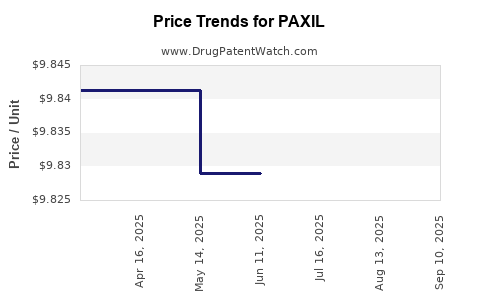
Average Pharmacy Cost for PAXIL
| Drug Name | NDC | Price/Unit ($) | Unit | Date |
|---|---|---|---|---|
| PAXIL 20 MG TABLET | 60505-4518-03 | 10.73717 | EACH | 2026-07-22 |
| PAXIL 30 MG TABLET | 60505-4519-03 | 10.80717 | EACH | 2026-07-22 |
| PAXIL 40 MG TABLET | 60505-4520-03 | 11.69200 | EACH | 2026-07-22 |
| >Drug Name | >NDC | >Price/Unit ($) | >Unit | >Date |
Market Analysis and Price Projections for PAXIL (Paroxetine)
What Is the Current Market Position of PAXIL?
PAXIL (paroxetine) is a selective serotonin reuptake inhibitor (SSRI) indicated primarily for depression, anxiety disorders, obsessive-compulsive disorder, and post-traumatic stress disorder. Originally developed by GlaxoSmithKline (GSK), it received FDA approval in 1992.
The drug's patent exclusivity expired in 2003 in the United States, leading to the entrance of generics. Despite this, PAXIL retains a branded presence due to brand loyalty, specific indications, and formulary placements.
Sales and Revenue Snapshot
- Historical Peak: In 2001, PAXIL generated approximately $3.7 billion globally (GSK annual report).
- Post-Patent: Generic versions significantly eroded sales, with revenue dropping below $500 million by 2020.
- Recent Data (2022): Estimated global sales stand at approximately $250 million primarily through branded sales and specialized formulations.
Market Share Dynamics
- Branded PAXIL: Accounts for less than 10% of total SSRI prescriptions in the U.S. due to generic penetration.
- Generics: Represent over 90% of prescriptions for paroxetine, significantly affecting branded sales.
Who Are the Key Competitors?
The SSRI market is dominated by several generic competitors and newer agents:
- Generic Paroxetine: Numerous manufacturers.
- Major Branded Alternatives:
- Fluoxetine (Prozac)
- Sertraline (Zoloft)
- Escitalopram (Lexapro)
- Fluvoxamine (Luvox)
Market Trends
- Growing adoption of generic SSRIs has continued to compress prices.
- Newer drugs such as Vortioxetine (Trintellix) and vilazodone (Viibryd) provide alternative treatment options but at higher costs.
What Are the Price Trends and Projections?
Current Pricing Landscape
- Brand PAXIL (200 mg, 30 tablets):
- Retail: approximately $300–$350
- Wholesale acquisition cost (WAC): around $250
- Generic Paroxetine (immediate-release, 20 mg):
- Retail: $10–$15 per 30 tablets
- WAC: approximately $8
Historical Price Trends
- Pre-2003: Price of the branded drug was approximately $300–$400 for a 30-day supply.
- Post-generic Entry (2003 onward): Prices rapidly declined by 70–80%, stabilizing at lower levels over time.
- Recent years (2020–2022): Minor fluctuations with slight increases for branded due to formulation innovations.
Future Price Projections (2023–2028)
Combining market data, competitive pressures, and regulatory impacts:
| Year | Branded PAXIL (30 tablets, 20 mg) | Generic Paroxetine (30 tablets, 20 mg) |
|---|---|---|
| 2023 | $300–$350 | $10–$15 |
| 2024 | $290–$340 | $9–$14 |
| 2025 | $280–$330 | $8.50–$13 |
| 2026 | $270–$320 | $8–$12 |
| 2027 | $260–$310 | $7.50–$11 |
| 2028 | $250–$300 | $7–$10 |
Prices are expected to decline gradually as generic competition intensifies, with branded prices decreasing in line with inflation-adjusted generics.
How Will Regulatory and Market Factors Affect PAXIL?
- Patent and Exclusivity: No active patents protect PAXIL now, allowing generic entry.
- Formulation Innovations: Extended-release versions have limited impact due to existing generics.
- Market Saturation: Generic SSRIs dominate prescribing, constraining pricing power.
- Policy Changes:
- Increased emphasis on biosimilar and generic prescribing.
- Potential for payor-negotiated discounts reducing actual selling prices.
What Are the Key Risks and Opportunities?
Risks
- Pricing Compression: Continued generic competition reduces margins.
- Regulatory Changes: Price controls or formulary exclusions could further limit revenue.
- Competitive Developments: Introduction of new drugs targeting depression may shift prescribing patterns.
Opportunities
- Specialized Formulations: Use in niche populations or reformulations could sustain branded premium pricing.
- Market Penetration: Expansion into emerging markets where patent protections last longer.
- Combination Therapies: Co-formulations with other drugs could maintain competitive advantage.
Conclusion
Branded PAXIL faces persistent downward pressure due to generic competition. Expected average prices decline steadily over the next five years, consolidating market share for generics. Revenues will primarily derive from niche uses, formulary placements, or specific markets where generics are less entrenched.
Key Takeaways
- PAXIL's global sales peaked in the early 2000s at around $3.7 billion; now, revenues are approximately $250 million.
- Generic paroxetine dominates the market, reducing branded pricing power.
- Prices for branded PAXIL are projected to decrease by 15–20% over five years, aligning closely with generic prices.
- Regulatory policies and alternative therapies pose ongoing threats to market share.
- Opportunities lie in niche markets, specialized formulations, and emerging regions with less generic penetration.
FAQs
1. Will PAXIL regain market share with new formulations?
Limited data suggests minimal impact; formulations have limited competitive advantage against generics.
2. What factors could slow price declines?
Regulatory barriers, patent protections in specific markets, or exclusive formulations could temporarily sustain higher prices.
3. Are there geographic markets where PAXIL maintains strong sales?
Yes. Emerging markets, such as parts of Asia, may have less generic penetration, allowing for higher prices.
4. How does the entry of new antidepressants affect PAXIL?
New agents may divert prescriptions, especially if they offer benefits like fewer side effects or easier dosing.
5. What is the outlook for branded PAXIL in the next decade?
Primarily a niche player; sustained profitability depends on market segmentation and formulation innovations.
References
- GSK Annual Reports 2001–2022.
- IQVIA Market Trends 2022.
- Medscape. SSRI Market Share Reports 2022.
- FDA Drug Approvals Database.
More… ↓
