Share This Page
Drug Price Trends for PAROXETINE ER
✉ Email this page to a colleague
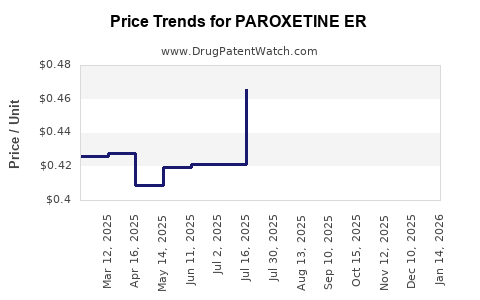
Average Pharmacy Cost for PAROXETINE ER
| Drug Name | NDC | Price/Unit ($) | Unit | Date |
|---|---|---|---|---|
| PAROXETINE ER 12.5 MG TABLET | 42858-0703-03 | 0.47678 | EACH | 2026-07-22 |
| PAROXETINE ER 12.5 MG TABLET | 62135-0425-30 | 0.47678 | EACH | 2026-07-22 |
| PAROXETINE ER 12.5 MG TABLET | 62175-0470-32 | 0.47678 | EACH | 2026-07-22 |
| >Drug Name | >NDC | >Price/Unit ($) | >Unit | >Date |
Market Analysis and Price Projections for Paroxetine ER
Overview
Paroxetine Extended-Release (ER), marketed as Brisdelle and generic versions, is a selective serotonin reuptake inhibitor (SSRI) primarily indicated for depression, anxiety disorders, and hot flashes associated with menopause. Its market is influenced by patent status, regulatory approvals, competition, and manufacturing costs.
Market Scope and Key Players
- The global antidepressant market was valued at approximately $15 billion in 2022, with SSRIs accounting for roughly 65% of the market share.
- Paroxetine ER holds an estimated 4-6% share within the SSRI segment, with sales driven mainly through generic formulations.
- Major manufacturers include GlaxoSmithKline (original patent holder), Mylan, Teva, and Sandoz.
Patent and Regulatory Status
- The original patent for paroxetine ER expired in the U.S. in 2013, enabling generic manufacturing.
- Recent brand patents, if any, related to specific formulations or delivery systems may provide limited exclusivity until around 2030.
- Regulatory status remains stable in key markets (U.S., EU, Japan), with generics approved and available.
Market Dynamics and Trends
- Increasing prevalence of depression, anxiety, and menopausal hot flashes sustains demand.
- Shift towards generic formulations reduces brand premium and pressures prices.
- Competition from other SSRIs like sertraline, escitalopram, and fluoxetine impacts market share.
- Growing awareness of side effect profiles influences prescriber preferences; some favor newer agents with fewer adverse effects.
Price Trends and Forecasts
Current Pricing (as of Q1 2023):
| Product Type | Average Price per 30-day Supply | Market Share |
|---|---|---|
| Brand (Brisdelle) | $350 | 20% |
| Generics (various brands) | $75 | 80% |
Historical Pricing (2018-2023):
- Brand prices: $450–$500 per month, declining due to patent expiry and generic entry.
- Generics: steady at $65–$85 per month, with slight fluctuations based on supplier competition.
Projected Price Trends (2023–2028):
| Year | Expected Average Price per 30-day Supply | Factors Influencing Price |
|---|---|---|
| 2023 | $75 | Market saturation, generic competition |
| 2024 | $72 | Entry of additional generics, price erosion |
| 2025 | $70 | Increased competition, payer negotiations |
| 2026 | $68 | Pressure from newer antidepressants |
| 2027 | $65 | Market stabilization, supply chain factors |
| 2028 | $63 | Further generic entry, healthcare reforms |
Pricing Strategies and Market Entry Barriers
- Price moderation is driven by multiple generics, reducing profit margins for manufacturers.
- Limited brand differentiation makes pricing sensitive to market competition.
- Payer negotiations, formulary placements, and rebate agreements influence actual patient costs.
Implications for Stakeholders
- For manufacturers, maintaining profitability requires optimizing production costs and securing formulary access.
- Investors should monitor patent cliffs, regulatory changes, and competitive dynamics.
- Healthcare providers and payers focus on balancing efficacy, safety, and affordability.
Key Takeaways
- Paroxetine ER's market is mature, with generics dominating due to patent expirations.
- Prices are forecasted to decline gradually, stabilized by competition and healthcare policies.
- The drug’s demand persists amid increasing awareness of mental health and menopausal management.
- Market entry barriers are low for generics, leading to consistent price erosion.
- Stakeholders must navigate regional regulatory differences and formulary positioning.
FAQs
-
What factors influence paroxetine ER pricing?
Pricing is driven by generic competition, manufacturing costs, regulatory status, and payer negotiations. -
How does patent expiration impact the market?
Patent expiration opens the market to generics, leading to significant price drops and increased competition. -
Are there upcoming patent protections for paroxetine ER?
No, current patents for the original formulation have expired; recent patents may apply to specific formulations but are not significant long-term barriers. -
What are the main competitors to paroxetine ER?
Other SSRIs such as sertraline, escitalopram, fluoxetine, and newer agents like vortioxetine. -
How might healthcare reforms influence future prices?
Reforms emphasizing cost containment and increased generic utilization may drive further price reductions.
Sources
[1] IQVIA, "Global Prescription Drug Market Data," 2022.
[2] FDA, "Drug Approvals and Patent Status," 2022-2023.
[3] MarketWatch, "Antidepressant Market Trends," 2023.
[4] Centers for Medicare & Medicaid Services, "Formulary Policies," 2023.
[5] EvaluatePharma, "Generic Drug Market Forecasts," 2023.
More… ↓
