Share This Page
Drug Price Trends for PAROXETINE CR
✉ Email this page to a colleague
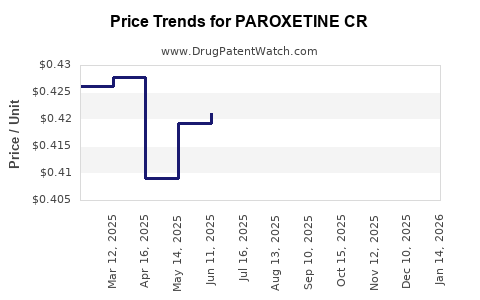
Average Pharmacy Cost for PAROXETINE CR
| Drug Name | NDC | Price/Unit ($) | Unit | Date |
|---|---|---|---|---|
| PAROXETINE CR 37.5 MG TABLET | 60505-1318-03 | 0.40751 | EACH | 2026-04-22 |
| PAROXETINE CR 12.5 MG TABLET | 60505-1316-03 | 0.52536 | EACH | 2026-04-22 |
| PAROXETINE CR 25 MG TABLET | 60505-1317-03 | 0.39634 | EACH | 2026-04-22 |
| PAROXETINE CR 37.5 MG TABLET | 60505-1318-03 | 0.42993 | EACH | 2026-03-18 |
| PAROXETINE CR 12.5 MG TABLET | 60505-1316-03 | 0.49289 | EACH | 2026-03-18 |
| PAROXETINE CR 25 MG TABLET | 60505-1317-03 | 0.42472 | EACH | 2026-03-18 |
| >Drug Name | >NDC | >Price/Unit ($) | >Unit | >Date |
Paroxetine CR Market Analysis and Price Projections
This report analyzes the market for Paroxetine CR, a selective serotonin reuptake inhibitor (SSRI) used for treating depression and anxiety disorders. The analysis covers patent landscape, market size, key market drivers, competitive landscape, and price projections.
What is Paroxetine CR's Current Market Position?
Paroxetine CR, marketed as Paxil CR and other generics, is an established antidepressant and anxiolytic. Its primary indications include Major Depressive Disorder (MDD), Obsessive-Compulsive Disorder (OCD), Panic Disorder, Social Anxiety Disorder (SAD), Generalized Anxiety Disorder (GAD), and Post-Traumatic Stress Disorder (PTSD). The drug operates via the inhibition of serotonin reuptake, increasing serotonin levels in the synaptic cleft.
The global market for antidepressants is substantial, driven by increasing prevalence of mental health disorders, rising awareness, and improved diagnostic rates. While newer antidepressants with potentially different efficacy and side-effect profiles exist, Paroxetine CR maintains a significant market share due to its established efficacy, long history of use, and generally favorable cost-effectiveness, particularly in its generic forms.
What is the Patent Landscape for Paroxetine CR?
Paroxetine was first patented by Ferrosan A/S in the 1970s. The original patents have long expired, allowing for the widespread availability of generic versions. Key patents relating to the controlled-release formulation (CR) also expired, contributing to the genericization of the drug.
- US Patent 4,536,518 (issued June 14, 1984): This patent covered the compound paroxetine itself. This patent expired decades ago.
- US Patent 5,023,268 (issued June 11, 1991): This patent covered a specific controlled-release formulation of paroxetine. This patent also expired, paving the way for generic CR versions.
The absence of active patent protection for the core compound and its primary formulations means that the market is largely driven by generic competition, making price the primary differentiating factor. Innovation in this space is unlikely to involve new patent-protected formulations of paroxetine itself but rather alternative delivery methods or combination therapies, which are not currently a significant focus for paroxetine.
How Large is the Global Paroxetine CR Market?
Estimating the precise market size for Paroxetine CR alone is challenging as data is often aggregated with other SSRIs and antidepressants. However, based on its established use and the broader antidepressant market trends, the global market for paroxetine, including both immediate-release and controlled-release formulations, is estimated to be in the hundreds of millions of US dollars annually.
Key Market Data Points and Projections:
- Global Antidepressant Market: The global antidepressants market was valued at approximately $15.2 billion in 2022 and is projected to reach $20.8 billion by 2030, growing at a CAGR of 4.0% from 2023 to 2030 [1]. Paroxetine CR represents a segment within this larger market.
- Generic Drug Dominance: As of 2023, the vast majority of Paroxetine CR prescriptions are for generic versions. The brand name Paxil CR is largely overshadowed by generic competitors in terms of volume and market share.
- Volume Trends: Prescription volumes for Paroxetine CR have remained relatively stable, with some decline in developed markets due to the introduction of newer drug classes and treatment modalities. However, its affordability continues to drive demand, especially in emerging markets and for patients with limited insurance coverage.
What are the Key Market Drivers for Paroxetine CR?
Several factors continue to support the demand for Paroxetine CR.
- Prevalence of Mental Health Disorders: The global increase in diagnosed cases of depression and anxiety disorders is a primary driver. The World Health Organization (WHO) estimates that over 280 million people globally suffer from depression [2].
- Cost-Effectiveness: Paroxetine CR is one of the most affordable treatment options for depression and anxiety, especially in generic form. This makes it accessible to a broad patient population and a preferred choice for healthcare systems focused on cost containment.
- Established Efficacy and Safety Profile: Decades of clinical use have established Paroxetine CR's efficacy in treating various mental health conditions. While not without side effects, its safety profile is well-understood and manageable for many patients.
- Physician Familiarity: Healthcare providers are highly familiar with paroxetine's prescribing patterns, dosages, and potential side effects, leading to continued confidence in its use.
- Accessibility in Emerging Markets: As healthcare infrastructure improves in emerging economies, the demand for affordable and effective treatments like generic Paroxetine CR is expected to grow.
What is the Competitive Landscape for Paroxetine CR?
The competitive landscape for Paroxetine CR is characterized by intense generic competition. There are numerous manufacturers offering generic versions of Paroxetine CR in various dosage strengths.
Major Generic Manufacturers (Examples, not exhaustive):
- Teva Pharmaceuticals: A leading global generic pharmaceutical company with a broad portfolio, including paroxetine.
- Mylan N.V. (now Viatris): Another significant player in the generic market.
- Sun Pharmaceutical Industries: An Indian multinational pharmaceutical company with a strong presence in generics.
- Accord Healthcare: A UK-based generic pharmaceutical company.
- Dr. Reddy's Laboratories: An Indian multinational pharmaceutical company.
Competition from Other Antidepressant Classes:
While generic competition dominates within the paroxetine market, Paroxetine CR also competes with other classes of antidepressants and therapeutic approaches:
- Other SSRIs: Fluoxetine, Sertraline, Citalopram, Escitalopram. These often have comparable efficacy and varying side effect profiles, with newer SSRIs potentially commanding higher prices.
- SNRIs (Serotonin-Norepinephrine Reuptake Inhibitors): Venlafaxine, Duloxetine. These offer a different mechanism of action and are often used when SSRIs are not fully effective.
- Atypical Antidepressants: Bupropion, Mirtazapine.
- Non-Pharmacological Treatments: Psychotherapy (Cognitive Behavioral Therapy - CBT, Interpersonal Therapy - IPT), electroconvulsive therapy (ECT), and other emerging treatments are also part of the broader competitive landscape for mental health conditions.
The development of novel antidepressants with improved efficacy, reduced side effects, or alternative mechanisms of action poses a long-term competitive threat, although the cost-effectiveness of generic paroxetine provides a significant barrier to displacement.
What are the Price Projections for Paroxetine CR?
Price projections for Paroxetine CR are primarily influenced by generic competition, manufacturing costs, and market demand. Given that patent exclusivity has long expired, price erosion is a continuous factor.
Price Trend Analysis:
- Sustained Price Erosion: The price of generic Paroxetine CR has steadily declined since its generic launch and is expected to continue this trend, albeit at a slower pace. Price competition among numerous generic manufacturers is intense.
- Average Wholesale Price (AWP) vs. Actual Selling Price: While AWP figures provide a benchmark, the actual selling prices negotiated between manufacturers, wholesalers, and pharmacies are typically lower due to discounts and rebates.
- Dosage Strength Variations: Prices can vary based on dosage strength (e.g., 12.5 mg, 25 mg, 37.5 mg). Higher dosages might have a slightly higher unit price but offer better value per milligram.
Projected Price Range (for generic Paroxetine CR, per prescription/unit):
Based on current market data and historical trends, the average price for a 30-day supply of generic Paroxetine CR is projected to remain within the range of $10 to $30 USD.
- Short-Term (1-2 years): Expect minor fluctuations, potentially a slight decrease of 1-3% annually due to ongoing competition and procurement negotiations.
- Medium-Term (3-5 years): The price is likely to stabilize within a narrow band, with continued downward pressure but at a rate of less than 1% annually as the market matures. Any significant price increases would likely be due to external factors such as major supply chain disruptions or significant shifts in manufacturing costs, which are currently not anticipated.
- Long-Term (5+ years): Prices will remain highly competitive and likely at the lower end of the current range, driven by commoditization and the availability of multiple generic suppliers.
Factors Influencing Price Projections:
- Manufacturing Costs: Fluctuations in the cost of raw materials and active pharmaceutical ingredients (APIs) can impact pricing, but the scale of production for generics often mitigates these effects.
- Regulatory Landscape: Changes in manufacturing regulations or approval processes could indirectly affect costs and pricing.
- Payer Contracts and Rebates: Agreements with insurance providers and pharmacy benefit managers (PBMs) significantly influence net prices.
- Demand Stability: While demand is expected to remain stable, any significant decline in prescription volumes could lead to increased price competition to maintain market share.
Key Takeaways
- Paroxetine CR is a well-established generic medication with no active patent protection for its core formulations.
- The market is dominated by generic competition, leading to intense price pressure.
- Key market drivers include the high prevalence of depression and anxiety disorders, the drug's cost-effectiveness, and physician familiarity.
- Paroxetine CR competes with other SSRIs, SNRIs, atypical antidepressants, and non-pharmacological treatments.
- Generic Paroxetine CR prices are projected to remain stable within a low range ($10-$30 per 30-day supply), with continued slight erosion.
Frequently Asked Questions
-
Will there be any new patent-protected formulations of Paroxetine CR developed? Given that the core patents have expired and the drug is a mature generic, the development of novel patent-protected formulations for Paroxetine CR is unlikely to be a significant focus for pharmaceutical innovation. Research efforts are more likely to concentrate on entirely new drug classes or delivery systems for other compounds.
-
What is the primary reason for the low price of generic Paroxetine CR? The primary reason for the low price is the absence of patent exclusivity. Once a patent expires, multiple generic manufacturers can produce and sell the drug, leading to market competition that drives prices down to cost-of-manufacturing levels.
-
How does Paroxetine CR's price compare to newer antidepressants? Generic Paroxetine CR is significantly less expensive than most newer antidepressants, including branded SSRIs, SNRIs, and atypical antidepressants. This price difference is a major factor in its continued use, especially for patients with limited insurance coverage or in cost-sensitive healthcare systems.
-
What are the most common side effects of Paroxetine CR that might influence patient choice and thus market demand? Common side effects include nausea, insomnia, dizziness, sexual dysfunction (e.g., decreased libido, delayed ejaculation), and weight gain. These side effects can influence patient adherence and physician prescribing habits, leading some patients to switch to other antidepressants with different side effect profiles.
-
Are there any supply chain risks specific to generic Paroxetine CR that could impact its price or availability? As with any generic medication manufactured globally, supply chain risks exist, including raw material sourcing issues, manufacturing plant disruptions, and logistical challenges. However, the broad base of generic manufacturers for paroxetine generally mitigates the risk of complete unavailability. Price fluctuations due to such disruptions are typically temporary.
Citations
[1] Grand View Research. (2023). Antidepressants Market Size, Share & Trends Analysis Report By Drug Class, By Indication, By Distribution Channel, By Region, And Segment Forecasts, 2023 - 2030. Retrieved from https://www.grandviewresearch.com/industry-analysis/antidepressants-market
[2] World Health Organization. (2022, September 13). Depression. Retrieved from https://www.who.int/news-room/fact-sheets/detail/depression
More… ↓
