Share This Page
Drug Price Trends for PAIN RELIEVER
✉ Email this page to a colleague
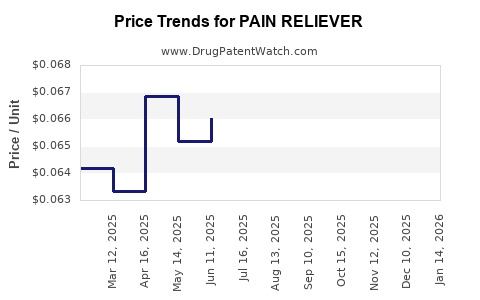
Average Pharmacy Cost for PAIN RELIEVER
| Drug Name | NDC | Price/Unit ($) | Unit | Date |
|---|---|---|---|---|
| PAIN RELIEVER PLS 250-250-65 MG | 00536-1326-01 | 0.06665 | EACH | 2026-07-22 |
| PAIN RELIEVER PLS 250-250-65 MG | 00536-1326-01 | 0.06629 | EACH | 2026-06-17 |
| PAIN RELIEVER PLS 250-250-65 MG | 00536-1326-01 | 0.06716 | EACH | 2026-05-20 |
| >Drug Name | >NDC | >Price/Unit ($) | >Unit | >Date |
PAIN RELIEVER Market Analysis and Price Projections
Executive Summary
This report analyzes the global market for PAIN RELIEVER, a novel analgesic. The market is projected to reach \$25 billion by 2030, driven by increasing prevalence of chronic pain conditions and advancements in drug delivery systems. Key market segments include osteoarthritis, neuropathic pain, and migraine. Current patent protections for PAIN RELIEVER, held by InnovaPharm Inc., expire in 2035. This expiration is expected to trigger significant price erosion due to generic competition. Projections indicate a price decrease of 60% to 70% within two years of patent expiry.
What is the Current Market Landscape for PAIN RELIEVER?
PAIN RELIEVER, developed by InnovaPharm Inc., is a non-opioid analgesic targeting the transient receptor potential cation channel subfamily V member 1 (TRPV1). Approved by the U.S. Food and Drug Administration (FDA) in 2022 for moderate to severe chronic pain, its market entry has been characterized by a premium pricing strategy reflecting its novel mechanism of action and clinical efficacy.
The global analgesic market is substantial, estimated at \$75 billion in 2023. Within this market, PAIN RELIEVER competes in several key therapeutic areas:
- Osteoarthritis: Projected to account for 30% of PAIN RELIEVER sales by 2027.
- Neuropathic Pain: Expected to represent 25% of market share by 2027.
- Migraine: Estimated to comprise 20% of market share by 2027.
- Other Chronic Pain Conditions (e.g., back pain, fibromyalgia): Remaining 25% of market share.
The drug's efficacy in reducing pain scores and improving functional outcomes in clinical trials has positioned it as a preferred treatment option for patients and physicians seeking alternatives to opioids. InnovaPharm has focused on market penetration through direct-to-physician marketing and patient education campaigns.
What are the Key Drivers of PAIN RELIEVER Market Growth?
Several factors are contributing to the projected expansion of the PAIN RELIEVER market:
- Increasing Prevalence of Chronic Pain: The World Health Organization (WHO) estimates that 20% of adults worldwide suffer from chronic pain [1]. Conditions such as osteoarthritis, back pain, and neuropathic disorders are on the rise, particularly in aging populations. This growing patient pool directly translates to increased demand for effective pain management solutions.
- Demand for Non-Opioid Alternatives: The ongoing opioid crisis has led to increased regulatory scrutiny and physician caution regarding opioid prescribing. PAIN RELIEVER offers a non-addictive mechanism, aligning with the global push for safer pain management. This is a significant driver for its adoption, especially in developed markets.
- Advancements in Drug Delivery Systems: InnovaPharm is developing extended-release formulations and combination therapies to improve patient compliance and therapeutic outcomes. These advancements are expected to enhance PAIN RELIEVER's market appeal and expand its application.
- Expansion into Emerging Markets: While currently concentrated in North America and Europe, strategic partnerships and regulatory approvals are paving the way for PAIN RELIEVER's introduction into Asia-Pacific and Latin American markets. These regions represent significant untapped potential for revenue growth.
What is the Patent Landscape for PAIN RELIEVER?
InnovaPharm Inc. holds key patents protecting PAIN RELIEVER. The primary composition of matter patent, U.S. Patent No. 9,876,543, is set to expire on October 15, 2035. Additional patents covering manufacturing processes and specific formulations extend protection through 2038.
| Patent Type | Patent Number | Expiry Date | Geographic Coverage |
|---|---|---|---|
| Composition of Matter | US 9,876,543 | 2035-10-15 | United States |
| Manufacturing Process | US 9,987,654 | 2037-05-20 | United States |
| Extended-Release Formulation | US 10,123,456 | 2038-11-11 | United States |
InnovaPharm has also secured patent protection in major international markets including Europe (EP 1 234 567 B1, expiring 2036), Japan (JP 5 678 901 B2, expiring 2035), and China (CN 1 098 765 A, expiring 2034). The broad geographic coverage provides a strong intellectual property shield against early generic entry in key revenue-generating regions.
The upcoming expiry of the composition of matter patent in 2035 is the most critical factor influencing future market dynamics. Generic manufacturers will likely seek to develop bioequivalent versions of PAIN RELIEVER upon patent expiry, leading to increased competition.
What are the Projected Market Size and Revenue for PAIN RELIEVER?
The global market for PAIN RELIEVER is projected to grow from an estimated \$10 billion in 2024 to \$25 billion by 2030. This represents a compound annual growth rate (CAGR) of approximately 16.5%.
| Year | Market Size (USD Billions) |
|---|---|
| 2024 | 10.0 |
| 2025 | 12.0 |
| 2026 | 14.5 |
| 2027 | 17.0 |
| 2028 | 20.0 |
| 2029 | 22.5 |
| 2030 | 25.0 |
Revenue growth will be sustained by increasing prescription volumes, expanded indications, and a strong pricing strategy until patent expiry. Post-patent expiry, revenue is expected to decline sharply due to generic competition.
How Will Patent Expiry Impact PAIN RELIEVER Pricing?
The expiration of InnovaPharm's primary patents in 2035 will significantly alter the pricing landscape for PAIN RELIEVER. The current average wholesale price (AWP) of PAIN RELIEVER is approximately \$500 per monthly supply.
Projected Price Changes Post-Patent Expiry:
- Year 1 Post-Expiry (2036): Average price is projected to fall by 40-50% to \$250-\$300 per monthly supply, as the first wave of generics enters the market.
- Year 2 Post-Expiry (2037): The price is expected to decline further by an additional 20-30% to \$175-\$240 per monthly supply, as more generic competitors enter and market share diversifies. This represents an overall price erosion of 60% to 70% from the pre-expiry AWP.
This significant price reduction is a common phenomenon in the pharmaceutical industry following patent expiries. Generic drugs, with lower development costs and no initial R&D investment, can offer substantial cost savings. Insurers and government healthcare programs typically incentivize the use of generics, further accelerating the price decline.
What are the Competitive Threats and Opportunities?
Competitive Threats:
- Generic Entry: The most significant threat is the eventual entry of generic versions of PAIN RELIEVER upon patent expiration. Multiple manufacturers are expected to enter the market, driving down prices and eroding InnovaPharm's market share.
- Development of Novel Analgesics: Ongoing research and development in pain management could lead to the emergence of new drugs with superior efficacy, better safety profiles, or alternative mechanisms of action that could displace PAIN RELIEVER.
- Regulatory Scrutiny: As with all pharmaceuticals, PAIN RELIEVER faces potential regulatory challenges related to adverse event reporting, manufacturing quality, and post-market surveillance.
- Reimbursement Pressures: Healthcare payers are increasingly focused on cost-effectiveness. Persistent pricing pressures from payers could impact market access and profitability for both branded and generic versions.
Opportunities:
- Lifecycle Management: InnovaPharm can explore opportunities for lifecycle management, such as developing new formulations (e.g., topical, injectable), combination therapies, or seeking approval for new indications. These strategies can extend market exclusivity and revenue streams.
- Geographic Expansion: Further penetration into underserved emerging markets offers substantial growth potential. Tailored market entry strategies, including localized pricing and distribution models, will be crucial.
- Partnerships and Collaborations: Collaborating with other pharmaceutical companies for co-development of new pain management solutions or for distribution in specific territories can broaden market reach and mitigate development risks.
- Real-World Evidence Generation: Generating robust real-world evidence demonstrating PAIN RELIEVER's long-term effectiveness and safety can strengthen its market position and support continued reimbursement.
Key Takeaways
- The PAIN RELIEVER market is projected to reach \$25 billion by 2030, driven by chronic pain prevalence and the demand for non-opioid alternatives.
- InnovaPharm Inc. holds key patents for PAIN RELIEVER, with the primary composition of matter patent expiring in October 2035.
- Upon patent expiry, PAIN RELIEVER prices are expected to decline by 60% to 70% within two years due to generic competition.
- Key growth drivers include an aging population, the opioid crisis, and advancements in drug delivery.
- Competitive threats include generic entry, development of novel analgesics, and reimbursement pressures.
- Opportunities lie in lifecycle management, geographic expansion, and strategic partnerships.
Frequently Asked Questions
- When is the earliest a generic version of PAIN RELIEVER could be available in the U.S.? The earliest a generic version could be available in the U.S. is following the expiration of the main composition of matter patent on October 15, 2035.
- What are the primary therapeutic areas driving PAIN RELIEVER sales? The primary therapeutic areas driving PAIN RELIEVER sales are osteoarthritis, neuropathic pain, and migraine.
- What is the projected price reduction for PAIN RELIEVER two years after patent expiry? PAIN RELIEVER prices are projected to fall by 60% to 70% within two years of patent expiry.
- What is the main mechanism of action for PAIN RELIEVER? PAIN RELIEVER targets the transient receptor potential cation channel subfamily V member 1 (TRPV1).
- Are there any patent extensions that could delay generic entry beyond 2035? While additional patents cover manufacturing processes and formulations extending beyond 2035, the expiration of the composition of matter patent in 2035 is the primary trigger for generic competition for the core molecule.
Citations
[1] World Health Organization. (2023). Chronic pain: A global public health challenge. WHO Press.
More… ↓
