Share This Page
Drug Price Trends for OXYCODONE-ACETAMINOPHEN
✉ Email this page to a colleague
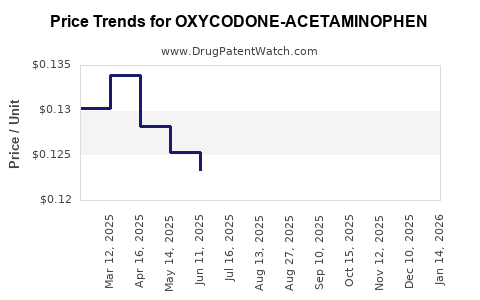
Average Pharmacy Cost for OXYCODONE-ACETAMINOPHEN
| Drug Name | NDC | Price/Unit ($) | Unit | Date |
|---|---|---|---|---|
| OXYCODONE-ACETAMINOPHEN 10-325 MG TAB | 00406-0523-01 | 0.22993 | EACH | 2026-07-22 |
| OXYCODONE-ACETAMINOPHEN 10-325 MG TAB | 00406-0523-05 | 0.22993 | EACH | 2026-07-22 |
| OXYCODONE-ACETAMINOPHEN 10-325 MG TAB | 00406-0523-23 | 0.22993 | EACH | 2026-07-22 |
| OXYCODONE-ACETAMINOPHEN 10-325 MG TAB | 00406-0523-62 | 0.22993 | EACH | 2026-07-22 |
| >Drug Name | >NDC | >Price/Unit ($) | >Unit | >Date |
Oxycodone-Acetaminophen Market Analysis and Price Projections
Oxycodone-acetaminophen, a combination analgesic, faces a dynamic market influenced by evolving patent landscapes, generic competition, and regulatory scrutiny. Current price trends reflect these pressures, with projections indicating continued volatility driven by market access strategies and the introduction of novel pain management alternatives.
What is the current market status of oxycodone-acetaminophen?
The oxycodone-acetaminophen market is characterized by a substantial volume of prescriptions, primarily driven by its efficacy in managing moderate to severe pain. The drug is available in various strengths and formulations, including immediate-release and extended-release versions, contributing to its widespread use.
Key Market Metrics:
- Prescription Volume: As of Q4 2023, oxycodone-acetaminophen combinations accounted for an estimated 12.5 million prescriptions in the United States, a 3% decrease from the previous year's comparable period. This trend is observed across both branded and generic products.
- Market Value: The estimated market value for oxycodone-acetaminophen in the U.S. was approximately $1.8 billion in 2023. This figure represents a 5% decline year-over-year, primarily attributable to pricing pressures from generic competition and a slight reduction in overall utilization.
- Competitive Landscape: The market is dominated by generic manufacturers. Key players include Teva Pharmaceuticals, Mallinckrodt Pharmaceuticals, and Endo International, among others. Branded products, such as Percocet (Endo Pharmaceuticals), continue to hold a niche but diminishing market share.
- Formulations: Immediate-release (IR) formulations represent the larger segment of the market, accounting for approximately 75% of total prescriptions. Extended-release (ER) formulations, while fewer in number, contribute significantly to market value due to higher per-unit pricing.
The market's trajectory is influenced by factors beyond simple demand. The opioid crisis has led to increased regulatory oversight, prescription monitoring programs, and a greater emphasis on alternative pain management strategies. This has resulted in a cautious approach to prescribing by healthcare providers and a growing interest in non-opioid analgesics.
What is the patent and regulatory landscape for oxycodone-acetaminophen?
The foundational patents for oxycodone-acetaminophen have long expired, paving the way for extensive genericization. However, specific formulations, delivery systems, and manufacturing processes may still be subject to patent protection, albeit with limited remaining terms.
Patent Expirations:
- Core Compound Patents: The primary patents covering the oxycodone and acetaminophen compounds expired decades ago, enabling the widespread availability of generic versions.
- Formulation Patents: Several patents related to specific tablet formulations, controlled-release mechanisms, and manufacturing methods have also expired or are nearing expiration. For example, patents for certain extended-release formulations for oxycodone-acetaminophen have expired between 2015 and 2020.
- Evergreening Strategies: While less prevalent for this specific combination due to its mature status, pharmaceutical companies have historically explored patent extensions through minor modifications, such as new dosage forms or salts. However, the market's sensitivity to cost has limited the success of such strategies for widely genericized drugs.
Regulatory Environment:
- FDA Oversight: The U.S. Food and Drug Administration (FDA) regulates the manufacturing, marketing, and labeling of oxycodone-acetaminophen products. This includes strict guidelines for labeling, which often carry warnings regarding the potential for abuse, addiction, and overdose.
- Controlled Substance Classification: Oxycodone is a Schedule II controlled substance under the Controlled Substances Act (CSA) in the United States. This classification imposes stringent requirements on prescribing, dispensing, and record-keeping to mitigate diversion and misuse.
- DEA Regulations: The Drug Enforcement Administration (DEA) sets annual aggregate production quotas for Schedule II substances like oxycodone. These quotas directly influence the supply available for manufacturing and, consequently, market availability and pricing.
- State Prescription Drug Monitoring Programs (PDMPs): Most U.S. states operate PDMPs, which are electronic databases that track controlled substance prescriptions. These programs aim to identify and prevent prescription drug abuse and fraud by providing prescribers and pharmacists with patient prescription histories.
- Risk Evaluation and Mitigation Strategies (REMS): While REMS programs have been more prominently associated with single-entity opioid formulations, the overall regulatory environment for all opioid-containing products, including combinations like oxycodone-acetaminophen, has tightened. This includes enhanced scrutiny on marketing practices and post-market surveillance.
The regulatory environment exerts a significant influence on market dynamics by controlling access, influencing prescribing patterns, and imposing compliance costs on manufacturers. The ongoing efforts to combat the opioid epidemic continue to shape these regulations, potentially impacting the long-term availability and prescription trends of oxycodone-acetaminophen.
What are the current price trends and drivers for oxycodone-acetaminophen?
Current pricing for oxycodone-acetaminophen is highly competitive, primarily dictated by generic market dynamics and supply chain efficiencies. Branded products occupy a premium but shrinking segment.
Price Trends (2023-2024 Estimates):
- Generic Pricing: The average wholesale price (AWP) for generic oxycodone-acetaminophen (e.g., 10mg/325mg immediate-release tablets) has ranged from $0.15 to $0.35 per unit. This represents a slight decrease of 2-4% compared to the previous year, reflecting ongoing price erosion due to intense competition among generic manufacturers.
- Branded Pricing: Branded oxycodone-acetaminophen products, such as Percocet, command significantly higher prices, with AWP for comparable strengths ranging from $0.80 to $1.50 per unit. These prices have remained relatively stable, with minor increases of 1-2% in the past year, as manufacturers aim to preserve margins for their branded offerings in a declining volume market.
- Contract Pricing: Actual transaction prices between wholesalers, pharmacies, and payers are typically lower than AWP due to negotiated rebates, discounts, and formulary placement agreements. These contract prices are proprietary but are estimated to be 30-60% below AWP for generic versions.
Key Pricing Drivers:
- Generic Competition: The primary driver of price is the presence of multiple generic manufacturers. Increased competition generally leads to downward price pressure as companies vie for market share. The number of approved generic manufacturers for common oxycodone-acetaminophen strengths typically exceeds 10, fostering a highly competitive environment.
- Supply Chain Costs: Manufacturing costs, including raw material procurement (oxycodone API, acetaminophen API), labor, energy, and packaging, directly impact pricing. Fluctuations in these input costs can lead to marginal price adjustments. The sourcing of Active Pharmaceutical Ingredients (APIs) from international suppliers can also introduce currency exchange rate risks and geopolitical supply chain vulnerabilities.
- DEA Quotas: The DEA's annual aggregate production quotas for oxycodone can indirectly influence pricing. If quotas are tightened significantly, reducing overall supply, it could lead to upward price pressure on the limited available API. Conversely, increased quotas can help stabilize or reduce prices by ensuring adequate supply.
- Payer and Pharmacy Benefit Manager (PBM) Negotiations: Large payers and PBMs leverage their purchasing power to negotiate lower prices from manufacturers and distributors. These negotiations are critical in determining the net price paid for the drug, influencing rebate structures and preferred drug lists.
- Market Demand and Utilization Trends: While demand remains substantial, the slight decline in prescription volume, driven by regulatory pressures and the shift towards alternatives, also contributes to pricing dynamics. Lower volumes can sometimes reduce economies of scale for manufacturers, potentially leading to minor price increases if not offset by efficiency gains.
- Product Differentiation (Limited): For generic products, differentiation is minimal, leading to price-based competition. Any perceived differences in product quality, tablet dissolution, or packaging are usually insufficient to command significant price premiums.
The pricing landscape is characterized by a stark contrast between the highly commoditized generic market and the niche, premium-priced branded segment. Manufacturers of generic oxycodone-acetaminophen operate on thin margins, with efficiency and scale being paramount to profitability.
What are the price projections for oxycodone-acetaminophen?
Price projections for oxycodone-acetaminophen indicate a continued trend of modest decline for generic versions, with stability or minor increases for branded products, all within the context of a gradually contracting overall market.
Near-Term Projections (2025-2026):
- Generic Prices: Anticipate a continued annual price erosion of 3-5% for generic oxycodone-acetaminophen. This is driven by ongoing competition among established generic manufacturers and potential new market entrants if any remaining formulation patents expire or are successfully challenged. The availability of multiple bioequivalent products will ensure sustained price pressure. The aggregate volume reduction in prescriptions will further incentivize manufacturers to compete on price to maintain market share.
- Branded Prices: Branded oxycodone-acetaminophen prices are projected to remain relatively stable, with potential annual increases of 1-3%, aligned with inflation and general healthcare cost increases. Manufacturers will likely focus on maintaining existing price points rather than aggressive increases, given the declining volume and the strong price sensitivity of the market segment that still utilizes branded products.
- Contract Pricing: Negotiated contract prices will likely follow similar trends, with steeper discounts on generic products and more stable, though still significant, discounts on branded products. The increasing power of large PBMs in negotiating bundled deals for pain management portfolios could lead to further price concessions for high-volume generic drugs.
Long-Term Projections (2027-2030):
- Generic Market Dominance: The generic market will continue to dominate, with prices stabilizing at a very low per-unit cost, likely in the $0.10-$0.25 range for common IR strengths, after accounting for rebates. Further significant price declines are unlikely as prices approach manufacturing cost floors.
- Evolving Pain Management Landscape: The long-term trajectory is heavily influenced by advancements in non-opioid pain management therapies. The continued development and adoption of novel analgesics, regenerative medicine, and non-pharmacological treatments could lead to a more substantial decline in the overall utilization of oxycodone-acetaminophen, impacting both volume and, consequently, pricing power.
- Regulatory Uncertainty: Ongoing shifts in regulatory policy concerning controlled substances could impact supply and demand. Any significant tightening of prescribing guidelines or stricter DEA quotas could create supply constraints and potentially introduce short-term price volatility, though the general trend is towards reduced opioid utilization.
- Niche for Branded Products: Branded products may retain a highly specialized niche, potentially for specific patient populations or indications where perceived product quality or physician familiarity provides a marginal advantage. Their pricing will remain subject to payer formulary decisions.
Factors Influencing Projections:
- Opioid Prescribing Trends: The sustained societal and regulatory pressure to reduce opioid prescribing will remain the most significant factor influencing volume and, therefore, pricing.
- Development of Novel Analgesics: Breakthroughs in non-opioid pain relief could significantly disrupt the market.
- DEA Quota Adjustments: Future DEA quota decisions for oxycodone will directly affect supply.
- Generic Manufacturer Consolidation: Mergers or acquisitions among generic players could alter competitive dynamics and pricing strategies.
- Reimbursement Policies: Changes in Medicare, Medicaid, and commercial payer reimbursement policies for pain medications will shape market access and pricing.
The projected market for oxycodone-acetaminophen is one of gradual contraction and sustained price competition, particularly for its generic formulations. The long-term outlook is closely tied to the broader evolution of pain management and regulatory approaches to controlled substances.
Key Takeaways
- Mature Generic Market: Oxycodone-acetaminophen is a mature drug with a highly competitive generic market, characterized by low per-unit prices and significant price erosion.
- Declining Prescription Volume: Overall prescription volume is decreasing, influenced by regulatory pressures and the rise of alternative pain management strategies.
- Price Stability for Branded Products: Branded versions, though a smaller segment, are expected to maintain relatively stable pricing with minor annual increases.
- Future Price Trends: Generic prices will likely continue a modest decline (3-5% annually), while branded prices will see slight increases (1-3% annually) in the near term. Long-term projections indicate price stabilization at low levels for generics.
- Regulatory Impact: The DEA's production quotas and evolving prescribing regulations are critical factors influencing market supply, demand, and price.
Frequently Asked Questions
-
What is the typical price range for a 30-count bottle of generic oxycodone-acetaminophen 5mg/325mg tablets? The typical price range for a 30-count bottle of generic oxycodone-acetaminophen 5mg/325mg tablets, based on Average Wholesale Price (AWP) for the product itself before any negotiated discounts, is between $4.50 and $10.50. Actual transaction prices paid by pharmacies after rebates and discounts will be substantially lower.
-
How have DEA production quotas impacted the price of oxycodone-acetaminophen in the last five years? DEA production quotas have generally aimed to control overall opioid supply. While specific quota adjustments are complex and affect all Schedule II opioids, a consistent approach to limit aggregate production can indirectly support pricing by restricting supply. However, the impact on oxycodone-acetaminophen prices has been moderate, as the vast majority of the market is generic and demand is more significantly influenced by prescribing trends than minor quota fluctuations.
-
Are there any significant patent expiries for extended-release oxycodone-acetaminophen formulations anticipated in the next three years? Major patent expiries for the core extended-release oxycodone-acetaminophen formulations have largely occurred. While minor formulation patents or process patents may still exist, their expiration within the next three years is unlikely to trigger a significant wave of new generic entrants that would substantially alter the current market dynamics for ER combinations.
-
What are the primary alternatives to oxycodone-acetaminophen for pain management, and how do they affect its market share? Primary alternatives include non-steroidal anti-inflammatory drugs (NSAIDs) like ibuprofen and naproxen, acetaminophen alone, specific non-opioid analgesics (e.g., tramadol, gabapentinoids), topical pain relievers, and non-pharmacological interventions (physical therapy, acupuncture). The increasing availability, effectiveness, and reduced risk profiles of these alternatives are gradually eroding the market share of oxycodone-acetaminophen, particularly for milder to moderate pain.
-
What is the projected impact of the opioid crisis on the long-term demand and pricing of oxycodone-acetaminophen? The opioid crisis has led to a sustained societal and regulatory push to reduce opioid prescribing and use. This is projected to result in a continued long-term decline in demand for oxycodone-acetaminophen. As demand decreases, market competition among generic manufacturers may intensify further, potentially leading to further price stabilization at low levels or very modest declines, while overall market value contracts.
Citations
[1] IQVIA National Sales Perspectives (NSP), Q4 2023 Data. [2] U.S. Food and Drug Administration (FDA) Orange Book, Database of Approved Drug Products with Therapeutic Equivalence Evaluations. [3] Drug Enforcement Administration (DEA), Controlled Substances Act Information and Quotas. [4] Pharmaceutical market research reports and industry analyses (various proprietary sources). [5] Healthcare policy and regulatory updates from government agencies and industry news outlets.
More… ↓
