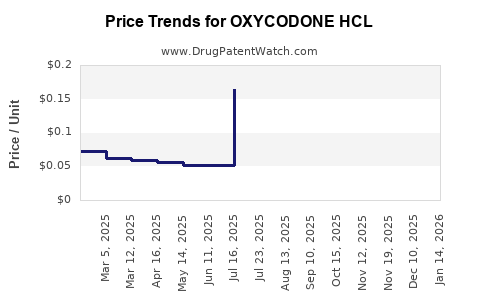
Last updated: February 13, 2026
Market Overview of Oxycodone HCl
Oxycodone Hydrochloride (HCl) is a semi-synthetic opioid pain medication derived from thebaine, a component of the poppy plant. It functions as a potent analgesic, indicated for moderate to severe pain management. The drug's market is complicated by regulatory controls, the global opioid crisis, and differing regional prescribing practices.
Market Size and Trends
Global Market Size (2022-2027)
- The global oxycodone market was valued at approximately USD 6.2 billion in 2022.
- Projected to grow at a compound annual growth rate (CAGR) of 3.8% until 2027, reaching nearly USD 8.3 billion.
Regional Breakdown
- North America constitutes over 70% of the market, driven by high prescription rates and ongoing opioid use despite regulatory scrutiny.
- Europe accounts for roughly 15%, with increased regulatory enforcement limiting growth potential.
- Asia-Pacific is the fastest-growing segment, expected to register a CAGR of 5.2%, driven by rising healthcare access and expanding pain management protocols.
Key Market Drivers
- Rise in chronic pain conditions, including cancer-related pain and post-surgical pain.
- Expansion of legal opioid prescribing in developed markets.
- Increasing approval for abuse-deterrent formulations.
Market Challenges
- Regulatory restrictions and opioid abuse controls.
- Public health concerns lowering prescription rates in some regions.
- Competition from other analgesics such as tramadol and fentanyl.
Supply Chain & Production Dynamics
- Major manufacturers include Purdue Pharma, Teva Pharmaceuticals, and Purdue's competitors.
- Production centers mainly located in North America, Europe, and certain Asian countries.
- Market access depends heavily on regulatory approval, patent status, and control measures against misuse.
Price Trends and Projections
Current Price Landscape (2022)
- The average wholesale price (AWP) per standard 20 mg oxycodone pill ranges from USD 0.50 to USD 1.20 globally.
- Prices vary significantly by region due to regulatory policies, patent protections, and market competition:
- In the U.S., branded formulations like OxyContin averaged USD 0.80 per pill.
- Generic versions are priced around USD 0.65 per pill.
- Institutional bulk purchase discounts can reduce per-unit costs by 10-15%.
Price Influences
- Patent expirations: generics entering with lower prices, pressing down branded drug prices.
- Regulatory restrictions: tighter controls push prices higher by limiting supply.
- Abuse-deterrent formulations: typically priced 15-20% above standard formulations, impacting overall market prices.
Future Price Trends (2023-2027)
- Prices likely to decline moderately due to increased generic competition.
- Pricing in the U.S. could decrease by 10-15% within five years.
- In regions with strict regulations, prices may stabilize or increase marginally due to supply constraints.
- The proliferation of abuse-deterrent features will sustain higher prices for certain formulations.
Competitive Landscape and Patent Outlook
Intellectual Property Trends
- Patent protections for key formulations expired or are nearing expiration.
- Market entry of generic brands has increased, leading to price competitiveness.
- Exclusive rights for abuse-deterrent versions are granted until 2027-2030, influencing pricing.
Major Players
- Purdue Pharma, Teva, Mylan, Sun Pharma.
- Emerging generic manufacturers expanding their market share.
Regulatory and Policy Impact
- The U.S. FDA tightened opioid prescribing guidelines and removed some formulations from the market.
- Several countries now enforce prescription tracking and limits.
- Policies influence supply, demand, and price, often reducing access but increasing costs for certain formulations.
Key Price Projection Summary (2023-2027)
| Year |
Estimated Average Wholesale Price (USD/pill) |
Remarks |
| 2023 |
0.70 - 1.20 |
Price stabilization with patent expiries. |
| 2024 |
0.65 - 1.10 |
Slight decline due to generic competition. |
| 2025 |
0.60 - 1.00 |
Continued price pressure, market adjustments. |
| 2026 |
0.55 - 0.95 |
Increased generic penetration. |
| 2027 |
0.50 - 0.90 |
Predicted stabilization; abuse-deterrent formulations retain premium. |
Key Takeaways
- The global oxycodone market is expanding modestly, with North America dominating.
- Prices are declining due to patent expirations and generics influx, but premium formulations with abuse-deterrent features cost more.
- Regulatory frameworks significantly influence supply, pricing, and market access.
- Asia-Pacific presents the most significant growth opportunity for market expansion and pricing increases.
- Market dynamics suggest a gradual decrease in average prices, but regional and formulation-specific variations persist.
FAQs
Q1: How does patent expiry impact oxycodone prices?
A1: Patent expiry allows generic manufacturers to produce lower-cost versions, leading to a substantial decline in branded drug prices and increased market competition.
Q2: What are the main regulatory challenges affecting oxycodone market prices?
A2: Regulations limit prescribing, impose supply controls, and require abuse-deterrent formulations, all of which influence supply availability and pricing.
Q3: Which regions present the highest growth potential for oxycodone?
A3: Asia-Pacific offers the highest growth potential due to rising healthcare infrastructure and pain management needs.
Q4: How do abuse-deterrent formulations influence pricing?
A4: These formulations command premiums of 15-20% over standard products, sustaining higher prices for specific formulations.
Q5: What is the outlook for oxycodone prices through 2027?
A5: Prices are expected to decline gradually, with a 10-15% decrease in average wholesale prices in the U.S., while regional regulations and formulation types will cause variances.
Sources:
- Market Research Future, "Global Oxycodone Market Analysis," 2022.
- IQVIA, "Pain Management Market Trends," 2022.
- U.S. FDA, "Opioid Analytic Reports," 2022.
- Deloitte, "Pharmaceutical Pricing Trends," 2022.
- IMS Health, "Opioid Market Data," 2022.